Although climate-controlled car seats don’t spring to mind when you think of energy efficiency, the latest technology underpinning this luxury automobile feature is based on thermoelectrics—materials that convert electricity directly into heating or cooling.
Conversely, thermoelectrics can also funnel excess heat from energy inefficient systems, such as car engines or power plants, by recovering this ‘waste heat’ and turning it into electricity. As a result, these materials offer a potentially clean source of energy to reduce fuel consumption and CO2 emissions.
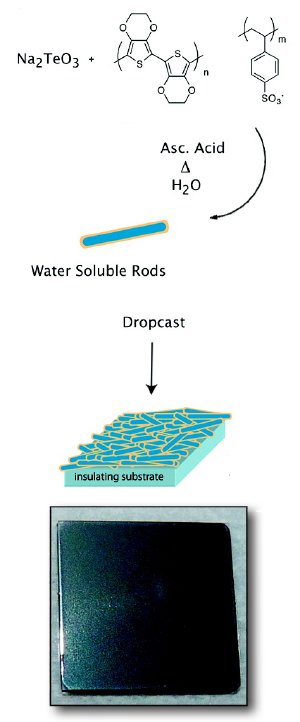 Using simple water-based chemistry to wrap a polymer that conducts electricity around a nanorod of tellurium, this composite nanoscale thermoelectric is easily spin cast or printed into a film.
Currently, this thermal energy is converted with high-efficiency, expensive thermoelectric materials. In automotive exhaust systems, for example, solid-state thermoelectrics recover waste heat that can result in fuel savings of up to five percent, but their high cost bars them from being used in smaller-scale settings. Boosting these savings through lower-cost materials could make a significant impact in power generation for batteries or electronic components in computers. Now, Lawrence Berkeley National Laboratory (Berkeley Lab) scientists are tackling this challenge by “changing the budget for thermal energy management,” said Jeff Urban, Deputy Director of the Inorganic Nanostructures Facility at the Molecular Foundry, a nanoscience user facility.
“Historically, high-efficiency thermoelectrics have required high-cost, materials-intensive processing,” said Urban. “By engineering a hybrid of soft and hard materials using straightforward flask chemistry in water, we’ve developed a route that provides respectable efficiency with a low cost to production.”
In their approach, Urban and colleagues constructed a nanoscale composite material by wrapping a polymer that conducts electricity around a nanorod of tellurium—a metal coupled with cadmium in today’s most cost-effective solar cells. This composite material is easily spin cast or printed into a film from a water-based solution. Along with its ease of manufacture, this hybrid material also has a thermoelectric figure of merit thousands of times greater than either the polymer or nanorod alone—a crucial factor in boosting device performance.
“In recent years, we’ve seen tremendous gains in thermoelectric efficiency, but there is a need for low-cost, moderate efficiency materials that are easy to process and pattern over large areas,” said Rachel Segalman, a faculty scientist at Berkeley Lab and professor of Chemical and Biomolecular Engineering at University of California, Berkeley. “We had a lot of intuition about what would work using polymers and nanocrystals, and will now explore materials space to optimize these systems and switch to more earth-abundant materials.”
A paper reporting this research titled, “Water-processable polymer-nanocrystal hybrids for thermoelectrics,” appears in Nano Letters and is available to subscribers online. Co-authoring the paper with Urban and Segalman were Kevin See, Joseph Feser, Cynthia Chen and Arun Majumdar.
Portions of this work at the Molecular Foundry were supported by DOE’s Office of Science.