Two scientists with the U.S. Department of Energy (DOE)’s Lawrence Berkeley National Laboratory (Berkeley Lab) were among the 85 researchers named by President Barack Obama to receive the prestigious Presidential Early Career for Scientists and Engineers (PECASE) Award, the highest honor bestowed by the United States government on early-career researchers.
The Berkeley Lab recipients were Gavin Crooks, a theoretical chemist with Berkeley Lab’s Physical Biosciences Division, and Trent Northen, a staff scientist with Berkeley Lab’s Life Sciences Division and with the Joint BioEnergy Institute (JBEI). They join 11 other DOE recipients of the 2010 PECASE Award, which will be received later this year at a White House ceremony. In addition to a citation and a plaque, each PECASE winner will receive DOE funding for up to five years to advance his or her research.
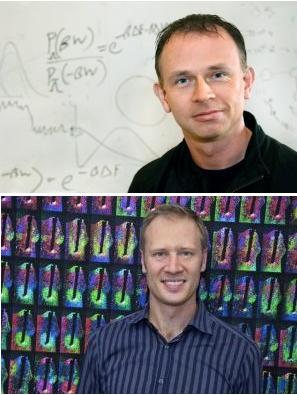 Top: Gavin Crooks. Bottom: Trent Northen
“Science and technology have long been at the core of America’s economic strength and global leadership,” President Obama said in announcing the awards. “I am confident that these individuals, who have shown such tremendous promise so early in their careers, will go on to make breakthroughs and discoveries that will continue to move our nation forward in the years ahead.”
Secretary of Energy Steven Chu, a Nobel laureate scientist, extended his own congratulations to the award winners.
“These gifted young scientists and engineers represent the best in our country,” Secretary Chu said. “The awards recognize ingenuity, dedication, diligence and talent. I congratulate the 2009 PECASE awardees and wish them continued success towards new discoveries and advances in science, energy research, and national security.”
Crooks was recognized “For groundbreaking development of the Crooks’ fluctuation theorem of statistical mechanics to describe thermodynamics for systems far from equilibrium which impact nano-scale device performance, materials design, and energy storage and capture; and for excellent and extensive mentorship of developing scientists.”
Understanding the thermodynamics of a molecular system – central to energy capture and storage – requires measurements of free energy changes within that system. Prior to Crooks’ fluctuation theorem it was almost impossible to measure changes in free energy for molecular systems that were not in equilibrium with their surroundings – a system is said to be in equilibrium when it does not change with time. Crooks’ discovery allows highly accurate measurements of free energy in molecular systems that are far from equilibrium.
Northen received his PECASE Award “For pioneering analysis of metabolomic features of biological systems with previously unattainable sensitivity and spatial resolution, providing new insights impacting biofuel development, understanding biofilms, and biological responses to low dose ionizing radiation; and for community service and diverse educational outreach.”
Among other achievements, Northen is the inventor of the Nanostructure-Initiator Mass Spectrometry (NIMS) technology, a highly sensitive method used to study and image metabolism within complex cellular communities. He also invented a related enzyme assay called “Nimzyme, which is a powerful analytical tool for directly detecting and characterizing enzymatic activities in environmental samples and other complex biological mixtures. At Berkeley Lab, he is using NIMS in collaboration with breast cancer researchers to evaluate the effects of low-dose radiation on cell metabolism within tissues. The Nimzyme assay is being used at JBEI to screen for enzymes that can be used to modify lignocellulose for the production of advanced biofuels that could replace gasoline on a gallon-for-gallon basis.
The PECASE Awards were established by President Clinton in February 1996, and are coordinated by the Office of Science and Technology Policy within the Executive Office of the President. Awardees are selected on the basis of two criteria: Pursuit of innovative research at the frontiers of science and technology and a commitment to community service as demonstrated through scientific leadership, public education, or community outreach. Winning scientists and engineers receive up to a five-year research grant to further their study in support of critical government missions.