Nov 15 2010
Scientists at the U.S. Department of Energy’s Argonne National Laboratory have begun to use molecular “stencils” to pave the way to new materials that could potentially find their way into future generations of solar cells, catalysts and photonic crystals.
Researchers at Argonne’s Center for Nanoscale Materials and Energy Systems Division have developed a technique known as sequential infiltration synthesis (SIS), which relies on the creation of self-assembled nanoscale chemical domains into which other materials can be grown. In this technique, a film composed of large molecules called block copolymers acts as a template for the creation of a highly-tunable patterned material.
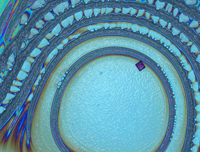 This film of block copolymers shows the material's characteristic tendency to separate into distinct regions.
This new method represents an extension of atomic layer deposition (ALD), a popular technique for materials synthesis that is routinely used by Argonne scientists. Instead of just layering two-dimensional films of different nanomaterials on top of one another, however, SIS allows scientists to construct materials that have much more complex geometries.
“This new technique allows us to create materials that just weren’t possible with ALD or block copolymers alone,” said Seth Darling, an Argonne nanoscientist who helped to develop SIS in collaboration with Argonne chemist Jeff Elam. “Having the ability to control the geometry of the material we’re making as well as its chemical composition opens the door to a whole universe of new materials.”
According to Darling, the success of the technique relies on the unique chemistry of block copolymers. Every block copolymer is composed of two chemically distinct subunits; for instance, one subunit might have an affinity for water while the other might repel water. In such a case, like would seek out like, creating a heterogeneous matrix of interspersed homogenous regions.
“You can think of a block copolymer as like a pair of molecular Siamese twins where one likes to talk and one likes to read quietly,” Darling said. “If you put a bunch of these twins together in a room, the talkative ones are going to try to be near the talkative ones and the readers are going to try to be near the readers, but they can’t simply all separate themselves to either side of the room, and it’s this action that gives us the geometries we’re looking for.”
Depending on the initial substrate, the block copolymers, and the processing that materials scientists use, regions can form that have many different shapes, from spherical to cylindrical to planar. While there are many types of block copolymers, in general they cannot serve as wide an array of purposes as inorganic materials. The challenge, according to Darling, is to bring the self-assembly of block copolymers together with the functionality of inorganic materials.
The physical and chemical properties of a material generated using SIS depend on how block copolymer chemistry and morphology interact with the chemistry of ALD techniques. “We can tailor our materials synthesis efforts in a much more precise way than we ever could before,” Darling said.
Darling and Elam have spent most of their careers at Argonne focused on the development of new types of materials, including the development of solar cells that combine organic and inorganic components. They believe that the types of materials that SIS can generate will drive fundamental solar energy technologies to greater efficiencies and lower cost.
“Our solar energy future does not have a one-size-fits-all solution,” Elam said. “We need to investigate the problem from many different angles with many different materials, and SIS will give researchers like us many new routes of attack.”