The instrument used for molecular beam epitaxy (MBE) looks a little like the lunar module, with spindly metal legs feeding into a large cylindrical canister. But this device isn't headed for the moon—it delves into molecules instead, helping scientists craft new materials layer by layer with nearly atomic precision.
The MBE facility, located at the U.S. Department of Energy's (DOE) Argonne National Laboratory, could provide the basis for new materials to improve fuel cells, electronics and batteries.
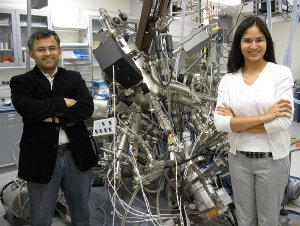 Argonne researchers Anand Bhattacharya (left) and Tiffany Santos flank the molecular beam epitaxy instrument, designed to craft materials with close to atomic precision.
"This is the dawn of a new era of materials discovery and synthesis," said Anand Bhattacharya, an Argonne physicist who designed the instrument. "In the right hands, it can really change materials science. In principle, the materials we might be able to make are limited only by our imagination."
Based at Argonne's Center for Nanoscale Materials, the instrument recently became available to scientists around the world who submit proposals for time on the machine. Tiffany Santos, an Argonne scientist who heads the user science activities, says the dozen studies in progress so far have examined everything from catalysis to superconductivity.
For example, Santos and colleagues are working to create materials whose magnetic properties can be controlled with an electric field. Today's computers and other digital devices store data on hard disk drives and memory cards, components of which need to be controlled with a magnetic field. "That's slow and also wastes energy," Santos said. "When a computer is off, it needs a long bootup time when you turn it back on because its capacitors need to be charged up to restore memory."
The ultimate goal is to perfect a system of nonvolatile memory; that is, a system where the data remain stored even while the device is turned off. "We could do this by using an electrical field to control the magnets," Santos explained, "which is more local than a magnetic field, and it would also allow us to make devices smaller and more efficient.
"It would be a huge breakthrough to eliminate the magnetic field," Santos said. "That would all but eliminate boot-up time, and the device would also consume less energy—we'd eliminate the heat load from wasted energy to charge capacitors."
Creating materials that would function in new ways is why the molecular beam epitaxy instrument was designed. The machine can fashion superlattices, or layers of materials with atomically sharp interfaces. It can also create high-quality films that maintain the crystalline structure that lends materials their unique properties.
"Layering allows you to look for new properties; making sharp interfaces between the different layers allows them to influence each other in unique ways," Santos said.
The device is ringed with canisters, each containing different pure metals that can be heated to more than 2,500 degrees Fahrenheit—so hot they actually evaporate. The beam of evaporated metal atoms shoots into a central chamber under an ultra-high vacuum. There it meets beams of different metals, hits a substrate and reacts with oxygen to form a compound in perfectly structured crystalline layers. Then the scientists can repeat the process to add more layers.
Argonne's machine is also unique in its use of ozone (O3) to react with the metals, rather than pure oxygen (O2). "Ozone is more reactive, which means that it bonds more readily with the metals," Santos explained. "This leaves fewer defects in the finished compound."
Because it's such a new field, designing custom materials takes theoretical work and a little finesse, the scientists say. "Like any good cook will tell you, you can have the best-stocked pantry," said Bhattacharya, "but the best cooks will choose the simplest ingredients and come out with something that is spectacular."