Malvern Panalytical has developed a new diffusion barrier method to eliminate protein denaturation when measuring zeta potential using electrophoretic light scattering. Utilising a U-shaped disposable capillary cell, the new method delivers significant improvement in the accuracy and repeatability of zeta potential results for proteins.
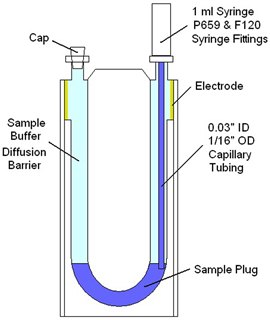 Malvern Panalytical has developed a new diffusion barrier method to eliminate protein denaturation when measuring zeta potential using electrophoretic light scattering.
Ultimately, the method makes protein characterization with Malvern Panalytical’s Zetasizer range even easier. A new application note explaining the technology and its applications is available at www.malvern.com/protein-zeta-potential-appnote
Zeta potential, which is a property of molecules and particles in suspension related to the surface charge, helps predict the stability of emulsions and colloids and also proteins in solution. Zeta potential measurement of proteins has always been challenging because of the tendency for aggregation to occur at the electrodes during the application of the electric field. When aggregates form, the measured result will be the zeta potential of the aggregates, which can be markedly different from the zeta potential of the native protein.
The diffusion barrier method protects the protein by keeping it away from the electrodes within a pool of buffer. This prevents aggregation and by eliminating this issue means the measured zeta potential is only that of the native protein. By eliminating protein aggregation, the diffusion barrier method improves the quality and accuracy of protein zeta potential measurement.
A multi-media presentation on the Diffusion Barrier method developed by Malvern Panalytical is freely available through Malvern Panalytical’s online knowledge base at: