JPK Instruments, a world-leading manufacturer of nanoanalytic instrumentation for research in life sciences and soft matter, reports on the use of AFM to study the nanoscale interactions of biological systems at the Intelligent Polymer Research Institute (IPRI) and ARC Centre of Excellence for Electromaterials Science (ACES)of the University of Wollongong in the group of Dr Michael Higgins.
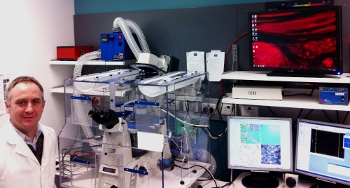 Dr Michael Higgins at the Intelligent Polymer Research Institute (IPRI) and ARC Centre of Excellence for Electromaterials Sciences (ACES), University of Wollongong, Australia, with his JPK NanoWizard® AFM system
Dr Michael Higgins is currently an ARC Australian Research Fellow in the Intelligent Polymer Research Institute (IPRI) within the ARC Centre of Excellence for Electromaterials Science (ACES) at the University of Wollongong (UOW) and leading research on the application of Scanning Probe Microscopy to biological systems. Dr Higgins's main interest and research has focused on the application of AFM to study the nanoscale interactions of biological systems, including living cells, model lipid membranes, single ligand-receptor interactions, individual protein unfolding, fundamental surface-force interactions, as well as being involved in AFM instrument development. He now has over 15 years of experience with AFM in the field of Biophysics.
Dr Higgins described his research goals: "We wish to develop organic conductors (CNT, graphene, conducting polymers) as advanced electrode coatings in biological applications, including electronic in vitro culture systems (e.g. electronic petri dishes), implantable electrodes for tissue regeneration and electroactive coatings for preventing inflammatory responses or bacterial adhesion. The premise for using these materials is that we can use electrical stimulation to control cell interactions."
He continued: "The motivation is that in order to successfully develop these types electrodes, we need a much better understanding of the cellular-material interface. For example, how do we fabricate these materials so that they make a better electrical 'connection' to the living cell or tissues? Or how can we harness their dynamic, electromaterial properties to control cell interactions? These will require an ability to guide cell growth toward the electrode, enhance cell-electrode adhesion, tailor surface chemistry for biomolecular and cellular recognition, and then ultimately use electrical stimulation via the electrode to control the cell interactions."
Having used a variety of commercial systems over a ten year period, the advent of the JPK NanoWizard® has provided new opportunities for advanced research and experimental flexibility. "We like the way it integrates well with optical techniques while the Fluid cell has several nice configurations (e.g. petri dish holders, BioCell™ etc.) that enable live cell studies. Specifically for us, the range of electrochemical cell configurations enables us to study single molecule and cell interactions in response to different electromaterials and electrical stimulation."