Sugar-frosting isn’t just for livening up boring bran flakes; it can also preserve important therapeutic proteins. Researchers at the National Institute of Standards and Technology (NIST) have developed a fast, inexpensive and effective method for evaluating the sugars pharmaceutical companies use to stabilize protein-drugs for storage at room temperature. The group presented their findings* at the 236th American Chemical Society National Meeting and Exposition.
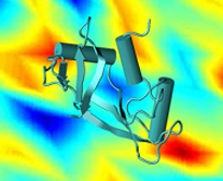 In this image, a ribbon of protein stands in the foreground against a computer-simulation of a stress field in a glassy material (like a sugar-glass) in the background. Researchers at NIST have developed a fast, inexpensive and effective method for evaluating the sugars pharmaceutical companies use to stabilize protein-drugs for storage at room temperature. Credit: NIST
Protein-based drugs such as insulin and vaccines must be stabilized after manufacturing in order to be used safely. For the past 30 years, researchers have been preserving therapeutic proteins by freeze-drying them and coating them with a thin layer of various formulations of glass-like sugars that act to stabilize their molecular structures. This allows them to be safely stored for extended periods of time. Pharmaceutical companies, though they have general guidelines, develop their formulations essentially by trial and error and have to wait up to two years to see if the glasses are suitable. The new methods will help pharmaceutical companies make the best choice about which formulations to test and make it easier to stabilize drugs at room temperature. Room-temperature storage is vital when the pharmaceuticals are to be used in areas of the world where controlled storage conditions are not available.
The new findings build upon previous work** at NIST in which the team used neutron scattering to determine that rapidly solidified sugars preserve such proteins best when they suppress molecular motions lasting a nanosecond or less. Their latest experiments center on the hydrogen bonding that makes the sugars rigid. They have shown that the lifetimes of these bond networks can be measured directly with a fluorescent probe. This method is much more convenient than using neutrons and could be used for routine formulation evaluation.
Hydrogen bonds are responsible for many of water’s properties; they make water a liquid at room temperature. All biological fluids, which are composed mostly of water, are also defined by their hydrogen bonds. Without these bonds, proteins would unfold, and life as we know it would be impossible. Sugars used to safeguard protein-based drugs act like cement, taking the place of water by bonding to the proteins and locking them in place. By rapidly freezing liquid sugar, its molecules have no time to form the usual orderly crystal patterns typically found in sugars that are solids at room temperature. Lead NIST researcher Marc Cicerone says that the randomly ordered sugar molecules fit the encased proteins like a glove, “stiffening” molecular motions that cause the proteins to chemically degrade.
Using the fluorescent probe, the team can now tell within minutes after freeze-drying the protein whether the formulation will be stable, reducing the time and expense associated with the “wait and see” method currently in use.
“Instead of needing relaxation measurements that require using neutron scattering—a national facility with limited time availability—we have developed a widely accessible solution in the form of readily available steady-state fluorescence measurements,” Cicerone says. “This will allow pharmaceutical companies to adopt the new metrology we’ve developed.”
When applied, the team’s findings should help to increase the availability of viable medicines in places where refrigeration is scarce or unavailable.
* M. T. Cicerone and J. M. Johnson. Hydrogen bond network lifetime as an indicator of protein stability in pharmaceutical preparations. Biophysical & Biomolecular Symposium: Current Challenges in Protein Formulations. 236th ACS National Meeting, Philadelphia, Penn., Monday, Aug. 18, 2008.