Masaki Suenaga, a retired metallurgist who remains an active researcher at the U.S. Department of Energy’s Brookhaven National Laboratory, has received the IEEE Council on Superconductivity Award for significant and sustained contributions to applied superconductivity. Originally referred to as the Institute of Electrical and Electronics Engineers, Inc., the nonprofit IEEE is the world’s leading professional association for the advancement of technology. Suenaga received a plaque and $5,000 at the recent Applied Superconductivity Conference in Chicago.
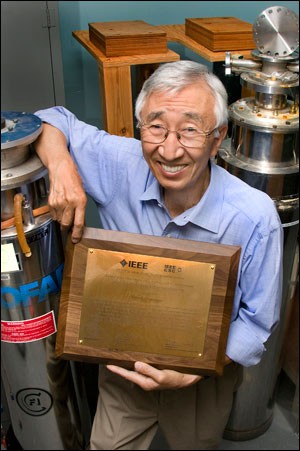
“I am gratified that my peers appreciate my work,” Suenaga said. “I feel fortunate that I’ve been able to do work that I like and that my research has resulted in useful technologies.”
Superconductivity refers to the lack of resistance to the flow of direct electric current by certain materials at very low temperatures. Suenaga has spent much of his early career studying the superconductor niobium-tin, and his research resulted in a process to make the first industrial niobium-tin superconducting wire for use in high-field magnets, such as those used in particle accelerators and fusion reactors. His work also led to the production of a flat niobium-tin tape with low losses of alternating electric current (AC), which made possible Brookhaven Lab’s Power Transmission Project, a program that began in the 1970s to develop a viable and cost-effective means of transmitting large amounts of electrical power underground. This project laid the groundwork for the Long Island Power Authority installing the world’s first high-temperature superconductor power transmission cable system in Holbrook, Long Island, earlier this year. The new cable uses far less wire and yet conducts up to five times more power in a smaller right-of-way than traditional copper-based cables.
Materials become superconducting at different temperatures, and, as a part of his research, Suenaga used a powerful electron microscope at Brookhaven to view the microstructure of both low- (minus 430 degrees Fahrenheit) and high- (minus 280 degrees Fahrenheit) temperature superconductors, to see how they are formed and how they grow under varied conditions in order to improve their properties. Suenaga and colleagues, for example, found that substituting small amounts of titanium for niobium in the niobium-tin superconductor enables it to carry a higher current at higher magnetic fields, which are needed in large superconducting magnets. Suenaga also determined that AC losses could be minimized by modifying the surface of niobium-tin tapes in commercial production, a finding that made the Brookhaven Lab transmission cable possible.
Suenaga earned a B.S. in electrical engineering in 1962 and a Ph.D. in metallurgy in 1969, both from the University of California at Berkeley. He joined Brookhaven Lab in 1969 as an assistant metallurgist and worked his way through the ranks to become a senior metallurgist in 1983. He was honored with Brookhaven Lab’s Distinguished Research & Development Award in 1992, and he became a Fellow of the American Physical Society in 2002. Suenaga retired in 2006, but he still works at the Laboratory on a part-time basis as a guest scientist. He is also an adjunct professor of materials science at Stony Brook University.