Physicist Paul Sorensen, a Maurice and Gertrude Goldhaber Distinguished Fellow at the U.S. Department of Energy's (DOE) Brookhaven National Laboratory, will receive the 2009 George E. Valley Jr. Prize from the American Physical Society (APS). The $20,000 prize was established in 2000 under the terms of a bequest from Massachusetts Institute of Technology physicist George E. Valley Jr. It is awarded biennially to recognize one individual in the early stages of his or her career for an outstanding scientific contribution to physics that is deemed to have significant potential for a dramatic impact in the field. Sorensen will receive the prize at the April 2009 APS meeting in Denver, Colorado.
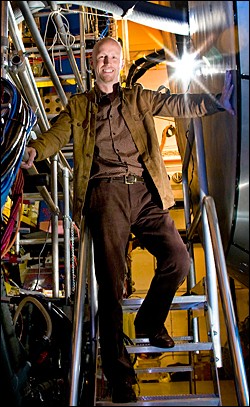
Sorensen was recognized for his role in discovering that subatomic particles called quarks are important throughout the expansion of the matter created in heavy ion collisions. The collisions are generated by physicists as they attempt to recreate the matter that existed in the universe one millionth of a second after the Big Bang. They do so by smashing together beams of heavy ions moving at nearly the speed of light in Brookhaven's world-class accelerator, the Relativistic Heavy Ion Collider (RHIC). The matter that they create behaves like a “perfect” liquid — having almost no viscosity or frictional resistance to flow.
“I am one of hundreds of people in the STAR collaboration at RHIC, and this award reflects on the talent and hard work of all of them,” Sorensen said. “I paticularly would like to thank my thesis advisor, Huan Huang; my mentor at Brookhaven Lab, Zhangbu Xu; STAR Group Leader Tim Hallman at Brookhaven; and STAR spokesperson Nu Xu for their guidance and leadership, as well as my collaborators and all the students and postdocs I've worked with and learned from who helped to make this award possible. It's fun to be part of this team that is pushing the frontiers of physics. As exciting as what we've learned already is, I think the next couple of years will be absolutely explosive.”
In 2005, physicists at RHIC created a state of hot, dense matter out of quarks and gluons, the fundamental building blocks of matter, that has not existed since micoseconds after the birth of the universe. Contrary to theory, which predicted that a gas called “quark-gluon plasma” would be formed, the matter created appeared to behave more like a “perfect” liquid. With his colleagues, Sorensen measured the mass, momentum and direction of subatomic particles from data derived from the STAR detector at RHIC. Sorensen and his collaborators proved that the “perfect” liquid depended on the interactions of quarks, rather than on more obvious properties, such as mass. Sorensen's ongoing experiments at RHIC will aim to better understand the properties of the “perfect” liquid, which may shed light on the phase structure of nuclear matter, or how it changes from solid to liquid or gas.
After earning a B.S. in physics from the University of Nebraska – Lincoln, in 1996, Sorensen went on to earn an M.S. and Ph.D. in physics, both from the University of California, Los Angeles, in 1999 and 2003, respectively. He was a postdoctoral researcher at DOE's Lawrence Berkeley National Laboratory for two years before joining Brookhaven Lab in 2005 as a Goldhaber Distinguished Fellow. Sorensen is the lead author of 16 peer-reviewed publications, accruing more than 800 citations. Sorensen recently became an associate physicist at Brookhaven.