JPK Instruments hosted the 7th international symposium on "Scanning Probe Microscopy in Life Sciences" on October 8-9th in Berlin. Nearly 100 scientists from around the world attended the meeting to present their results and share scientific knowledge. The meeting is part of the NanoBioVIEWS(TM) series of international meetings initiated by JPK to further the scientific interchange of knowledge on applications and instrumentation that applies nanotechnology in the life sciences.
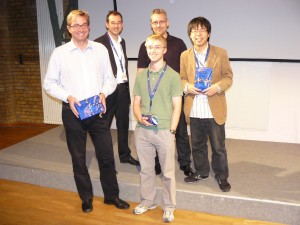 Harry Heinzelmann (Swiss Center for Electronics and Microtechnology, CH, far left) winner of the Poster Competition together with runners-up and staff from JPK Instruments.
This year’s event ran for two days in the impressive Umspannwerk Ost center providing a comfortable and relaxed surrounding inspiring an excellent dialogue between delegates. The format of this year’s meeting saw four subject groups split between applications and instrumental methods. The first session discussed cell mechanics and was opened by Thomas Ludwig (DKFZ Heidelberg, DE) presenting a review illustrating the need for nanoscale techniques to study cancerous cells. He reviewed recent applications of single cell force spectroscopy which allows nanoscale probing of cells and extra cellular matrices. French researchers, Redouane Fodil (INSERM UMR Creteil) and Pierre Bongrand (INSERM CNRS Marseille), considered mechanical properties of the cytoskeleton and the effects of the substrate supporting the cell being studied. Andrew Pelling (University of Ottawa, CA) took mechanical property measurement further simultaneously combining traction force microscopy and las er scanning confocal microscopy with atomic force microscopy.
The afternoon session focused on the combination of AFM and advanced optics. Jerome Chalmeau (LAAS CNRS Toulouse, FR) discussed how AFM may be used to control and quantify a new method to make membrane-bound protein microchips. Terry McMaster (University of Bristol, GB) showed developments in force spectroscopy and their application to help localize specific protein and glycoprotein moieties. The first day was brought to a close by Volker Deckert (ISAS Dortmund, DE) describing the use of near and far-field spectroscopies for bio-molecule identification on the nanoscale. The main process used is TERS (tip-enhanced Raman scattering) which is currently the only tool that may be used to molecularly assign compounds on the nanometer scale.
Day two started with a report from Atsushi Ikai (Tokyo Institute of Technology, JP) on results from his large research group. Rather than an overview, this presentation showed the latest work on the pulling of proteins from cell surfaces using AFM. Analysis of force curves enabled a better understanding of the mechanical linkage lining ECM proteins to the actin-based cytoskeletal network. The single molecule theme continued with diverse talks from Joon Won Park (University of Pohang, KR) on using modified AFM tips for the mapping and sensing of DNA. Talks applying force spectroscopy were presented by (Yuri Lyubchenko (University Nebraska, US) and Sergi Garcia-Manyes (Fernandez Lab, Columbia University, US) and concluded with Phil Williams (University of Nottingham, GB) giving an amusing talk about the joys of supervising a student to obtain valid results. More importantly, he described new insights of the study of the HIV-neutralising 2F5 monoclonal antibody.
The final session looked at new methods in AFM. Rikke Meyer (Aarhus University, DK) showed how she uses AFM and fluorescence microscopies combined to study bacterial adhesion. The work of Zoya Leonenko (University of Waterloo, CA) combined electrical measurements (Kelvin Force spectroscopy) with AFM to reveal information on the structure and functionality of pulmonary surfactants through mapping electrostatic forces. The final presentation came from Suzi Jarvis (University College Dublin, IE) who showed a remarkable home-built AFM with a very low noise floor that uses frequency modulation to obtain remarkably high resolution studies in liquid at very low applied forces (10pN).
The fifteen invited talks were complemented with a popular poster competition. The young scientists who produced the posters should be congratulated for their high standards of presentation. The winning poster came from Harry Heinzelmann’s group (CSEM, Neuchatel, CH) presenting a novel approach for the dispensing of nanoscale materials using hollow AFM probes.
On presenting the poster awards, JPK co-founder, Torsten Jähnke, invited the audience to return to Berlin in a year’s time which will be the tenth anniversary of the founding of JPK. In the meantime, JPK invites you to visit their web sites www.jpk.com and www.nanobioviews.net and learn more about the science presented during the symposium.
JPK invites you to visit their new web site and learn more about the exciting world of nanotechnology and its application to the life sciences. Visit www.jpk.com today.