Rigaku Americas Corporation today announced that the Department of Chemistry and Biochemistry at the University of Texas at Austin (UT) has purchased three Rigaku X-ray Diffraction (XRD) instruments to establish a Cyber-Enabled Teaching/Research X-ray Diffraction Facility, which was funded by a Chemistry Research Instrumentation and Facilities: Departmental Multi-User Instrumentation (CRIF:MU) grant from the National Science Foundation (NSF). The instrumentation suite includes: a Rigaku SCXminiâ„¢ benchtop small molecule X-ray crystallography system, a Rigaku Saturn 724+ Kappa CCD-based small molecule XRD system, and a Rigaku RAPID IIâ„¢ curved image plate (IP) detector XRD system.
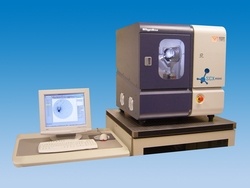 Rigaku SCXmini
Rigaku X-ray diffraction systems were chosen by Prof. Richard Jones, Prof. Brad Holliday and Dr. Vincent Lynch to enhance the X-ray facilities of the Department of Chemistry and Biochemistry in support of education and research at UT and a consortium of "cyber enabled remote partner" (CERP) universities distributed over Texas, Ohio, Illinois and Florida. These institutions include: Bowling Green State University, Eastern Illinois University, Florida Memorial University, LeTourneau University, The University of Texas at Dallas, and University of the Incarnate Word.
In a recent interview series, Professor Jones explained that the CERP approach will enable institutions that, "have a high concentration of traditionally underrepresented students …. [and want to use single crystal X-ray diffraction for teaching or research or both." He went on to explain that the selection of Rigaku was based, in part, on "the quality of the instrumentation" and that the "instrumentation perfectly matches the kinds of activities that we want to use it for, namely undergraduate and graduate level teaching in both chemistry and engineering courses." Dr. Lynch elaborated that the remote operators "will have a video hookup and [after we align the crystal on the instrument … [we will then pass instrument control to the end user." Dr. Lynch emphasized the completeness of the cyber partnership arrangement when he described the goal as being to "make whatever's available [accessible to whoever wants to use it."
All the instruments will be housed in Robert A. Welch Hall (WEL), with the RAPID II and Saturn 724+ Kappa systems updating the existing X-ray facility. The SCXmini benchtop X-ray diffractometer is being located in a special area on the 4th floor as part of the Freshman Research Initiative (FRI) and, as Dr. Lynch explained, will be "reserved for the FRI … and off-limits to graduate students." Professor Jones explained that "we are initiating a new … FRI Stream, which is also supported by the NSF, in which we take a maximum of about 30 freshman undergraduates and provide them with a genuine research experience. There are about 20 or 30 of these Streams going on in the College of Natural Sciences at the moment. Students will do synthetic research … and also be exposed to data collection [and structure solving for single crystal X-ray crystallography." Profs. Jones and Holliday are currently FRI "Stream leaders" for an inorganic chemistry curricula. Professor Jones described their FRI Stream as "an unprecedented [educational experiment" and that they were "quite excited about it."
Commenting on the purchase from Rigaku's perspective, Tom McNulty, VP Materials Analysis, added that "what excites Rigaku about the new facility is UT's desire to provide such a broad range of experimental capability to such a wide range of users. We are particularly pleased with the choice to include the SCXmini in the Freshmen Research Initiative. We have always envisioned the SCXmini playing a key role in the education of undergraduate students, as they are not typically not given access to this level of crystallographic instrumentation."