Applied Materials, Inc. today announced its Applied Aera2(TM) for Lithography system. Using the system's IntenCD(TM) technology in the fab, semiconductor manufacturers can improve wafer critical dimension uniformity (CDU) by more than 20%, increasing device yield and lowering the per-wafer cost of patterning. In addition, the Aera2 for Lithography can be used to extend photomask lifetime and bring productivity gains to the entire lithography cell.
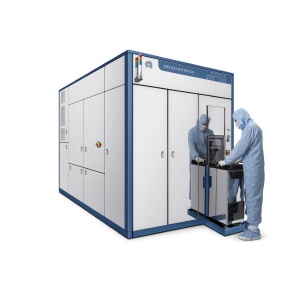 The Aera2 platform's IntenCD technology can improve wafer critical dimension uniformity by more than 20%. (Photo: Business Wire)
"CD uniformity specifications are very tight at the 45nm node and below, especially for double patterning, and at least half of the variation in CD comes from the mask," said Tom St. Dennis, senior vice president and general manager of Applied Materials' Silicon Systems group. "By taking Applied's proven aerial imaging technology into the lithography cell we're enabling chipmakers to track and correct for changes in photomask quality, leading to more accurate patterning, shorter cycle times and greater mask availability."
Key to this new lithography application is the Aera2 platform's IntenCD technology that creates high precision, high definition CDU maps from the aerial image of an entire reticle. By replacing wafer-based measurements with IntenCD maps, the time to decision shrinks from two days to as little as an hour, and accuracy improves by eliminating cumulative errors that can arise from multiple wafer processing steps. The improved uniformity data allows advanced scanners to compensate for CD variations, delivering major improvements in linewidth accuracy on product wafers and ultimately, increased yield.
Regularly inspecting masks within the fab using the IntenCD technology can stretch photomask lifetime significantly, a compelling benefit in an era when a single mask for a critical device layer can cost more than $100,000. Mask properties change dynamically and non-uniformly with cumulative exposure, inducing CD errors from haze defect growth and pellicle degradation. By replacing traditional fixed mask reconditioning intervals with predictive scheduling, fab managers can use the Aera2 system to minimize mask reconditioning cycles, increasing mask lifetime and availability.
To optimize cycle time, the industry-leading Applied Tetra™ Reticle Clean system can also be added to the lithography cell, eliminating the need to send masks outside the fab for reconditioning. The Aera2 for Lithography and the Tetra Reticle Clean are Applied's most recent additions to its strong, proven line-up of solutions to enable cost-effective patterning of next-generation devices. For more information on the Applied Aera2 for Lithography, visit: www.appliedmaterials.com/products/mask_inspection_4.html.