Bayer MaterialScience has begun work on the construction of a new facility for the production of carbon nanotubes (CNTs) in Chempark Leverkusen. The new plant will have a capacity of 200 tons/year, making it the largest of its kind in the world. The company is to invest around EUR 22 million in the planning, development and construction of the plant, which will create 20 new jobs.
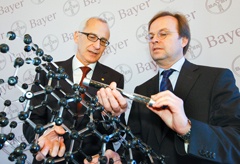 Dr. Wolfgang Plischke, the Board member responsible for research, and Thomas Rachel, Parliamentary State Secretary at the Federal Ministry of Education and Research (BMBF), with a model and a sample of carbon nanotubes.
"We are investing in a key technology of the future that will open up a broad range of new applications for us. We intend to utilize this opportunity to the full. At the same time, the construction of the new CNT facility is a declaration of faith in Leverkusen and the State of North Rhine-Westphalia as an industrial location," said Dr. Wolfgang Plischke, the member of the Bayer AG Board of Management responsible for innovation, technology and the environment, at a press conference to mark the start of construction. Current forecasts predict that the global market for carbon nanotubes will grow by 25 percent a year. In ten years, annual sales of these products are expected to reach US-Dollar 2 billion.
Following the official start of construction work, representatives of the Innovationsallianz "CNT - carbon nanomaterials conquer markets" - in brief: Inno.CNT - met in Chempark Leverkusen for their kick-off event. In this alliance, which is supported by the German Federal Ministry for Education and Research (BMBF), more than 70 partners from industry and science have joined together to develop new technologies and applications for CNT-based materials.
Bayer MaterialScience is one of the few companies that can produce carbon nanotubes of consistently high quality on an industrial scale. A pilot plant with an annual capacity of 60 tons has been in operation in Laufenburg in southern Germany since 2007. Production involves a catalytic process in which the carbon nanotubes are obtained from a carbon-containing gas at elevated temperature in a reactor. "Bayer is investing in this, the world's largest CNT production plant, because we are convinced of the technological and economic efficiency of the process," said Plischke.
With the company's know-how, Bayer can now take a product from the research laboratory and smooth its progress into a broad spectrum of applications relevant to society, such as energy, the environment, mobility, safety and construction. Baytubes® - the brand name for Bayer's carbon nanotubes - are already being used to produce tough, extremely strong, lightweight materials. This means, for example, that rotor blades for wind turbines are more energy-efficient, that transport containers weigh less and that sports equipment can be made more robust.
Innovationsallianz CNT to enhance competitiveness
Plischke also welcomed Thomas Rachel, Parliamentary State Secretary in the BMBF - the ministry backing the project - to the event. Future developments in the field of CNT-based materials are to focus on applications involving energy and the environment, mobility and lightweight construction. A total of EUR 80 million will be invested in research and development as part of Inno.CT, of which the BMBF will contribute about EUR 40 million. In addition, the participating companies want to invest up to EUR 200 million in the further development of these technologies and applications during the course of the projects and also after their conclusion.
Rachel pointed out that Germany and the European Union had set themselves ambitious climate targets. To achieve them, he said, efficient and responsible energy management was essential. The German government wanted to significantly reduce energy consumption in Germany by 2020, and new materials would make a major contribution to this.
Rachel: "Carbon nanotubes will play a particularly important role. They offer all kinds of benefits, such as improving fuel and battery technologies and reducing the weight of vehicles. To exploit the enormous potential of these new materials, the German Federal Ministry for Education and Research will fund the Innovationsallianz CNT to the tune of around EUR 40 million over a period of four years. This alliance will play a significant part in implementing the Federal government's high-tech strategy, through which we aim to strengthen Germany's competitiveness."
The main purpose of the two-day kick-off event in Leverkusen for the alliance partners was to exchange technical ideas and coordinate further cooperation on the project.