Feb 12 2009
Researchers have developed a novel thin-film coating providing an unparalleled level of surface passivation of crystalline silicon solar cells. Using Oxford Instruments' FlexAL® ALD tool, the team from the Eindhoven University of Technology (TU/e) showed that ultra-thin aluminium oxide layers deposited by remote plasma ALD outperform existing passivation coatings in terms of eliminating the - normally significant - electronic losses at solar cells' back and front surfaces.
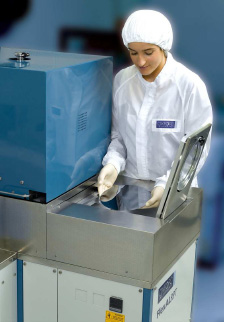 Oxford Instruments’ Flexal® ALD Tool
Oxford Instruments customised its popular FlexAL and OpAL™ tools for this specific application, which has resulted in multiple sales to the rapidly growing solar cell industry.
The development facilitates breakthrough efficiencies for an important class of solar cells. This was recently demonstrated in collaboration between TU/e and the leading Fraunhofer Institute for Solar Energy Research (ISE) in Germany. An efficiency of 23.2% was obtained for PERL solar cells based on n-type silicon by the application of an ultra-thin aluminium oxide layer at the front of the solar cell. To date the p-type front of this class of solar cells was hard to passivate and the relative efficiency improvement of 6% is therefore a significant advance.
Chris Hodson, ALD Product Manager at Oxford Instruments Plasma Technology is delighted with this research, “Dr. Kessels and the Plasma & Materials Processing (PMP) group at TU/e are pushing the boundaries of ALD research into new application areas. This key technology breakthrough using our ALD tools is creating real interest, and I am confident our continued collaboration with TU/e will bring further advances in this and other technology areas.
Dr. Kessels comments, “Surface passivation is a major issue for crystalline silicon solar cell technology, a type of solar cell that dominates 90% of the photovoltaic market. Many thin film coatings have been studied to reduce electronic losses at the front and rear surfaces of the solar cells. Until recently none were found to satisfactorily passivate the highly doped p-type surfaces of next-generation solar cells based on the more cost-effective n-type base material. During the recent PhD research of Dr. Hoex, we have shown the unprecedented high level of built-in negative charges in an ultra-thin aluminium oxide layer deposited by plasma ALD can almost entirely eliminate electronic loses at the solar cell surfaces. Aluminium oxide has recently gained the attention of the photovoltaics community as a versatile and compatible material that is expected to facilitate several advances in solar cell design and technology.”