A team of U.S. and Japanese scientists has shown for the first time that the spectroscopic "fingerprint" of high-temperature superconductivity remains intact well above the super chilly temperatures at which these materials carry current with no resistance. This confirms that certain conditions necessary for superconductivity exist at the warmer temperatures that would make these materials practical for energy-saving applications - if scientists can figure out how to get the current flowing.
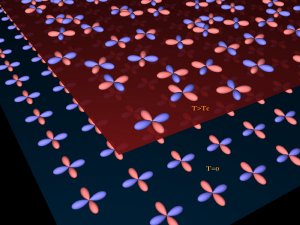 Quasiparticle interference imaging in the cuprate pseudogap state (T>Tc) reveals the spectroscopic "fingerprint" of phase incoherent d-wave superconductivity.
"Our measurements give the most definitive spectroscopic evidence that the material we studied is a superconductor, even above the transition temperature, but one without the quantum phase coherence required for current to flow with no resistance," said physicist Seamus Davis of the U.S. Department of Energy's (DOE) Brookhaven National Laboratory and Cornell University, who led the research team. Davis was recently selected to head a DOE-funded Energy Frontier Research Center at Brookhaven that will examine the underlying nature of superconductivity in complex materials.
"The spectroscopic 'fingerprint' confirms that, at these higher temperatures, electrons are pairing up as they must in a superconductor, but for some reason they are not co-operating coherently to carry current," Davis said.
The technique and findings, described in a paper published August 28, 2009, in Science, may point the way to identifying what inhibits coherent superconductivity at higher temperatures. That knowledge, in turn, may help scientists achieve the ultimate goal of developing super-conducting materials for real-world practical devices such as zero-loss power transmission lines.
Many previous studies have hinted that the higher temperature "parent" state in copper-oxide, or cuprate, superconductors might be a "quantum phase incoherent" superconductor — a state in which electron pairs exist but don't flow coherently as they do below the transition temperature. "But the methods used in these studies were indirect," Davis said. "Each of the results could be described by alternate explanations. What we were searching for was an incontrovertible signature."
Using a spectroscopic imaging scanning tunneling microscopy method developed over many years, Davis and his collaborators had previously conducted extensive studies of the superconducting state of a copper-oxide superconductor containing bismuth, strontium, and calcium (known as BSCCO). These studies identified a detailed spectroscopic signature containing all the quantum mechanical details of that superconducting state.
The new study was designed to see whether the signature changed when the material was warmed above the transition temperature, which is 37 kelvin, or -236 degrees Celsius]. This was a major challenge, however, because the method works best at very cold temperatures. As materials warm up, electrons start moving around more energetically, decreasing the resolution of the measurements.
"We had to make a series of modifications to greatly increase the signal-to-noise ratio for all measurements," Davis said. Some measurements were made over a period of up to 10 days. By averaging measurements over those long times, the scientists were better able to isolate a weak signal from the random background noise.
The results were definitive: "We found that the characteristic signature passes unchanged from the superconducting state into the parent state — up to temperatures of at least 55 K — or 1.5 times the transition temperature," Davis said. "We know of no explanation for why this fingerprint should remain other than that it represents the phase-incoherent superconducting state which has been proposed to exist based on other kinds of measurements."
If the parent state is indeed an incoherent superconductor, the next step is to figure out why. "What breaks the cooperation of the electron pairs? What is the problem that is overwhelming the superconductivity?"
These are questions Davis's technique can address in a quantitative manner. For example, by varying the chemical composition, level of doping, or characteristics of the copper-oxide planes in the layered material, the scientists can measure the strength of quantum phase fluctuations affecting electron-pair cohesion.
These measurements may help scientists zero in on ways to induce coherent superconductivity at a higher range of temperatures than previously possible. And that would be an essential step to achieving real-world applications without the need for expensive cooling systems.
This research was supported by the U.S. Department of Energy's Office of Science (Office of Basic Energy Sciences); the U.S. Office of Naval Research; the Ministry of Science and Education (Japan); and the Japan Society for the Promotion of Science. One collaborator also receives support from the U.S. Army Research Office.