Oct 7 2009
NanoSight, manufacturers of unique nanoparticle characterization technology, is pleased to report that the School of Chemical Engineering at the University of Birmingham is using multiple NanoSight nanoparticle characterization systems to study viruses and catalyst nanoparticles. Working in the group of Professor Kevin Kendall, Marie-Curie Research Fellow, Dr Shangfeng Du, says “it's a very good tool for us to characterize the molecular adhesion and fracture, and interaction between particles in the research areas of catalysts and the biosciences.”
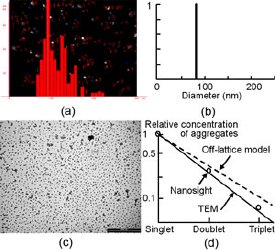
Dr Du’s research concentrates on the catalyst nanoparticles for fuel cells. An important emphasis of this effort is on the synthesis of nanoparticle catalysts of Pt, Ni and base metals, especially to produce new degrees of aggregation in their structure, characterizing the nanoparticles to define the new structures, compositions and processes.
For catalyst characterization, knowing the particle size based on number is very important as it is directly link to the catalytic performance. By knowing the size distribution of the particles in suspension, information on the molecular adhesion such as the singlet, doublet, triplet and larger aggregations can be obtained. This is very useful in the understanding of the processing of dispersions.
Before finding out about NanoSight, the group mainly used electron microscopy (TEM and SEM) and dynamic light scattering (DLS) to measure particle size and aggregation. The main benefit of NanoSight’s nanoparticle tracking analysis (NTA) is that it tracks particles individually making it possible to analyze small aggregations like doublets or triplets which were not seen by DLS. Moreover, it can be used to analyze the sample using a very low concentration which is very difficult by DLS or electron microscopy techniques.
The successes at Birmingham have led to Dr Du saying “I believe we'll get more achievements in this area.” This work has already been expanded into the measurement of molecular interactions between nanoparticles and could have significant application use in a number of fields. One such area is on-line calibration of virus number concentrations which may be studied simultaneously with the interactions of viruses with polymer surfaces.