Today, the U.S. Department of Energy's (DOE) Brookhaven National Laboratory and Advanced Energy Systems, Inc. of Medford, N.Y. (AES) celebrated the opening of a new hi-tech facility at the AES site that will produce crucial components used in particle accelerators around the world.
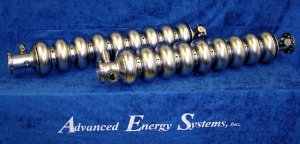 Advanced Energy Systems produces superconducting radiofrequency cavities for use in particle accelerators around the world.
Brookhaven Science Associates, which manages Brookhaven Lab for DOE, purchased equipment worth approximately $2 million as its contribution to the facility. AES invested in the infrastructure improvements it needed to expand its operations, assisted by a $200,000 grant from the Empire State Development Corporation.
"This facility is the result of a unique public/private partnership meant to spur technology advances on Long Island," said Brookhaven Lab Director Sam Aronson. "The collaboration - the first of its kind that Brookhaven Science Associates has undertaken - will help us reach our scientific goals while contributing to the growth of a local company."
"The effort by Brookhaven Lab and New York State to support the growth of AES has already resulted in more hi-tech jobs for Long Island, with more to come in the future," said AES president and founder Tony Favale. "It's a testament to what you can achieve when government helps small businesses grow."
"As U.S. industries are fighting fierce competition from around the world, this program is bolstering America's leadership in hi-tech manufacturing," said U.S. Congressman Tim Bishop - who, along with the rest of the Federal and New York State delegation, has supported the Lab's efforts to grow New York's technology base. "Brookhaven Lab continues to draw the best scientific minds to Long Island in pursuit of new technologies that will make America stronger and more competitive, and I will keep advocating for federal funds to support the Lab's critical work and bring even more of these high-quality jobs to Long Island."
AES will use the new facility to produce superconducting radio-frequency (SRF) cavities, which are used to accelerate particles to very high energies. Since SRF technology is a highly efficient way to accelerate particle beams, nearly all particle accelerators and colliders currently proposed or under construction incorporate them. Particle accelerators based on SRF cavities have great potential in basic and applied research in the fields of nuclear physics, medicine, energy, environment, and national security.
Favale estimates that AES will add 10 to 15 employees to its 28-person staff by 2011 to take advantage of the increased production ability enabled by Brookhaven Science Associates' investment. AES recently won several contracts worth more than $11 million to produce SRF cavities for institutions around the world.
The SRF cavities produced by AES are highly polished hollow, sphere-like structures made of niobium, a metal that becomes superconducting at low temperatures. The individual cells are strung together like pearls and, when complete and installed in a particle accelerator, are bathed in liquid helium to keep them at the ultracold temperature that is key to their operation and high efficiency. During the accelerator's operation, as particles move through the electrically charged cavities, they receive "kicks" of energy, eventually approaching light speed.
SRF cavities are difficult to make because they must have an almost flawless surface. During production and assembly, the niobium metal undergoes a very demanding chemical cleaning and polishing process, which must take place in a clean room. The slightest irregularity -- even a speck of dust -- can greatly reduce a cavity's efficiency. Brookhaven's investment in the AES facility includes the clean rooms and equipment necessary to ramp up production of these cavities.
"In partnering with AES, we saw an opportunity to help them expand and also reduce the long-term costs to the Laboratory," said physicist Ilan Ben-Zvi, Brookhaven's lead on the project. "The end result is that we now have the capability to develop these cavities as we need them, while the ongoing costs for the highly trained technicians needed for this operation can be spread across many projects from different institutions."
Over the next several years, Brookhaven anticipates using the AES facilities to develop SRF cavities for upgrades to its Relativistic Heavy Ion Collider (RHIC) as well as the construction of the proposed next generation electron-ion collider known as eRHIC. If approved, this billion-dollar facility would require hundreds of SRF cavities. Most if not all of these cavities could be built at AES.
As part of this collaborative effort, in addition to its investment in the AES facility, Brookhaven has also expanded its Vertical Test Facility to give it much greater versatility in testing the performance of the cavities produced by AES for Brookhaven and other institutions.
"The only way to confirm you have made a high-performance cavity is to test it under normal operating conditions," said Ben Zvi. "Our Vertical Test Facility is an essential element of the complex, as it allows us to cool the cavities processed at AES to their operating temperature with liquid helium, and then use advanced instrumentation to measure their performance."