Oct 5 2010
Rice University composer Anthony Brandt has compressed an entire evening at the symphony into a six-minute opus -- a "nanosymphony" -- as part of Rice University's Year of Nano celebration. The River Oaks Chamber Orchestra will premiere the piece Sunday at Rice's Buckyball Discovery Gala.
The gala begins the Week of Nano, the highlight of a yearlong celebration of the 25th anniversary of the Nobel Prize-winning discovery of the buckyball, the nickname for the carbon-60 molecule, at Rice.
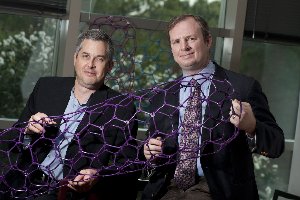 Anthony Brandt, left, and Todd Frazier will debut their new music at Rice University's Buckyball Discovery Gala on Oct. 10. (Credit: Jeff Fitlow/Rice University)
Brandt, an associate professor of composition and theory at Rice's Shepherd School of Music, thought of atoms as notes and molecules as motifs when he wrote the nanosymphony.
"When I was asked to do this, I almost immediately saw what I wanted," Brandt said. "I wanted to write a complete symphony orchestra concert with a tuning segment, an overture, a modern piece, a piano concerto, the intermission, a symphony on the second half and an encore — all in about the length of a commercial pop song.
"It's a complete evening's worth of music on the scale of a single piece."
Brandt's mini-masterpiece is one of two commissioned for the Buckyball Discovery Gala. The other, a musical tribute to Richard Smalley, who was a University Professor and the Gene and Norman Hackerman Chair of Chemistry at Rice until his death in 2005, was written by Houston composer Todd Frazier and will feature a narrative by former Rice President Malcolm Gillis.
The discovery of the buckyball led to a Nobel Prize for the team of Smalley, Robert Curl and Sir Harry Kroto, along with graduate students Sean O'Brien and Jim Heath. What they found on a summer day in 1985 laid the groundwork for the still-growing field of nanotechnology.
The musical works' genesis goes back to Smalley himself, said Wade Adams, director of Rice's Smalley Institute for Nanoscale Science and Technology. "I had wanted something like this for a long time, since it was a conversation -- actually, an argument -- between Rick Smalley and my wife, Mert, that turned Rick on to the emotional power of music. I had conversations with people at the Shepherd School several years ago, and I was delighted when Tony and Todd stepped up to write these fabulous pieces."
Brandt took his cues from the nature of nanotechnology as he scaled down the elements of a night at the concert hall. "I needed some special strategies to make this work," he said. "Usually, a lot of the impact of music is its staying power -- the repetition of ideas, getting familiar with them. I can't give you the chance in this piece. I don't have the time."
Brandt's work is based on a central motif, which is modified throughout the composition. Altering a single note changes its character in the same way replacing a single atom changes the chemical composition of a molecule. "This will be challenging to hear on first listening, because it's so embedded in the way the piece is put together. But it's a metaphor for how nanotechnology works," he said. "Essentially, there's only one theme, manifested in a different way in each movement."
The 12 elements in Brandt's musical table came together nicely -- but for one. "I wanted there to be a 'modern' piece as a movement of the composition, but it took me a long time to figure out how to do it. I went through a whole catalog of possibilities and finally got to the point where the modern piece was the only one I hadn't written," he said.
"Then it hit me. That section (which lasts only 15 seconds) would be made up of one 'molecule' from each movement. It's the most 'nano' of the whole piece.
"The movement occurs early, where you'd typically put a modern piece on a concert. As a result, most of it looks ahead to things that haven't happened yet. So its gaze is more toward the future than the past, which is also a wonderful metaphor for nanotechnology as a whole," Brandt said.
Frazier, a Juilliard alumnus and director of both Young Audiences of Houston and The Methodist Hospital's Center for Performing Arts Medicine, whose works include an oratorio about Thomas Jefferson, spent months researching Smalley's life and achievements before writing a note of his nine-minute contribution. "My challenge for this composition was the same as for Jefferson," he said. "I had to decide what to leave out. There were so many directions in which it could go and so many angles to illuminate."
Knowing that Brandt "really responded to the interpretation of the science embodied in music," Frazier highlighted Smalley's humanity. "The more people I talked to about nanotechnology and the buckyball, the more I realized the event of the discovery was exciting and special and could be shared across any discipline. Everyone could participate in that 'Aha!' moment, and that needed to be captured."
Frazier's piece also details the discovery's aftermath, highlighted by Smalley's testimony before Congress in 1999, where he used his own cancer, which ultimately took his life, as an example of what nanotechnology could someday cure.
The compositions were commissioned by gala co-chairs Anne and Albert Chao and Reinnette and Stan Marek and will get a second performance Oct. 16 at 7:30 p.m. at Zilkha Hall at Houston's Hobby Center for the Performing Arts, 800 Bagby St. They will be performed by Musiqa, which Brandt co-founded and serves as its musical director. Gillis will again narrate Frazier's tribute.
The gala will be held at the Hyatt Regency Downtown and precedes the four-day Buckyball Discovery Conference, which will draw top scientists from all over the world to Rice to discuss the past, present and future of nanotechnology.
Lockheed Martin is the primary sponsor of Year of Nano events.
Tickets for the gala are available at buckyball.smalley.rice.edu/gala/.
Register for the Buckyball Discovery Conference at buckyball.smalley.rice.edu/registration/.