What do a smart window company, a microbial analysis start-up and waste-heat recovery start-up have in common? They’re all located in the San Francisco Bay Area and they’re all based on technology developed at Lawrence Berkeley National Laboratory.
What’s more, these three start-up companies have either had highly successful launches or closed major deals in the last several months. One of the companies announced a new manufacturing facility that will create hundreds of jobs across the country and bring energy-savings technologies to a wider market.
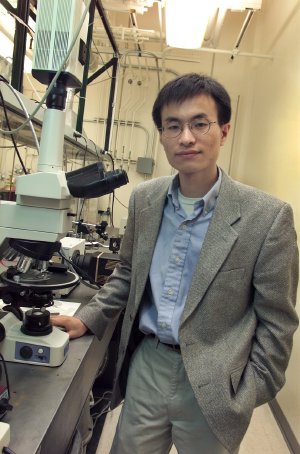 Peidong Yang, a chemist with Berkeley Lab and UC Berkeley, invented a novel thermoelectric material.
“Some people think scientists spend years in their laboratories just studying problems, but beyond the research, a top priority for Berkeley Lab is to push our scientific innovations to market,” said Viviana Wolinsky, deputy department head for Technology Transfer and Intellectual Property Management at Berkeley Lab. “Every year we patent dozens of technologies in health, computing, biofuels and many other areas, license many of these and launch about two start-ups a year.”
Soladigm announced recently that it would build a plant in Olive Branch, Mississippi, near Memphis, to produce dynamic glass for windows, which it said could potentially reduce a building’s energy consumption by 25 percent by saving on heating and cooling costs. The plant is projected to begin production in early 2012 with about 100 employees; the company expects to increase capacity and have more than 300 employees within five years.
“A product like this brings energy efficiency as well as changing the user experience. It’s kind of like a holy grail,” said Erich Klawuhn, Soladigm’s vice president for business development. “This technology allows you to control the heat and glare dynamically with what’s going on in the environment, and it doesn’t obstruct the views. You can totally eliminate blinds.”
The glass uses an absorptive electrochromic technology based on tungsten-oxide. Through a Collaborative Research and Development Agreement (CRADA), Berkeley Lab scientist Andre Anders worked with Soladigm to characterize both the individual layers of the glass as well as the integrated device comprised of the combined layers. In 2008 Soladigm also licensed a reflective electrochromic technology developed by Berkeley Lab scientist Tom Richardson, which is expected to have higher performance and lower cost than first-generation dynamic windows. “It is being developed and could be our next-generation product,” Klawuhn said.
In addition to $30 million it has raised from venture capital firms Khosla Ventures and Sigma Partners, Soladigm was also recently awarded a grant from the U.S. Department of Energy for $3.5 million from the American Recovery and Reinvestment Act. The company currently has about 50 employees at its headquarters in Milpitas, California, where it also operates a pilot facility. “R&D will remain in Milpitas,” Klawuhn said. “We have substantial growth plans here for development.”
San Francisco start-up PhyloTech is based on the PhyloChip, which was developed by Berkeley Lab scientists Gary Andersen, Todd DeSantis and others. The PhyloChip quickly, accurately and comprehensively detects the presence of up to 50,000 species of bacteria and archaea in a single sample from any environmental source, without the need of culturing. The PhyloChip was recently used in the Gulf of Mexico to study how much of the deepwater oil plume has been degraded by microbes.
Since only 2 to 3 percent of bacteria can be cultured, PhyloTech expects that its product—running microbial community analyses for samples from any environment, whether from an ecosystem or the human body—will have hundreds of possible applications, from human health to agriculture to environmental assessments. “Anywhere there are microbes in or on your body, there’s an opportunity for diagnostics,” said CEO Thane Kreiner. “It can be used for lots of diseases, including allergies, asthma and Crohns’ disease, plus there are ecological applications, such as investigating contaminated recreational water. One of the big questions people can’t answer is how that contamination came about.”
PhyloTech closed $1.2 million in seed financing in April and had its first customer order within three months. “The number of leads we’ve been able to generate and the interest in using the technology has surpassed our expectations,” Kreiner said. “There’s tremendous potential for this one very unique innovation out of Berkeley Lab.”
Alphabet Energy is another start-up that has seen tremendous investor and market interest in a short amount of time. Founded in 2009, the San Francisco-based start-up licensed a breakthrough technology from Berkeley Lab that can inexpensively convert heat to electricity. Alphabet plans to use the new thermoelectric material, created through nanotechnology, for waste heat recovery, a potentially multi-billion-dollar market.
Nearly two-thirds of all the energy produced in the world is lost as heat. More than half the energy in a gallon of gas leaves automobiles as waste heat. Waste heat is a free source of energy that is almost wholly unused today because large-scale waste heat recovery has not been feasible. Converting waste heat to electricity could offset as much as 500 million metric tons of carbon per year that would otherwise be released into the atmosphere.
“The inquiries are pouring in,” said CEO Matthew Scullin. “There’s been an enormous amount of interest from the investment community, from potential customers and also from supply chain customers who can benefit from the sale and installation of waste heat recovery systems.”
Scullin, who also co-founded company, said potential customers that have expressed interest include heat exchange companies and companies that make aluminum, glass, cement, steel, automobiles and aircraft, as well as the military. The technology was invented by scientist Peidong Yang and others in his lab; Yang is also a company co-founder.
Alphabet has raised $1 million in seed funding from Claremont Creek Ventures and the CalCEF Clean Energy Angel Fund. Currently with eight employees, the company has developed a working prototype and hopes to install a pilot plant by the end of 2011. “By the middle of next year we’ll be hiring again,” Scullin said.”