Mar 26 2008
A UK scientist has discovered clumps of previously-unreported callus hairs growing in the flesh of mature apples of Fuji and closely-related varieties, which may have storage implications for commercial growers.
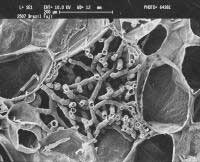 Scanning Electron Micrograph of Fuji apples showing extensive branching of callus hairs.
“To find out something new about apples is really exciting”, says Dr Mary Parker of the Institute of Food Research. “Apples have been cultivated for about as long as human history and Fuji apples are particularly prized for their crispness, sweet flavour and keeping qualities “.
The variety was developed in Japan, but is widely grown in the Southern Hemisphere, China, Southern Europe and the USA. It is a cross between Ralls Janet and Red Delicious, and is itself used as a parent in breeding programmes.
“The reason these hairs have not been spotted before is probably because the full extent of their growth can only be appreciated in 3D”, says Dr Parker.
Dr Parker used light microscopy and scanning electron microscopy to reveal clumps of small, elongated and branched cells in the air spaces between cells. She named them callus hairs because of their resemblance to the cells which make up the white velvety tufts (sometimes mistaken for fungus) which develop around the seeds in some apple varieties.
The presence of callus hairs filling the airspaces of mature Fuji could account for the susceptibility of late-harvested apples to internal browning. Unrestricted gas flow through the fruit is vital for successful long-term storage particularly in modified atmospheres. Callus hair growth, with its own oxygen requirement and carbon dioxide output, may reduce the efficiency of gas transport through the spaces between cells.
“With this new knowledge, breeders could pick parent varieties with all the positive traits of Fuji apples but with less-developed callus hairs”, says Dr Parker. The presence or absence of callus hairs could also be used to test the authenticity of dried apples labelled as Fuji.
Preliminary studies have shown that callus hairs are rich in phytonutrients but may also contain allergens. Further investigations are needed to establish how growth conditions and orchard management affect the extent of callus hair development.