Apr 7 2008
Mud may be coming to a medicine cabinet or pharmacy near you. Scientists in Arizona report that minerals from clay could form the basis of a new generation of inexpensive, highly-effective antimicrobials for fighting MRSA infections that are moving out of health care settings and into the community. These “superbugs” are increasingly resistant to multiple antibiotics and cause thousands of deaths each year.
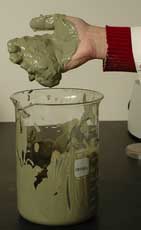 Minerals from clay could provide a source of powerful antimicrobials for fighting deadly MRSA infections and other diseases. Credot: Arizona State University, John C. Phillips.
Unlike conventional antibiotics that are often administered by injection or pills, the so-called “healing clays” could be used as rub-on creams or ointments to keep MRSA infections from spreading, the researchers say. The clays also show promise against a wide range of other harmful bacteria, including those that cause skin infections and food poisoning, the scientists add. Their study, one of the first to explore the antimicrobial activity of natural clays in detail, was presented today at the 235th national meeting of the American Chemical Society.
Clays have been used for thousands of years as a remedy for infected wounds, indigestion, and other health problems, either by applying clay to the skin or eating it. Today, clays are commonly used at health spas in the form of mud baths and facials. Armed with new investigative tools, researchers are beginning to explore their health claims scientifically.
“Clays are little chemical drug-stores in a packet,” said study co-leader Lynda Williams, Ph.D., a geochemist at Arizona State University in Tempe. “They contain literally hundreds of elements. Some of these compounds are beneficial but others aren’t. Our goal is to find out what nature is doing and see if we can find a better way to kill harmful bacteria.”
In the new study, funded by the National Institutes of Health, Willams and her colleagues collected more than 20 different clay samples from around the world to investigate their antibacterial activities. In collaboration with study co-leader Shelley Haydel, Ph.D., a microbiologist with Arizona State, the researchers tested each of the clays against several different bacteria known to cause human diseases. These bacteria include MRSA (methicillin-resistant Staphylococcus aureus), Mycobacterium ulcerans (a microbe related to the tuberculosis bacterium that causes a flesh-eating disease known as Buruli ulcer), as well as E. coli and Salmonella (which cause food poisoning). The researchers identified at least three clays that killed or significantly reduced the growth of these bacteria.
The researchers are working to identify the specific compounds in the clays that may be responsible for its antibacterial activity. Using electron and ion microscopy, the researchers are also exploring how these antibacterial clays interact with the cell membranes of the bacteria in order to find out how they kill.
Williams and Haydel are continuing to test new clay samples from around the world to determine their germ-fighting potential. They hope that the more promising clays will be developed into a skin ointment or pill to fight a variety of bacterial infections or possibly as an agricultural wash to prevent food poisoning. Several companies have expressed interest in forming partnerships to develop the clays as antimicrobial agents, the scientists say.
But ordinary mud can contain dangerous bacteria as well as toxic minerals like arsenic and mercury, the researchers point out. Until healing clays are developed that are scientifically proven, which could take several years, handwashing and other proper hygiene techniques may be your best bet for keeping MRSA and other harmful bacteria at bay, they say.
The American Chemical Society - the world’s largest scientific society - is a nonprofit organization chartered by the U.S. Congress and a global leader in providing access to chemistry-related research through its multiple databases, peer-reviewed journals and scientific conferences. Its main offices are in Washington, D.C., and Columbus, Ohio.