Oct 17 2008
A new research field called transformation optics may usher in a host of radical advances including a cloak of invisibility and ultra-powerful microscopes and computers by harnessing nanotechnology and "metamaterials."
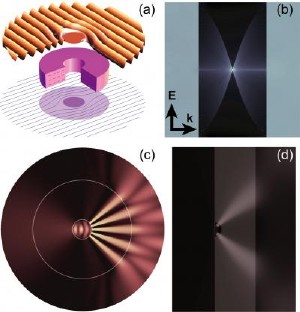 These are graphical representations of numerical simulations depicting four potential applications of a new field called transformation optics. Clockwise from top left are: a design for optical cloaking; a light. Credit: Courtesy of the journal Science
The field, which applies mathematical principles similar to those in Einstein's theory of general relativity, will be described in an article to be published Friday (Oct. 17) in the journal Science. The article will appear in the magazine's Perspectives section and was written by Vladimir Shalaev, Purdue's Robert and Anne Burnett Professor of Electrical and Computer Engineering.
The list of possible breakthroughs includes a cloak of invisibility; computers and consumer electronics that use light instead of electronic signals to process information; a "planar hyperlens" that could make optical microscopes 10 times more powerful and able to see objects as small as DNA; advanced sensors; and more efficient solar collectors.
"Transformation optics is a new way of manipulating and controlling light at all distances, from the macro- to the nanoscale, and it represents a new paradigm for the science of light," Shalaev said. "Although there were early works that helped to develop the basis for transformation optics, the field was only recently established thanks in part to papers by Sir John Pendry at the Imperial College, London, and Ulf Leonhardt at the University of St. Andrews in Scotland and their co-workers."
Current optical technologies are limited because, for the efficient control of light, components cannot be smaller than the size of the wavelengths of light. Transformation optics sidesteps this limitation using a new class of materials, or metamaterials, which are able to guide and control light on all scales, including the scale of nanometers, or billionths of a meter.
"The whole idea behind metamaterials is to create materials designed and engineered out of artificial atoms, meta-atoms, which are smaller than the wavelengths of light itself," Shalaev said. "One of the most exciting applications is an electromagnetic cloak that could bend light around itself, similar to the flow of water around a stone, making invisible both the cloak and an object hidden inside."
Shalaev and researchers from his group - doctoral students Wenshan Cai and Uday K. Chettiar and principal research scientist Alexander V. Kildishev - in 2007 took a step toward creating an optical cloaking device in the visible range of the spectrum. Their theoretical design uses an array of tiny needles radiating outward from a central spoke, resembling a round hairbrush, and would bend light around the object being cloaked.
The mathematical equations for transformation optics are similar to the mathematics behind Einstein's theory of general relativity, which describes how gravity warps space and time, Shalaev said.
"Whereas relativity demonstrates the curved nature of space and time, we are able to curve space for light, and we can design and engineer tiny devices to do this," he said. "In addition to curving light around an object to render it invisible, you could do just the opposite - concentrate light in an area, which might be used for collecting sunlight in solar energy applications. So, general relativity may find practical use in a number of novel optical devices based on transformation optics."
The metamaterials also may enable engineers to overcome obstacles now confronting the semiconductor industry: It is becoming increasingly difficult to make faster computer chips because the technology is reaching its limits. But computers using light instead of electronic signals to process information would be thousands of times faster than conventional computers. Such "photonic" computers would contain special transistor-size optical elements made from metamaterials.
Transformation optics also could enable engineers to design and build a "planar magnifying hyperlens" that would drastically improve the power and resolution of light microscopes.
"The hyperlens is probably the most exciting and promising metamaterial application to date," Shalaev said. "The first hyperlens, proposed independently by Evgenii Narimanov at Princeton and Nader Engheta at the University of Pennsylvania and their co-workers, was cylindrical in shape. Transformation optics, however, enables a hyperlens in a planar form, which is important because you could just simply add this flat hyperlens to conventional microscopes and see things 10 times smaller than now possible. You could focus down to the nanoscale, much smaller than the wavelength of light, to actually see molecules like DNA, viruses and other objects that are now simply too small to see."
The hyperlens theoretically would compensate for the loss of a portion of the light transmitting fine details of an image as it passes through a lens. Lenses and imaging systems could be improved if this lost light, which scientists call "evanescent light," could be restored. Such a hyperlens would both magnify an image and convert this evanescent light so that it does not weaken with distance but continues to propagate.
Meta in Greek means beyond, so the term metamaterial means to create something that doesn't exist in nature.
Unlike natural materials, metamaterials are able to reduce the "index of refraction" to less than one or less than zero. Refraction occurs as electromagnetic waves, including light, bend when passing from one material into another. It causes the bent-stick-in-water effect, which occurs when a stick placed in a glass of water appears bent when viewed from the outside. Each material has its own refraction index, which describes how much light will bend in that particular material and defines how much the speed of light slows down while passing through a material.
Natural materials typically have refractive indices greater than one. Metamaterials, however, can make the index of refraction vary from zero to one, which possibly will enable cloaking as well as other advances, Shalaev said.
He estimated that researchers may be building prototypes using transformation optics, such as the first planar hyperlenses, within five years.