Researchers at Bio Nano Consulting (BNC), a specialist bio-nanotechnology product development consultancy, have produced a miniaturized version of the London tube map, measuring only 2x3 mm - about the size of a pinhead. The map was etched using specialised lasers by Dr Richard Winkle, a BNC researcher at Imperial College London, whilst testing the capabilities of an Oxford Lasers micromachining system.
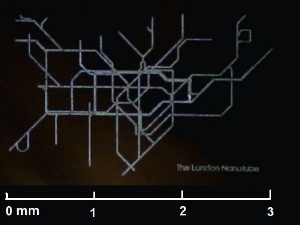
The 'London Nanotube' was aptly named as nanotubes are an essential building block for nanotechnology. The incredible precision required to produce the London Nanotube highlights the ability of the BNC to provide extremely fine detailed work on an exceptionally small scale.
Dr Mike Fisher, Business development Director of Bio Nano Consulting commented, "The successful creation of the London Nanotube demonstrates the vast capabilities of the BNC. Producing such intricate detail on such a small scale reflects the immense knowledge and expertise of BNC scientists, which is transferable to a number of nano-scale projects across industry, such as the manufacture of microfluidic systems." He continued, "This version of the London Nanotube is not strictly on the nanoscale, so we are taking on this challenge. Using our state-of-the-art micro and nanofabrication equipment, we believe we can shrink the tube map another 100 times, making it invisible to the naked eye."
The London Nanotube will be on display on the BNC exhibition stand at the Nano 4 Life conference on 11th February. Run by BNC on behalf of the NanoKTN (Nanotechnology Knowledge Transfer Network), this one-day conference will explore key areas where nanotechnology offers opportunities to advance healthcare provision from speakers from GSK, AstraZeneca and GE Healthcare.