Low-temperature nanopositioning concept to address growing demand for ultra-precise optical alignment in cryogenic environments.
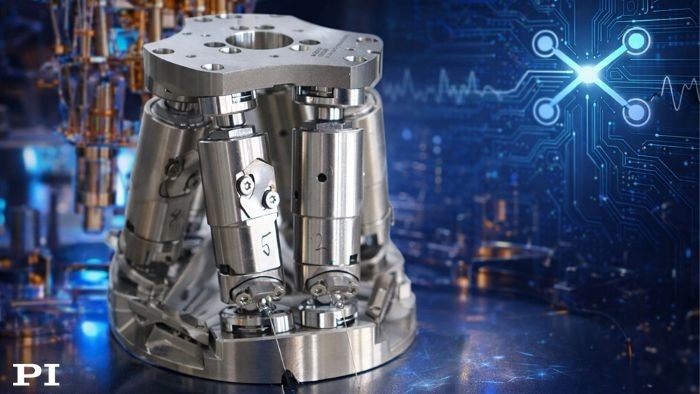 A new low-temperature hexapod concept to advance quantum precision. Image Credit: PI (Physik Instrumente) LP
As quantum and photonics technologies continue to evolve, the need for precise optical alignment under cryogenic conditions is becoming increasingly critical. Addressing this demand, PI (Physik Instrumente), a global leader in precision motion control and nanopositioning technologies, has launched a dedicated low-temperature development program focused on extending its nanopositioning expertise into multi-axis systems for quantum applications.
While early cryogenic motion solutions relied on stacked XYZ stages, emerging applications now require 5- and 6-degree-of-freedom alignment systems capable of handling larger payloads and more complex optical configurations.
PI’s concept approach centers on compact, 6DOF parallel-kinematics, designed to deliver nanometer-scale precision across multiple axes within the confined environments of cryostats and dilution refrigerators. Engineered to support key optical tasks - including beam steering, lens aberration correction, polarization control, fiber alignment, and precision positioning of dispersive elements such as gratings and prisms - these systems operate at ultra-low temperatures down below 4 K, while enabling motion of several hundred grams over millimeter-scale travel ranges, all with high stability and repeatability.
Hexapod-type parallel kinematics enable simultaneous control of all six degrees of freedom, reducing error accumulation common in stacked systems. Additional advantages include low inertia, requiring less energy, a programmable pivot point for precise rotational alignment, and an open aperture for unobstructed optical access.
The piezo-based architecture minimizes heat generation and enables self-locking operation even when power is switched off, an advantage for thermally sensitive low-temperature environments. Non-magnetic materials and UHV compatibility further support integration near sensitive quantum devices.
With this initiative, PI is positioning its motion technologies to support the next generation of quantum research and advanced cryogenic photonic systems.
Industries Served
Quantum Technology, Photonics, Semiconductors
»Learn more