Non-destructive SR-DLS enables particle size characterization without sampling, dilution or sample contact.
Particle size is a Critical Quality Attribute (CQA) for a broad range of products and formulations, from pharmaceutical nanomedicines and biologics to emulsions, colloidal suspensions, and innovative materials.1
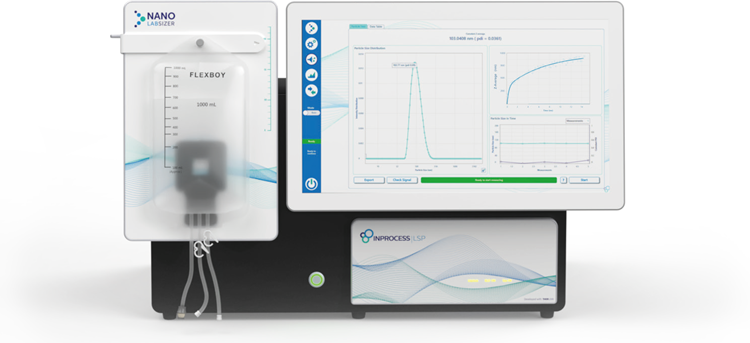
Image Credit: InProcess-LSP
It determines bioavailability, stability, and end-of-use performance. Getting it right requires strong, reproducible measurement techniques across the product lifecycle, from early formulation through batch release and long-term stability monitoring.2,3
Why conventional particle-size analysis adds complexity
Traditional characterization methods can needlessly complicate this process. Samples must be extracted, diluted, and transported to specialist facilities, introducing contamination risk, impaired sterility, and adding time, complexity, and cost at every stage.
A technique that can measure particle size directly within closed containers at native concentrations without requiring sample preparation would radically alter current procedures.
Spatially Resolved Dynamic Light Scattering (SRDLS), the technology that powers the NanoLabSizer, accomplishes this. SR-DLS is based on Fourier Domain Low-Coherence Interferometry (FD-LCI)4 and resolves scattered light as a function of depth within the sample.5
The system collects the signal in full backscatter mode. The result is quick, non-destructive particle size measurements through a variety of transparent containers, such as clear and amber glass vials, syringes, tubes, IV bags, and plastic containers, without opening the container, diluting the sample, or making any sample contact.
From SR-DLS technology to closed-container measurements
The NanoLabSizer (NLS) enables these capabilities on the benchtop. It is designed for static measurements across a wide range of container types and sample matrices, making it a useful tool for method development, stability monitoring, formulation screening, fill-finish quality control, and change control studies.
Measurement turnaround is quick, generally only a few seconds, making it ideal for high-throughput operations. Third-party automation platforms can be linked to the system to enable higher-throughput sample routines, extending its utility in screening and quality control applications.
In this article, pharmaceutical development and sterile fill-finish are the primary business cases, but the basic measuring principle applies whenever particle size matters and sample integrity cannot be compromised.
The NanoLabSizer (SR-DLS)
The NanoLabSizer (NLS) is an analytical tool designed to address key challenges in particle size monitoring across various industrial processes (Figure 1A). The NLS can measure (sub)micron hydrodynamic particle size from 5 nm to 5 µm.
The measurements are based on SR-DLS. SR-DLS (as well as normal DLS) is based on determining the diffusion rate of particles suspended in a liquid by lighting them and evaluating the fluctuations in scattered-light signal at a certain collection angle (Figure 1B).
Suspended particles disperse by Brownian motion and therefore constantly shift their relative positions in the scattering volume. As a result, the scattered signal swings at a rate proportional to the particles' diffusion rate.
By calculating decorrelation functions of the scattered signal, one can determine the diffusion constant (or its distribution), which can be converted to the hydrodynamic size and size dispersity of the diffusing particles using the Stokes-Einstein relation.6
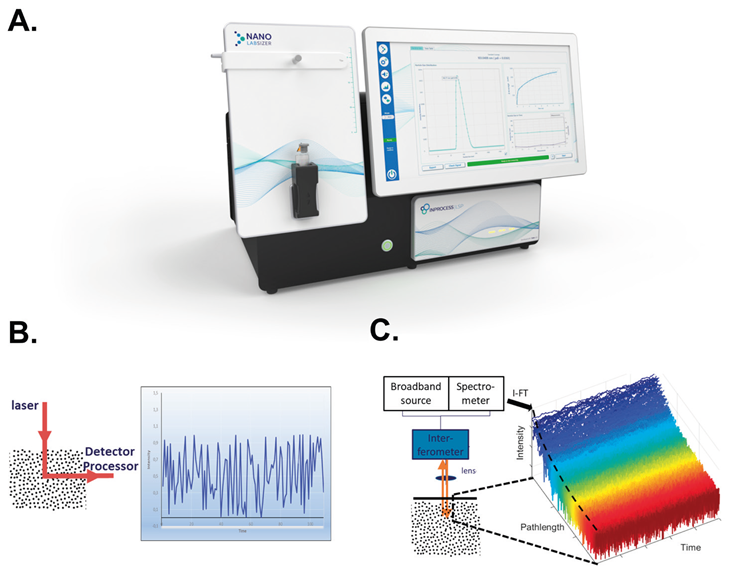
Figure 1. Spatially Resolved Dynamic Light Scattering (SR-DLS). A. NanoLabSizer set-up fit for non-invasive measurements. B. In standard DLS measurements, the scattering signal of the illuminated volume is analyzed as a single large voxel, thus yielding a single time-dependent intensity signal that is then used to extract the corresponding particle size distribution. C. SR-DLS employs a different set-up to acquire spatially resolved data. Details of the detection scheme: interferograms from the spectrometer are transformed to give the scattered light from each depth in the sample. High-speed acquisition thus yields the fluctuations of this scattered light at the different depths (blue: close to the wall, red: deeper in the suspension). Image Credit: InProcess-LSP
SR-DLS differs from traditional DLS in several ways: first, the collection angle is 180° (full backscattering), so observations are independent of sample container geometry, as measurements can be performed even through curved or rounded vessel walls.
Secondly, SR-DLS implements Low Coherence Interferometry (LCI) approaches. In LCI, broadband light illuminates the samples and is then combined with the reference beam in an interferometer.
From the measured spectrum of this mixed signal (across all wavelengths of the light source), the scattered signals from different depths in the sample can be resolved concurrently.
Usually, 1000 consecutive depths with an accuracy of a few microns and a total depth in the sample of a few millimeters are therefore evaluated. The system rapidly captures signal at each depth, and a decorrelation function can be computed to determine particle size (Figure 1C).
The ability to obtain an extensive number of correlation functions resolved in depth using a full backscattering optical set-up permits measurements in flowing pipes (via specific flow cells) and observations at high turbidity in curved and complex product container geometries.
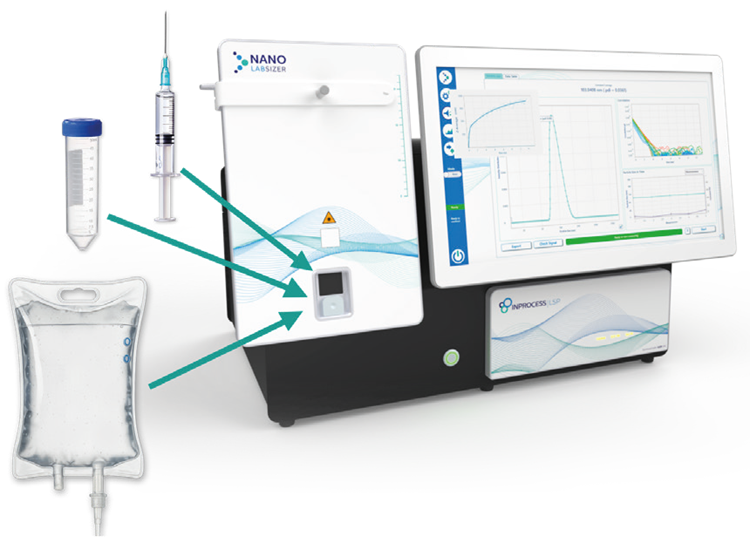
Figure 2. The NanoLabSizer and its modularity. Multiple modules are available and can be easily custom-made to suit specific sample containers. Image Credit: InProcess-LSP
The NanoLabSizer: A Geometry-Independent Particle Size Tool
Dedicated Sample Modules: Comfort and Robustness
The NanoLabSizer is an adaptable, modular system that can be configured with different front modules to accommodate the sample of interest. The modules' primary function is to guarantee that samples are properly positioned for measurement (Figure 2).
The standard vial module accepts 10 mL glass vials, which are commonly used for filling and finishing parenteral medicines. On request, this module can be customized to hold any other size of vial.
The IV bag holder is an adjustable device that clamps soft-walled items like IV bags, allowing them to be fixed in place relative to the NanoLabSizer's measurement optics. The system gathers scattered light and resolves depth from the container's inner edge, then calculates particle size.
Consistent Measurements Across Different Containers
To demonstrate the NanoLabSizer's ability to easily characterize particle size inside various common glass labware, a 1% weight fraction suspension of silica (Akzo Nobel) was measured as a control in 10 mL glass vials (Nipro, Fiolax glass clear, vial module) and 50 mL glass bottles (Schott) of varying glass color (transparent and amber, custom bottle module).
All measurements were consistent, indicating that glass color has no effect on NIR light (121 ± 1 nm, 120 ± 1 nm, and 124 ± 1 nm). All PDI values were 0.2 ± 0.1.
The vial module is very adjustable and may accommodate a variety of smaller, widely used vials or glass syringes. We demonstrated this by analyzing a 135 nm polystyrene reference sample (Sigma-Aldrich).
The glass vials measured 134 ± 1 nm, while the glass syringe was 132 ± 1 nm. All PDIs were 0.1 ± 0.1.
Measuring Finished Products in Their Original Packaging
The system's versatility was demonstrated by connecting a commercially available centrifuge tube (Propofol emulsion, Fresenius Kabi) to the NanoLabSizer (Figure 3B), allowing particle-size measurements in the emulsion without disturbing the sterile liquid in the syringe.
We then tested the same item in a standard 10 mL vial for comparison. Given SR-DLS's high turbidity limits, we could directly measure particle size in the prefilled syringe as received, and the result was similar to the control measurement using extracted material in a standard vial (Figure 3C).
Similarly, a study conducted for a recent FDA workshop7 found that it could estimate the exact PSD of a phytonadione micelle formulation using the original amber package (Figure 3D and E, respectively). Phytonadione is oxygen- and light-sensitive and comes in sealed glass ampules.
Assessing the critical size CQA non-invasively reduces sample waste and provides better insight into how processing and storage conditions affect particle size.
From Measurement to Quality Control
For an established manufacturing technique, the measured PSDs can serve as a unique product fingerprint and as quality indicators directly from the finished product.
This NanoLabSizer arrangement allows for quick, on-line particle size analysis of finished pharmaceutical products. In a related point, the NanoLabSizer's software can be offered in a completely GMP-compliant (21 CFR Part 11) format.
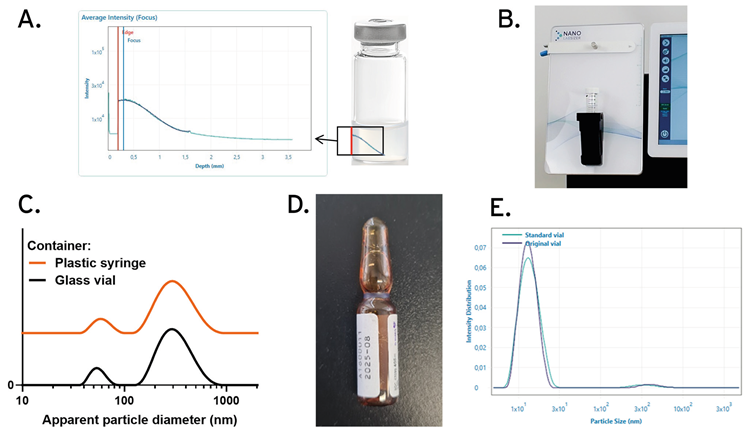
Figure 3. The NanoLabSizer and measurements inside typical laboratory glassware and tubes. A. Intensity of the scattered light signal at each sample depth. The red line indicates the inner container surface, from which the suspension scatters. The blue line indicates the maximum intensity of scattered light, which is tuned to be immediately after the container’s wall during set-up. On the right, a schematic of a flask and where the scattering signal comes from, with a red line to also indicate the recipient’s edge. The NanoLabSizer is, therefore, geometry-independent. B. Prefilled centrifuge tube fixed at the measuring window of the NanoLabSizer by a dedicated module. C. PSDs corresponding to Propofol suspensions (Fresenius Kabi) measured either in their native packaging (orange line) or as a control in a standard vial (black line). D. Phytonadione 10 mg/mL injectable emulsion in an amber glass ampule, measured as received. Image Credit: InProcess-LSP
Sterile Bag Holder Measurements: Flexible Container Compatibility
Pharmaceutical packaging comes in a variety of shapes and sizes that may not necessarily fit into the existing flask modules. However, the modules are utilized to accurately position the sample in the measurement window. As a result, if a sample is placed in the correct position, it can be measured.
This article demonstrates this concept with the NLS's IV bag holder (Figure 4A), which may be used to insert transparent bags in front of the optical path. Please keep in mind that for specific applications, you may always request module customization or the construction of a new dedicated module.
We measured the previously used silica suspension (1% weight fraction in water) in a standard IV bag.
The same suspension was tested in an IV bag (Flexboy), which has a particularly problematic geometry due to its soft nature (Figure 4B). Particle size was measured at 122 ± 1 nm (PDI: 0.1 ± 0.1) inside the IV bag, with consistent repeatability across the entire particle size distribution (PSD).
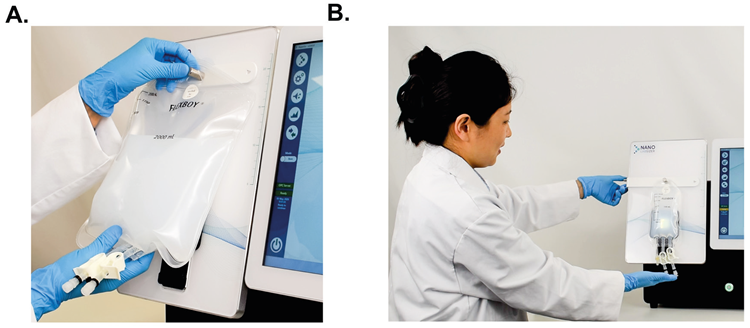
Figure 4. The NanoLabSizer and measurements inside large and odd-sized sterile bags. A. 2-liter IV bag measurement. B. Particle size was measured inside an IV bag, which also yielded consistent particle size and PSD to the reference measurements. Image Credit: InProcess-LSP
Conclusion
The NanoLabSizer was used to determine particle size inside closed containers of various materials and shapes. This was possible because SR-DLS is geometry-independent.
Most lab-scale containers (on the order of a liter or smaller) have specific modules to position the samples in the measurement window. With these arrangements, we could test standard laboratory bottles, glassware, and numerous packaged formulas.
Across Vials, Syringes and IV Bags
We also tested a prefilled syringe loaded with propofol, producing its unique PSD fingerprint, which can be detected even at high turbidity. Measurements for sterile holding or IV bags can also be performed with the NLS's current IV bag holder. To demonstrate this, we measured PSD in IV bags.
To summarize, the NanoLabSizer uses specialized modules to characterize the PSD and PDI of suspensions in nearly any transparent vessel, regardless of the container's geometry. These modules can be customized upon request.
Acknowledgments
Produced using materials originally written by Azeem Khan, Carl Schuurmans, Michiel Damen, and Ad Gerich from InProcess-LSP.
References
- Santer, G., K. Schlich, F. von der Kammer, and F. S. Baumann. "Particle Size as a Critical Quality Attribute for Pharmaceutical Nanomedicines, Biologics, Emulsions, Colloidal Suspensions, and Advanced Materials." Pharmaceutical Research, 2018: 35:10, 195
- Barcelo-Chong, C.M., et al. (2024). How spray drying processing and solution composition can affect the mAbs stability in reconstituted solutions for subcutaneous injections. Part II: Exploring each protein stabilizer effect. International Journal of Pharmaceutics, (online) 655, p.124014. DOI:10.1016/j.ijpharm.2024.124014. https://www.sciencedirect.com/science/article/abs/pii/S0378517324002485.
- Varela-Fernández, R., et al. (2021). Design, development, and characterization of an idebenone-loaded poly-ε-caprolactone intravitreal implant as a new therapeutic approach for LHON treatment. European Journal of Pharmaceutics and Biopharmaceutics, (online) 168, pp.195–207. DOI:10.1016/j.ejpb.2021.09.001. https://www.sciencedirect.com/science/article/pii/S0939641121002332.
- Kalkman, J., et al. (2010). Path-Length-Resolved Diffusive Particle Dynamics in Spectral-Domain Optical Coherence Tomography. Physical Review Letters, 105(19). DOI:10.1103/physrevlett.105.198302. https://journals.aps.org/prl/abstract/10.1103/PhysRevLett.105.198302.
- Besseling, R., et al. (2019). New unique PAT method and instrument for real-time inline size characterization of concentrated, flowing nanosuspensions. European Journal of Pharmaceutical Sciences, (online) 133, pp.205–213. DOI:10.1016/j.ejps.2019.03.024. https://www.sciencedirect.com/science/article/pii/S0928098719301332.
- Einstein, A. (1905) On the movement of small particles suspended in stationary liquids required by the molecular-kinetic theory of heat. Annalen der Physik, 17, pp. 549–560.
- Xu, X., et al. (2026). Mastering particle size analysis: lessons, challenges, and future directions from the FDA–CRCG workshop. AAPS Open, 12(1). DOI:10.1186/s41120-026-00148-4. https://link.springer.com/article/10.1186/s41120-026-00148-4.

This information has been sourced, reviewed and adapted from materials provided by InProcess-LSP.
For more information on this source, please visit InProcess-LSP.