Two-photon lithography (TPL) enables the development of a multifunctional materials platform that combines mechanical strength and optical activity, all contained in three-dimensional nanoarchitected metamaterial housings.
At the nanoscale, the main challenge in pursuing this development is the limited availability of suitable, multifunctional printable materials. To achieve this, materials must demonstrate high stiffness, high energy absorption, and large recoverable strain alongside tunable optical functionality, specifically plasmonic and chiral responses.
To address these concerns, the researchers designed an innovative TPL photoresist based on Ag28Pt nanoclusters with atomic precision. These were then scattered across an acrylate-functionalized polyhedral oligomeric silsesquioxane (POSS) matrix. The nanoclusters serve dual purposes: they act as highly efficient two-photon photoinitiators and as nanoscale reinforcing agents.
Their ultrasmall size (∼3 nm) reduces scattering during laser writing, facilitating high-resolution printing of intricate 3D architectures, while the nanoclusters' chemistry enables strong bonding to the polymer network. By achieving integration of the desired properties, the researchers were able to fabricate a series of mechanically robust, optically active nanocomposites that are otherwise more complex to fabricate using traditional organic photoinitiators or larger nanoparticle fillers.
The TPL photoresist also enabled researchers to produce micropillars and triply periodic minimal surface (TPMS) gyroid nanolattices via a commercial assembly process. Gyroids are deemed suitable due to their stretching-dominated architectures, which are known to demonstrate relevance to photonic and chiral metamaterials, along with outstanding stiffness-to-weight ratios and high energy absorption.
The printed structures exhibit exceptional fidelity and stability, despite comparable nanocluster-free POSS structures failing at low relative densities throughout the development process. What’s more is that submicron measurements are retained while architectural integrity is preserved post-processing.
Significant improvements were observed during mechanical testing of printed micropillars when nanoclusters were incorporated. Compared to nanocluster-free POSS polymers, micropillars comprising around 14 wt.% nanoclusters display a 216 % increase in elastic modulus and a 166 % increase in energy absorption at 40 % strain, while elastic recovery is retained at around 96 %.
These enhancements exceeded the expectations of the models, which were based on examples of conventional composites. This suggests that the nanoclusters are more active than passive fillers.
By comparing previous studies with the strain-hardening behavior observed here, there is an indication that ligand-mediated covalent bonding between nanoclusters and the polymer network produces additional crosslinking junctions, improving stiffness while maintaining a highly elastic network.
As nanocluster loading increases, there is a more pronounced shift in strain hardening, accompanied by a modest decrease in failure strain, consistent with a more constrained polymer network. Elastic recovery remains above 90 % even at the highest loadings.
The metal–polymer composites demonstrate density-dependent mechanical behavior representative of TPMS architectures when massed into gyroid nanolattice structures.
Low-relative-density lattices (∼0.1–0.5) progressively experience buckling and densification, hitting failure strains as high as ∼80 % alongside the highest energy absorption values observed for lightweight nanoarchitected materials.
Higher-density lattices demonstrate greater stiffness and stress yield but fail more rapidly due to wall fracture. Notably, elastic recovery is extremely high across all densities under 20 % strain. Here, the recovery of the nanolattices is> 97 % with no discernible cracking. This shows that mechanical energy is effectively stored due to the effective combination of architecture and nanocomposite material.
A key advancement of this work is the ability to transform printed nanocomposites into nanoparticle–silica glass via controlled thermal annealing. Heating to 650 °C breaks down the organic polymer, transforming POSS into an amorphous fused-silica network, which leads to the nanoclusters coalescing into silver nanoparticles (∼50–70 nm).
Although this results in a material behavior change, from pliable polymerics to a more fragile glass-like behavior, the resulting nanoparticle-embedded silica shows significant improvements in strength when compared to the more traditionally fused silica.
Micropillars annealed at 650 °C display an energy absorption increase of 54 % increase in relation to fused silica of comparable density, an increase demonstrated by crack deflection, crack bridging, and reduced plastic deformation associated with the metallic nanoparticles. Importantly, the nanoarchitected geometry remains intact despite significant isotropic shrinkage.
Optically, clear plasmonic behavior is observed in the annealed structures. Extinction measurements reveal localized surface plasmon resonance (LSPR) peaks near 420 nm, consistent with silver nanoparticles embedded in a silica matrix.
By diversifying the time and atmospheric conditions in the annealing process, the researchers were able to tune nanoparticle size, oxidation state, and plasmonic response. Optical spectroscopy can thereby be considered a non-destructive solution when assessing the formation and uniformity of the nanoparticles across the printed architectures.
Beyond plasmonic absorption, the work demonstrates chiral optical functionality. Left- and right-handed gyroid lattices exhibit distinct transmission spectra under linearly polarized light, confirming that optical response is encoded by lattice handedness.
These results align with theoretical predictions and prior demonstrations of chiral gyroid metamaterials, where a three-dimensional arrangement of plasmonic elements produces asymmetric transmission and, potentially, circular dichroism. The ability to precisely control unit-cell size, lattice orientation, and handedness via TPL enables optical responses that are difficult to achieve through self-assembly or planar fabrication techniques.
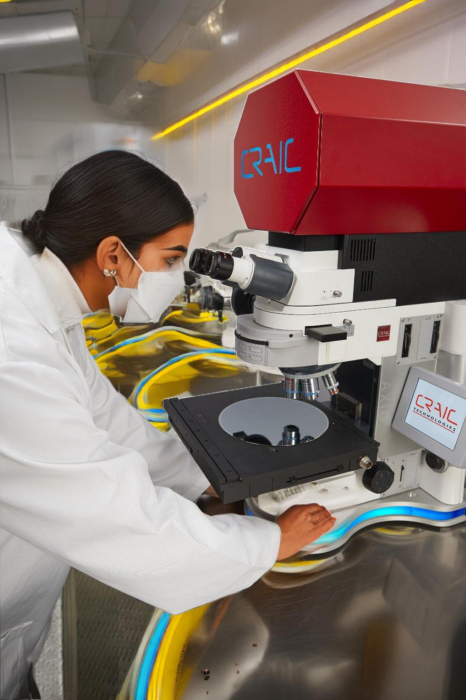
Image Credit: CRAIC Technologies
Role of the 2030PV PRO™ Microspectrophotometer
CRAIC Technologies supplied its 2030PV PRO™ microspectrophotometer for the optical characterization of the nanocluster-based metamaterials. Rather than running bulk or ensemble-averaged spectroscopy, the 2030PV PRO™ enables direct, localized transmission and extinction measurements on individual micropillars and nanolattices.
Direct comparison between left- and right-handed enantiomers was achieved using the 2030PV PRO’s™ linearly polarized illumination and microscale apertures to measure wavelength-dependent transmission spectra from specific regions of the chiral gyroid lattices.
The system's key features (high spatial resolution and UV–visible spectral range) were fundamental when it came to ensuring a resolution of the plasmonic features near 420 nm related to the silver nanoparticles, while simultaneously isolating the optical response of single printed architectures.
Throughout this study, the microspectrophotometer gave the researchers a direct link between nanoscale structure, plasmonic nanoparticle formation, and chiral optical response, showing why microscale optical spectroscopy is an exceptional tool when it comes to characterizing multifunctional nanoarchitected metamaterials.
References and Further Reading
- Cheung, S., et al. (2026). Mechanical and Optical Properties of Nanocluster-Silica Metamaterials. Advanced Materials. DOI: 10.1002/adma.202521526. https://advanced.onlinelibrary.wiley.com/doi/10.1002/adma.202521526.

This information has been sourced, reviewed and adapted from materials provided by CRAIC Technologies.
For more information on this source, please visit CRAIC Technologies.