Additive manufacturing (AM) is a quickly developing field that has seen much interest from those in a wide range of sectors. It is able to produce small batches of custom parts and fabricate components from 3D CAD models directly, thus making it a cost-effective alternative to legacy manufacturing techniques.
In addition, the layer-by-layer approach that is employed in AM creates less waste than traditional subtractive methods. For example, in metal powder-based processes, as much as 95–98 % of unused powder can be recycled.1
Powder bed fusion (PBF) is an often-employed AM technique that involves the sequential spreading of thin powder layers over a build plate. A heat source is subsequently applied to selectively melt or sinter specific areas of the powder bed.
To form a uniform powder layer, good flowability is crucial. Poor flowability can cause discontinuities in the final product and affect layer porosity, reducing part quality and mechanical strength.2
The Hall and Carney flow rate methods are often used to assess flowability. These techniques measure the time taken for a set amount of powder to pass through a calibrated orifice.
Though these funnel-based methods are user-friendly, cost-effective, and easy to use, they are highly operator-dependent. Powder aeration can also influence flow behavior significantly, meaning these techniques are best suited for simple comparative testing.3
Modern rheometers can be employed to evaluate powder flow in a more reproducible and controlled way. This article highlights how powder rheology techniques can be used to evaluate the flowability of the metal powders that are typically used in PBF and compares such results with those acquired from the Hall and Carney methods.
Materials and Methods
This study investigates the flow behaviors of a copper alloy powder (GRCop–42), an aluminum alloy powder (AlSi10Mg), a titanium powder (Ti64), and two stainless steel powder batches (316 L-A and recycled 316 L-B).
Key parameters for each sample, such as particle size distribution (D10, D50, and D90) and bulk density, are summarized in Table 1. The values D10, D50, and D90 refer to the particle diameters below which 10 %, 50 %, and 90 % of the total sample volume is found.
Table 1. Particle size distribution and respective bulk densities of powder samples. Source: Thermo Fisher Scientific – Materials & Structural Analysis
| Sample |
D10 in μm |
D50 in μm |
D90 in μm |
Bulk density in g/ml |
| Ti64 |
25.1 |
40 |
56.2 |
2.6 |
| GRCop–42 |
17.0 |
27.2 |
40.2 |
4.2 |
| AlSi10Mg |
38.3 |
48.8 |
62.6 |
1.4 |
| 316L-A / 316L-B |
18.8 |
28.8 |
40.9 |
4.2 |
Particle sizes and bulk densities were ascertained in line with the DIN EN ISO 3923-1 and ISO 13322-2 standards, respectively.
A Thermo Scientific™ HAAKE™ MARS™ iQ Rheometer, fitted with the powder rheology measuring geometry, was employed to characterize powder flowability (Figure 1).
A powder flow test was orchestrated by measuring the powder’s resistance against the helical motion path of a vane rotor. This path is defined by a helix angle (α) and the tip speed (v_tip) of the rotor. The rheometer controls both the rotational speed of the rotor and the axial movement of the measuring head (Figure 2).
When used in combination, the helical path and the rotor’s twisted shape facilitate two different movement patterns.
A common step in the sample conditioning process involves a clockwise-rotating downward movement, which removes trapped air and stress from the powder. This results in a low-stress, homogeneous packing state.
The second movement (a typical test mode) is an anticlockwise downward motion, which is designed to apply high stress and compress the sample.
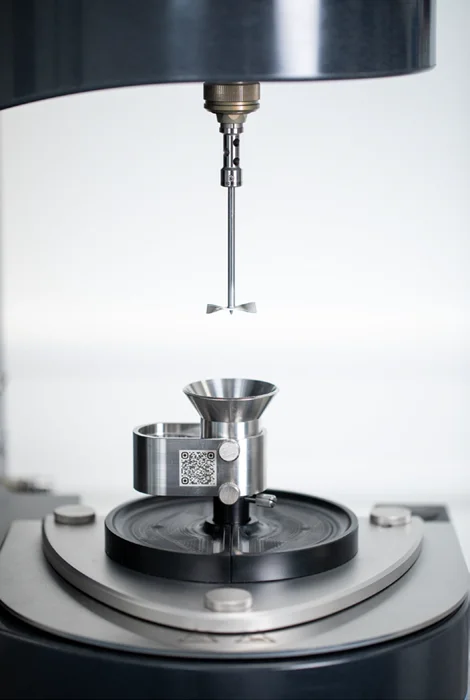
Figure 1. HAAKE MARS iQ Rheometer series with powder rheology accessory for powder flow measurements. Image Credit: Thermo Fisher Scientific – Materials & Structural Analysis
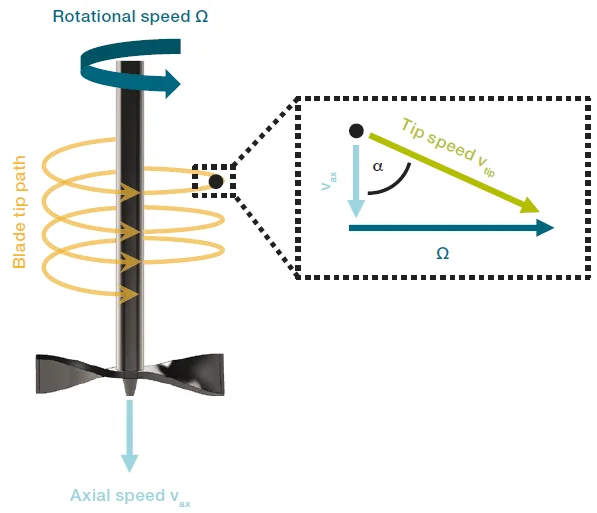
Figure 2. Movement principal a powder flow test. Image Credit: Thermo Fisher Scientific – Materials & Structural Analysis
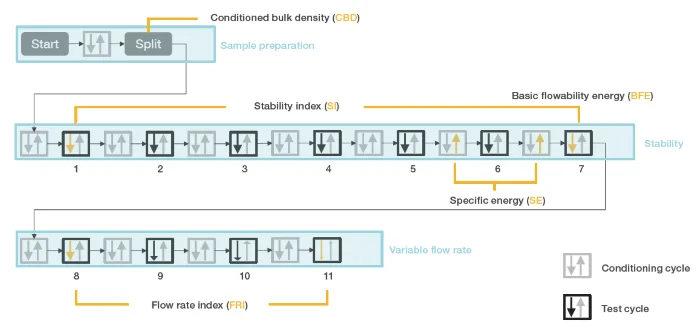
Figure 3. Schematic of the complete powder flow measurement procedure. Image Credit: Thermo Fisher Scientific – Materials & Structural Analysis
The full powder flow measurement process involves a series of helical upward and downward movements across several cycles of conditioning and testing. Figure 3 schematically outlines the full three-part protocol.
Firstly, the sample is loaded into the measurement geometry up to the funnel (Figure 4A). A first conditioning cycle is performed at 40 mm/second to remove entrapped air and loading-related stress (Figure 4B).
This step ensures that the test is independent of the operator and that any trapped air is removed, which prevents the sample’s possible aeration.
After this, the funnel is slid sideways to perform a sample split, which removes excess powder to acquire a set volume of 21.3 ml in the powder flow cup (Figure 4C). The cup is weighed (Figure 4D), and the powder mass is input into the Thermo Scientific™ HAAKE™ RheoWin™ software to work out the conditioned bulk density (CBD).
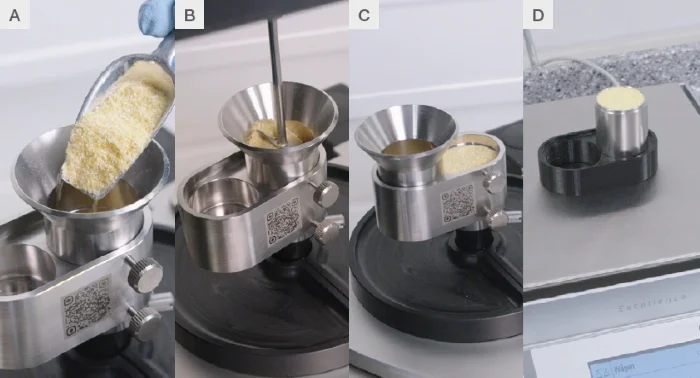
Figure 4. Images at various stages of the sample loading and conditioning procedure for powder flow tests. Image Credit: Thermo Fisher Scientific – Materials & Structural Analysis
The second phase is the stability measurement, which begins after the reinstallation of the conditioned and weighed powder. This involves seven conditioning and test cycles: the conditioning cycles are run at 40 mm/second, and the test cycles at 100 mm/second.
The HAAKE™ RheoWin™ software is used to calculate the flow energy (Eflow) for the downward movement. This evaluation is based on the helix angle (α) that is employed during the movement, and the resistance of the powder against excitation in the form of recorded normal force FN and torque M (Equation 1).
The radius of the rotor, in addition to its start and end positions and path, is used in the flow energy calculation to account for the measuring geometry and the distance that is traveled during the test.
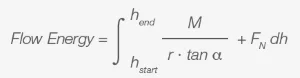
Equation 1
The second part of the powder flow measurement procedure also assesses powder stability during repeated testing that employs the stability index (SI) (Equation 2).
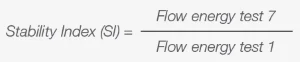
Equation 2
A sample with an SI value of around one is generally considered stable, and the flow energy measured during the seventh cycle can be used to determine the basic flowability energy (BFE).
The specific energy (SE) is calculated using data from the sixth and seventh conditioning steps of the stability test, taking into account the split mass of the sample (Equation 3).
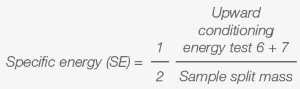
Equation 3
SE measures the energy that is needed to gently shear and lift conditioned powder as the rotor moves upward in the powder sample. It is used to evaluate powder flow behavior in a low-stress state, especially particle interlocking caused by variations in particle texture, shape, and cohesion.
The final part of the powder flow measurement consists of four alternating conditioning and test cycles. The conditioning tip speed is set to 40 mm/second for each cycle, while the test tip speed decreases with each cycle, starting at 100 mm/second and sequentially decreasing to 70 mm/second, 50 mm/second, and 25 mm/second.
This section of the procedure is used to analyze the powder’s sensitivity to changes in flow rate using the flow rate index (FRI) (Equation 4).
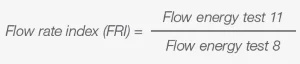
Equation 4
The helix angle for each cycle was set to five degrees. Figure 5 shows the respective HAAKE™ RheoWin™ measurement procedure.
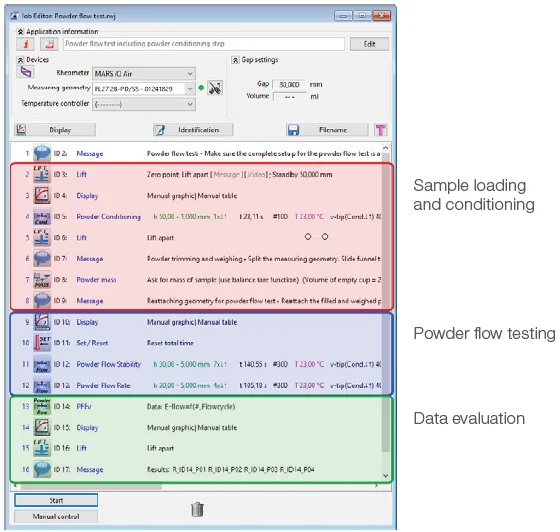
Figure 5. Powder flow measurement procedure in HAAKE RheoWin Software. Image Credit: Thermo Fisher Scientific – Materials & Structural Analysis
Flowability data was also acquired by employing Hall and Carney flow methods to evaluate the results from the powder flow measurement procedure against industry standards.
Results and Discussion
Bulk Density
Bulk density (BD) is the ratio of powder weight to its occupying volume, including interparticle voids. It is an important benchmark for evaluating the final part’s properties. For example, using powders with low bulk densities in PBF can produce final parts with higher levels of surface roughness.2
A key advantage of the powder flow measuring procedure is its ability to offer a series of useful specifications for powder flow assessment while also revealing extra information about CBD.
Because the procedure uses conditioning steps and a powder flow cup with a defined volume, it helps to eliminate operator dependencies during the sample filling process or the manual reading of volume values from beakers’ scales.
Figure 6 compares BD from Table 1 with CBD.
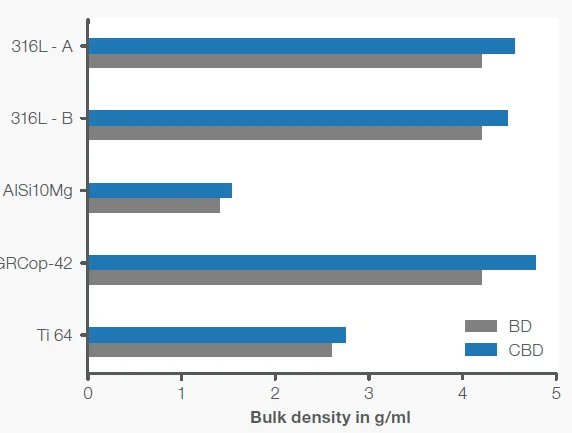
Figure 6. Comparison between bulk density (BD) and conditioned bulk density (CBD). Image Credit: Thermo Fisher Scientific – Materials & Structural Analysis
As per ISO 3923-1, BD is defined as the mass of powder flowing through a funnel into a cup with a known volume. Contrastingly, CBD is measured from a conditioned state, in which the powder is loosened gently by the vane rotor, achieving a homogeneously packed state with more tightly packed particles.
This important distinction means that CBD is always higher than BD: deviations range from 5 % (Ti64) to 12 % (GRCop-42). These two materials follow the same trend, however, which suggests that CBD is an appropriate tool to measure the comparative bulk density of powders in the scope of the presented study.
One key benefit of determining bulk density after conditioning, as opposed to the funnel method, is that the test is operator independent. If air is trapped in the powder as it flows from the funnel into the cup, this can cause a seeming increase in the seen bulk density.
Powder Flowability
For the majority of powder flow-related evaluation parameters, only the downward movement of the vane rotor during the test cycle is relevant. Figure 7 shows the flow energies calculated from the torque against the normal force recorded during the helical movement.

Figure 7. Calculated flow energies as a function of flow test cycle for each powder sample. Image Credit: Thermo Fisher Scientific – Materials & Structural Analysis
In the presented example, AlSi10Mg demonstrates the lowest overall flow energy, suggesting that it should be highly flowable. This is unusual because aluminum powders usually have poor flowability on account of their tendency to agglomerate. However, the powder studied in this instance was optimized by the manufacturer for additive manufacturing, which improved its flowability.
GRCop-42 exhibited the highest flow energies of all of the samples in this study, suggesting it is probably the least flowable.
Table 2 shows all parameters derived from the performed powder flow measurements.
Table 2. Evaluation parameters derived from the powder flow measurement, as well as Hall and Carney flow. Source: Thermo Fisher Scientific – Materials & Structural Analysis
| Sample |
BFE
in mJ |
SI |
SE
in mJ/g |
FRI |
Hall flowability
in s/50 g |
Carney flowability
in s/50 g |
| Ti64 |
71.8 |
0.94 |
0.9 |
1.29 |
45.4 |
- |
| GRCop–42 |
178 |
0.96 |
1.26 |
1.45 |
19 |
4 |
| AlSi10Mg |
40.2 |
0.98 |
0.98 |
1.43 |
44 |
10 |
| 316L-A |
152 |
0.97 |
1.25 |
1.43 |
- |
- |
| 316L-B |
149 |
0.98 |
1.22 |
1.41 |
The powder samples all behaved stably during the stability test. The SI value for all powders is near to one, suggesting no detectable electrostatic charging or powder friability.
BFE appears to correlate well with the flowability results obtained with both Hall and Carney flows, suggesting that high BFE is associated with low Hall and Carney flowability. The Ti64 sample, however, was not measured using the Carney funnel.
It should also be noted that neither of the 316 L batches could be characterized using any of the funnel methods because the powder did not flow through the orifice. Even so, the powder flow measurement procedure delivered meaningful results for powders that were not completely free flowing.
Most of the powders displayed an FRI of roughly 1.4, with only Ti64 demonstrating a lower dependency on tip speed changes. This could be because of reduced particle interlocking, which results in less flow resistance at different rates. The flow behavior of Ti64 changes less when exposed to varying flow rates in comparison to the other samples.
It is also crucial to recognize that all of the discussed powder flow-related parameters were acquired under confined flow conditions. The powder has little space inside the powder flow cup to avoid the vane rotor’s compressing motion. This causes the sample to be pushed downward in front of the blade, which results in a relatively high-stress state.
SE, however, is calculated from the upward movement of the vane rotor. The rotor gently lifts the powder particles, creating a low-stress and unconfined flow condition. The primary parameter impacting SE is the degree of particle interlocking in low-stress flow.
Ti64 also had the lowest SE, corroborating that this powder displayed reduced particle interlocking, possibly as a result of smoother particle shapes.
AlSi10Mg also showed a considerably lower SE when compared to 316 L or GRCop-42. This is like Ti64 and correlates with BFE, since both samples exhibit the lowest flow energy and the best Hall flowability.
These findings correspond to pre-existing literature, in which BFE and SE were correlated with Ti64 powders' irregular particle interlocking and shape.4
Powder flow properties can be related to layer surface, layer porosity, or layer packing density in parts manufactured using AM, as well as to other powder-related parameters like the size distribution of particle surface properties and particle shape.2
Conclusion
This article has evaluated the flow characteristics of multiple metal powders. Powder flow measurement results were compared against bulk density, and Hall and Carney flow measurements, demonstrating congruity in each case. It was also observed that powder flow testing enabled evaluation of samples that could not be measured using Hall or Carney flow methods.
As well as assessing powder flowability in a manner comparable to commonly used testing methods, this method can also evaluate the influence of particle interlocking arising from particle morphology and shape.
These results show that the utilization of appropriate rheometric instrumentation enables the evaluation, control, and optimization of powder performance in additive manufacturing processes.
References and Further Reading
- Ford, S. and Despeisse, M. (2016). Additive manufacturing and sustainability: an exploratory study of the advantages and challenges. Journal of Cleaner Production, (online) 137(1), pp.1573–1587. DOI: 10.1016/j.jclepro.2016.04.150. https://www.sciencedirect.com/science/article/pii/S0959652616304395.
- Talebi, F.A., et al. (2024). Spreadability of powders for additive manufacturing: A critical review of metrics and characterisation methods. Particuology, 93, pp.211–234. DOI: 10.1016/j.partic.2024.06.013. https://linkinghub.elsevier.com/retrieve/pii/S1674200124001238.
- Schulze, D., et al. (2007b) Powders and bulk solids, Springer eBooks. DOI: 10.1007/978-3-540-73768-1. https://link.springer.com/book/10.1007/978-3-540-73768-1.
- Mehrabi, M., et al. (2023). An investigation of the effect of powder flowability on the powder spreading in additive manufacturing. Powder Technology, (online) 413, p.117997. DOI: 10.1016/j.powtec.2022.117997. https://linkinghub.elsevier.com/retrieve/pii/S0032591022008786.
Acknowledgments
Produced from materials originally authored by Philipp Beutler from Thermo Fisher Scientific.

This information has been sourced, reviewed and adapted from materials provided by Thermo Fisher Scientific – Materials & Structural Analysis.
For more information on this source, please visit Thermo Fisher Scientific – Materials & Structural Analysis.