A carefully optimized nanographite concentration strengthened printed resin without compromising processability, while higher loadings triggered agglomeration and sharply reduced performance.
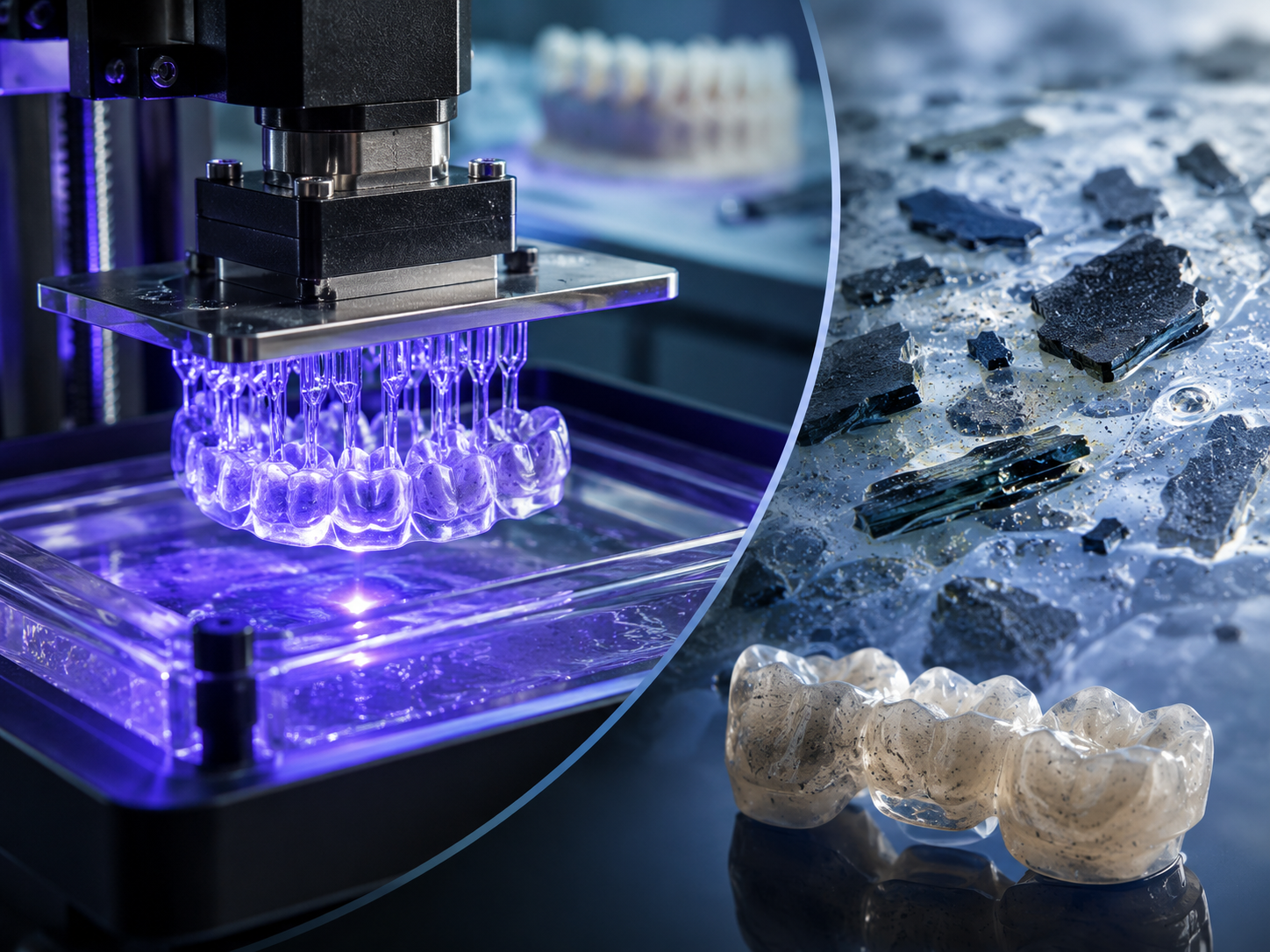
Paper: SLA-printed nanographite-reinforced UV-curable resin composites for dental applications. Image credit: AI-generated image created using ChatGPT/OpenAI
An 'article-in-press' study accepted by the journal Scientific Reports shows that adding an optimized concentration of nanographite (NG) can improve the measured mechanical performance of a model stereolithography (SLA)-printed UV-curable resin being investigated for potential dental applications. The researchers investigated how different NG concentrations affect printability, curing behavior, mechanical strength, and microstructure. The findings highlight the importance of optimizing nanofiller concentration to develop stronger SLA-printable resin formulations for further dental-material research.
Optimizing Nanocomposites for Advanced Dental Applications
Resin-based composites are widely used in restorative dentistry because they closely resemble natural teeth and can be fabricated into complex dental structures. The adoption of stereolithography (SLA) has further expanded their use by enabling the high-precision printing of surgical guides, temporary crowns, aligners, and dental models. Despite these advantages, conventional SLA resins have limited mechanical strength and fracture resistance. They are also vulnerable to long-term degradation due to repeated mechanical loading and moisture exposure in the oral environment.
Researchers have investigated several nanomaterials, including graphene, silica nanoparticles, and ceramic fillers, to strengthen these resins. NG has attracted attention because it shares several key properties with graphene while being more readily available and easier to process. However, its application in SLA-printable dental resins remains largely unexplored. Increasing NG content can also reduce curing efficiency, promote particle agglomeration, and compromise print quality, making it important to identify an optimal filler concentration.
The researchers evaluated UV-curable resins containing 0.5, 1, 3, and 5 wt.% nanographite. They examined how each formulation affected printability, curing behavior, mechanical performance, and microstructure. Their findings provide preliminary formulation guidance for developing reinforced nanocomposite resins for additive-manufacturing research in dentistry.
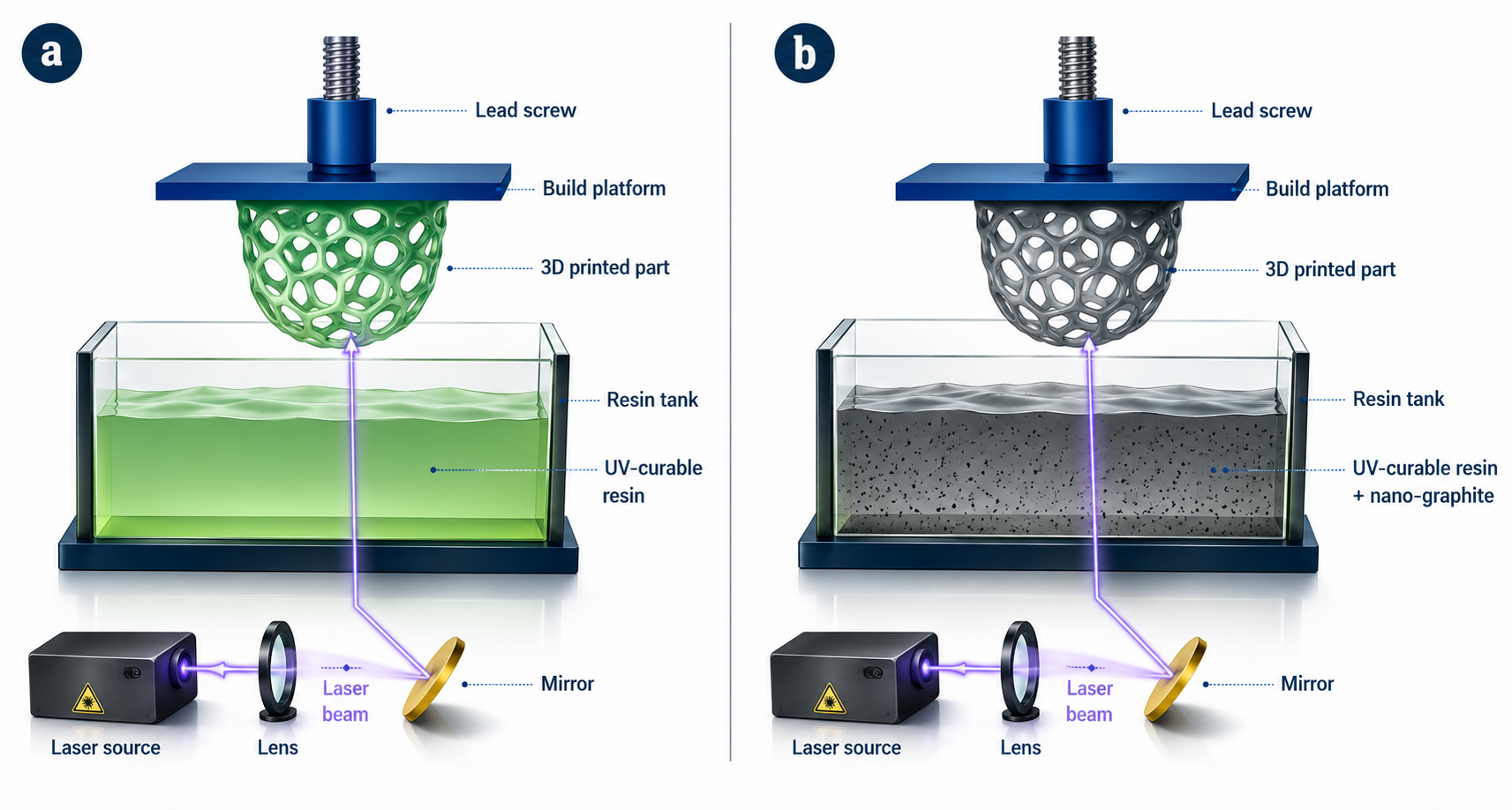
(a) SLA printing with resin (b) SLA printing with resin and NG
Evaluating the Effects of Nanographite Reinforcement
The researchers prepared five resin formulations using a commercially available UV-curable SLA resin with 0, 0.5, 1, 3, and 5 wt.% nanographite. They dispersed the nanographite using centrifugal mixing and ultrasonication before printing the specimens with an SLA printer. After printing, the samples underwent isopropyl-alcohol cleaning and ultraviolet post-curing to promote further polymerization.
The team evaluated properties relevant to printability and potential environmental stability. They measured resin viscosity and ultraviolet (UV) absorption to assess printing and curing behavior. They also analyzed moisture content, water absorption, and gel content to evaluate environmental stability and crosslinking efficiency. Mechanical performance was assessed through tensile, three-point bending, and Shore D hardness tests. Optical microscopy and scanning electron microscopy (SEM) provided detailed insights into filler dispersion and fracture morphology. Together, these analyses helped relate NG loading and microstructure to the measured material properties.
Optimizing Nanographite Reinforcement
The study showed that NG loading strongly influences the performance of SLA-printed resin composites. All formulations were printable under the tested settings, and their viscosities remained within a suitable range, but the 1 wt.% NG formulation produced the best overall balance of measured properties. This formulation achieved the highest tensile strength (20 MPa), flexural strength (50 MPa), and Shore D hardness (72), outperforming the unmodified resin in the reported laboratory measurements.
The researchers attributed these improvements to the relatively uniform dispersion of NG observed within the polymer matrix. The authors interpreted this dispersion as supporting more effective mechanical load transfer and reducing susceptibility to crack development. Optical microscopy and SEM showed a compact, homogeneous microstructure with minimal defects. This optimized structure was accompanied by high gel content and an altered UV absorbance profile, while supporting higher measured strength and hardness.
Increasing the NG content beyond 1 wt.% produced the opposite effect. At 3 wt.% and 5 wt%, microscopy and fracture-surface SEM showed particle agglomeration, localized microvoids, particle pull-outs, and other structural defects. The researchers interpreted these features as stress-concentration sites that could disrupt load transfer and promote earlier cracking and failure during mechanical loading; consequently, the 5 wt.% composite showed the lowest tensile, flexural, and hardness values, demonstrating that higher filler loading does not necessarily improve performance.
NG loading also influenced curing behavior and environmental stability. All formulations maintained suitable viscosity for SLA printing. Low NG concentrations altered the UV absorbance profile, while all formulations retained gel contents above 99%. Gel content declined modestly as NG loading increased. The authors interpreted this trend as consistent with slightly reduced curing efficiency associated with greater light scattering, UV shielding, and particle agglomeration. The 1 wt.% NG composite also exhibited lower moisture and water absorption than higher-loading formulations in the short-term laboratory tests. Overall, the results show that achieving uniform NG dispersion is just as important as selecting the appropriate filler concentration.
Implications and Study Limitations
This study shows that optimizing the NG concentration can improve the measured performance of SLA-printed model resin composites intended for dental-material research. The researchers found that 1 wt.% NG provided the best balance of measured strength, printable viscosity, high gel content, and microstructural quality among the tested formulations. Their results also indicate that microstructural quality plays a key role in determining the overall performance of polymer nanocomposites.
The researchers acknowledge that additional studies are needed before clinical translation. The paper reports descriptive comparisons without inferential statistical testing, so the statistical uncertainty and external reproducibility of the measured differences remain to be established. Future work should evaluate wear resistance, fracture toughness, fatigue behavior, thermal aging, color stability, biocompatibility, and long-term durability under simulated oral conditions. They also mentioned that the resin used in this study is a model SLA photopolymer rather than a clinically approved dental restorative material.
Overall, the study provides preliminary guidance for developing reinforced nanocomposite resin formulations for further investigation. By identifying the best-performing NG concentration within the tested formulations and linking microstructure to material performance, the researchers establish a foundation for future material design. Their findings could support the development of provisional dental restorations, temporary prosthetic components, dental models, and other non-load-bearing dental applications, subject to further laboratory and clinical validation.
Disclaimer: The views expressed here are those of the author expressed in their private capacity and do not necessarily represent the views of AZoM.com Limited T/A AZoNetwork the owner and operator of this website. This disclaimer forms part of the Terms and conditions of use of this website.
Source:
- Mullappally, A., Vijay Kumar, V., & Arpitha, G. R. (2026). SLA-printed nanographite-reinforced UV-curable resin composites for dental applications. Scientific Reports (article in press). DOI: 10.1038/s41598-026-62252-5, https://www.nature.com/articles/s41598-026-62252-5