From MicrotracReviewed by Emily MageeFeb 23 2026
In this interview, AZoMaterials speaks with Yoann Lefeuvre, Director of Product Management at Microtrac, about stability testing in the detergent and cosmetic industries. He discusses the science behind dispersions, the limits of visual testing, and how TURBISCAN technology enables faster, more objective stability evaluation.
Can you please introduce yourself and your role at Microtrac?
My name is Yoann Lefeuvre, and I am part of the Microtrac team, where I work closely with customers involved in formulation, such as in the detergent and cosmetic industries.
My role is focused on helping formulators better understand dispersion stability and how to characterize it using analytical tools like the TURBISCAN. I regularly work with R&D, product development, and quality control teams to support faster and more reliable stability testing.
Image Credit: Shutterstock.com/Aleksandar Malivuk
How would you define stability in the context of detergents and cosmetics?
Stability is the ability of a product to resist changes in its initial properties over time under defined storage and usage conditions. These changes can be visual, such as phase separation, but they can also be related to texture, performance, or sensory properties.
Importantly, stability must be defined by the manufacturer. There is no universal time frame. It could be days, weeks, or months, depending on the product and internal quality criteria.
Why are most detergent and cosmetic formulations inherently unstable?
Most of these products are dispersions rather than true solutions. That means you have particles, droplets, or air dispersed in a liquid rather than dissolved at a molecular level. These systems are thermodynamically unstable, so they will evolve over time.
The goal of formulation science is not to make them perfectly stable, which is impossible, but to slow down destabilization enough so the product remains acceptable throughout its intended shelf life.
What are the main destabilization mechanisms that formulators need to consider?
There are two main routes. The first is gravitational or physical instability, where particles migrate due to density differences, leading to sedimentation or creaming and eventually visible phase separation. The second is colloidal instability, where particles grow over time due to aggregation or coalescence. Even if this growth is not visible, it can significantly affect product performance, such as sunscreen efficiency, texture, or color in cosmetics.
How is stability typically tested today, and what are the limitations of these methods?
Most stability testing is still based on visual observation. Samples are stored and checked regularly over weeks or months to see if anything changes.
While this approach is simple, it has major drawbacks. It is very time-consuming, highly subjective, and not quantitative. You often end up with results like “good,” “bad,” or “maybe,” which makes it extremely difficult to scientifically optimize a formulation or compare multiple samples.
Why is there a need for faster and more quantitative stability testing?
Waiting one or two months to find out whether a formulation is stable has a significant impact on time to market. It slows down R&D and often leads to over-stabilized formulations because people add extra ingredients just to be safe. What formulators really need is an objective, quantitative method that can detect instability early and provide meaningful data they can use to improve their formulations quickly.
How does TURBISCAN technology address these challenges?
The TURBISCAN uses static multiple light scattering to analyze samples directly in their native state, without dilution or stress. A near-infrared light scans the sample from bottom to top, measuring both transmission and backscattering. These signals are extremely sensitive to small changes in particle size, concentration, or refractive index.
By repeating scans over time, we can detect destabilization processes long before they become visible.
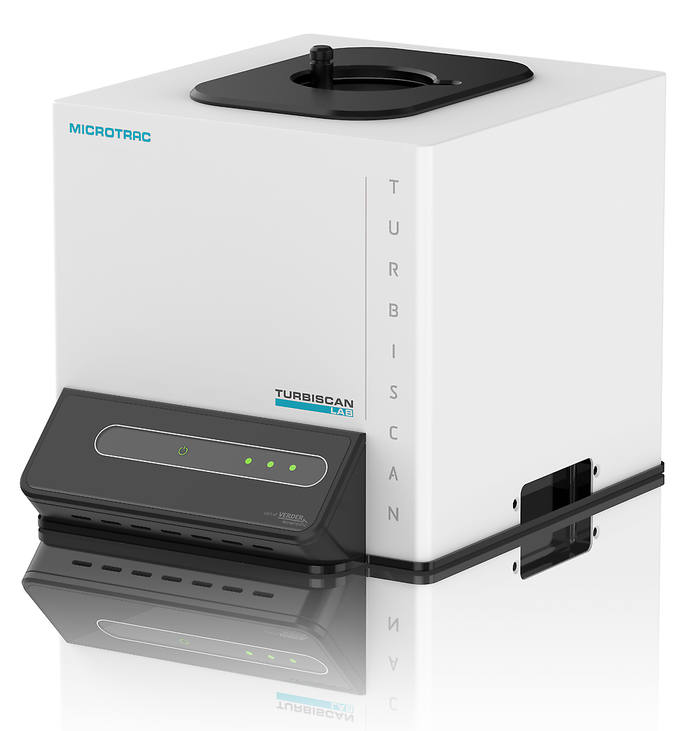
Image Credit: Microtrac
What makes TURBISCAN different from traditional particle size or accelerated tests?
Unlike particle size analyzers, TURBISCAN does not require dilution, which can completely change the behavior of a formulation. And unlike accelerated tests that apply strong forces like centrifugation, TURBISCAN measures samples at rest. This means the data is much closer to what actually happens during real storage. It allows formulators to detect migration, aggregation, or even chemical changes that affect optical properties.
Can you explain the role of the Turbiscan Stability Index (TSI)?
The TSI is a single numerical parameter that summarizes all the detected variations in a sample over time. It takes into account changes occurring throughout the entire height of the sample. The higher the TSI, the lower the stability.
What makes it powerful is that it is fast, objective, and very easy to use. With one click, you can rank multiple formulations and immediately identify the most stable ones.
How does TURBISCAN help formulators predict long-term stability?
A very effective approach is comparative testing. If you have a reference formulation that is known to pass a three-month visual test, you can measure it alongside new formulations for just a few days using TURBISCAN. By comparing their stability kinetics or TSI curves, you can predict which new formulations are likely to pass long-term tests. In many cases, you can get reliable answers in less than a week instead of waiting months.
Beyond stability, are there other applications of TURBISCAN in detergents?
One interesting application is detergency efficiency. Using TURBISCAN instruments with mixing capabilities, we can study how dirt is removed and whether it redeposits onto fabrics. This allows manufacturers to evaluate cleaning performance faster and in a more controlled way than traditional washing-machine-based tests.
What would you say is the biggest benefit of using TURBISCAN for stability testing?
The biggest benefit is replacing guesswork with facts. You get faster results, quantitative data, and objective measurements that closely correlate with what you would eventually see visually. This saves time, reduces costs, and allows formulators to make confident decisions much earlier in the development process.
About Yoann Lefeuvre
Yoann Lefeuvre is Director of Product Management at Microtrac, where he focuses on particle characterization and dispersion stability technologies. Based in Toulouse, France, he oversees the development and worldwide technical support of the Turbiscan product line, delivering advanced solutions for evaluating formulation stability across pharmaceuticals, cosmetics, food, and industrial applications.
He studied at Université Lille I - ENSCL and has developed extensive expertise at the intersection of colloid and particle science, analytical instrumentation, and real-world industrial R&D. His work bridges fundamental scientific principles with practical formulation challenges, helping organizations better understand, predict, and optimize dispersion stability.

This information has been sourced, reviewed and adapted from materials provided by Microtrac.
For more information on this source, please visit Microtrac.
Disclaimer: The views expressed here are those of the interviewee and do not necessarily represent the views of AZoM.com Limited (T/A) AZoNetwork, the owner and operator of this website. This disclaimer forms part of the Terms and Conditions of use of this website.