A reusable polymer-coated sponge uses ultrasound-triggered electrocatalysis to generate reactive oxygen species, kill bacteria, and degrade stubborn water contaminants, pointing toward cleaner and more sustainable treatment systems.
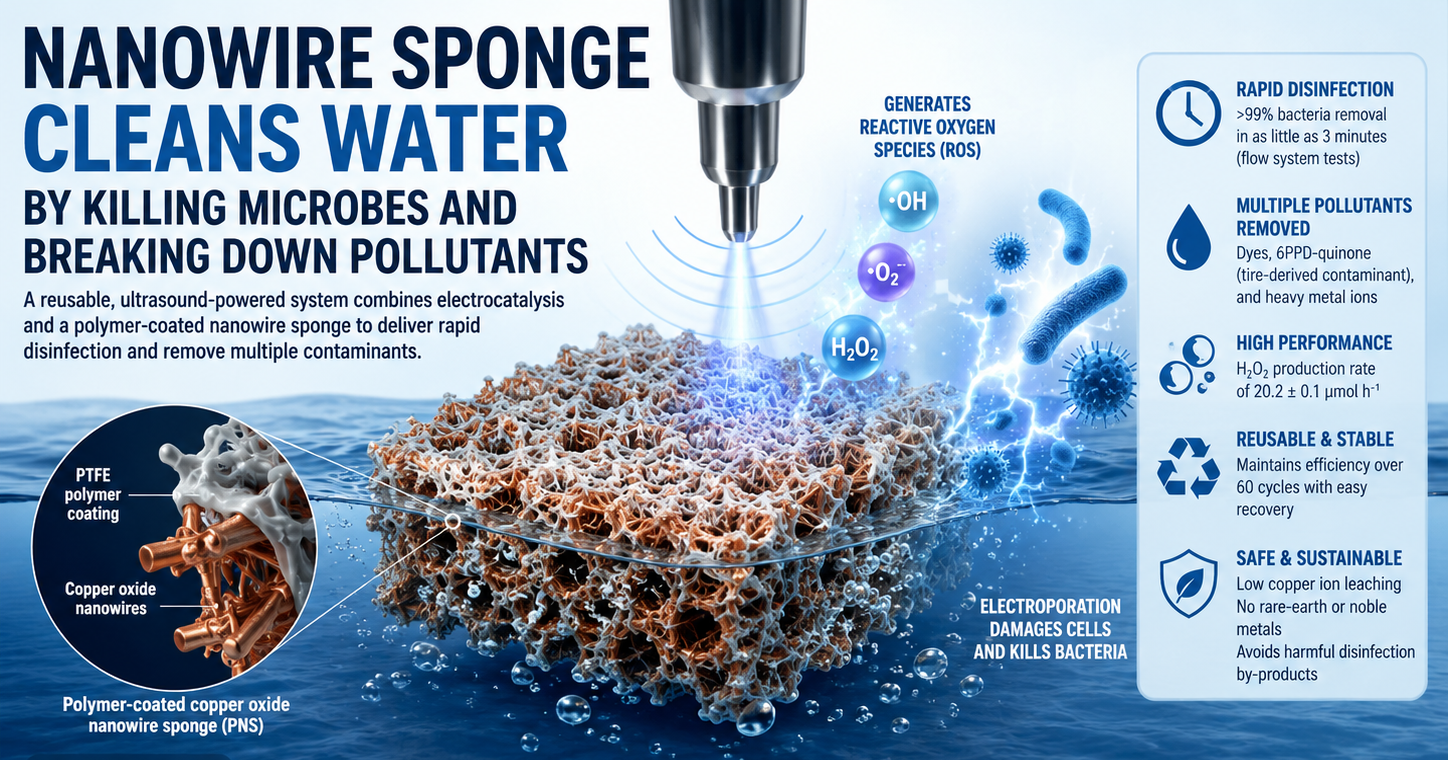
AI-generated illustration based on Lin et al. (2026), Nature Communications, DOI: 10.1038/s41467-026-73425-1. This image does not reproduce or adapt any original figure from the article. Study: A polymer-coated nanowire sponge–based contact electrocatalytic system for simultaneous disinfection and removal of multiple micropollutants
A paper recently published in the journal Nature Communications proposed a contact electro-catalysis (CEC) system based on a polymer-coated nanowire sponge (PNS) to simultaneously disinfect microorganisms and degrade several micropollutants.
Limitations of Existing Approaches
The demand for clean water has increased significantly owing to rapid socioeconomic development and population growth. However, urban, agricultural, and industrial pollution are exacerbating the clean water crisis by introducing various micropollutants and biological pathogens, leading to persistent, highly complex contamination in wastewater that is insufficiently treated or untreated.
While various water decontamination approaches, such as biochemical processes, exist, they rely on costly catalysts, target only specific contaminants, and require complex fabrication strategies. Thus, an energy-efficient, residue-free, and simple water treatment approach is required for effective removal of several micropollutants and microbial disinfection.
The Importance of CEC
CEC, a redox technology, integrates mechanochemistry, catalysis, and contact electrification. CEC is advantageous over traditional catalytic methods due to its strong reusability, lower costs, and the use of catalysts free of noble and rare-earth metals.
Through solid-liquid contact electrification, CEC triggers or accelerates redox reactions, which can be further improved by rapid contact-separation cycles induced by ultrasound. Thus, CEC can effectively degrade organic pollutants in aqueous solutions, generate hydrogen peroxide (H2O2), and recycle spent lithium-ion batteries.
In the CEC system, the catalyst design has a key role in improving the rate of reactive oxygen species (ROS) generation. Fluorinated materials, such as polytetrafluoroethylene (PTFE), can be suitable for CEC because their low ionization energy and high surface fluorine content improve charge transfer at the interface during contact-separation cycles.
Yet, fluorinated materials have inherent hydrophobicity, which restricts their aqueous dispersion. Thus, designing catalyst materials that offer easier recovery, improved oxygen accessibility, and improved water dispersibility simultaneously to boost CEC efficiency is essential.
The Proposed Approach
In this work, researchers used a synthesized PNS to develop an ultrasound-assisted CEC for the removal of several micropollutants and efficient disinfection within a short period.
A 3 mm thick copper (Cu) sponge with a density of 1800 g/m² and a pore size of 90 pores per inch (PPI), 37 wt% hydrochloric acid (HCl) solution, potassium dichromate, methyl blue, crystal violet, N-(1,3-dimethylbutyl)-N’-phenyl-p-phenylenediamine-quinone (6PPD-quinone), 5,5-dimethyl-1-pyrroline N-oxide (DMPO), p-benzoquinone, tert-butanol, agar and Luria Bertani (LB) broth, and 60 wt% PTFE solution were used as starting materials.
Initially, copper oxide nanowires were grown on a Cu sponge, which was followed by the preparation of PNS. Then, researchers performed characterization using various methods, including field-emission scanning electron microscopy (FE-SEM) equipped with energy-dispersive spectroscopy (EDS), a laser diffraction particle size analyzer, Fourier-transform infrared spectroscopy (FTIR), and X-ray photoelectron spectroscopy (XPS).
Subsequently, bacterial solutions were prepared, and an antibacterial experiment was performed. Researchers also performed dye degradation experiments, 6PPD-quinone degradation experiments, heavy metal reduction experiments, scavenger tests, ROS analysis, and hydroxyl radical detection using the terephthalic acid (benzene-1,4-dicarboxylic acid) assay.
They also performed detection of superoxide radicals using the 2,3-bis(2-methoxy-4-nitro-5-sulfophenyl)-2H-tetrazolium-5-carboxanilide (XTT) assay, measured total organic carbon (TOC) concentrations using a TOC analyzer, determined fluoride ion concentration using the ion chromatograph (IC) method, and conducted COMSOL simulations.
Effectiveness of the Approach
PNS under ultrasonic stimulation facilitated interfacial electron transfer and generated a high ROS generation rate. Static charge electroporation and ROS generation achieved over 99% disinfection in as little as 3 minutes in the study’s summary and flow-system tests, degraded 6PPD-quinone, a tire-derived contaminant, and dyes, and reduced heavy metal ions in wastewater under ambient conditions. It delivered a H2O2 production rate of 20.2 ± 0.1 μmol h-¹.
The improved performance was attributed to the PNS design, in which PTFE was deposited on copper oxide nanowire sponges. This architecture addressed dispersion challenges in catalytic electrochemical systems by leveraging the high surface area of Cu sponges to ensure uniform catalyst distribution and facilitate easier recovery in water.
PNS exhibited stable water immersion and easy recoverability, maintaining high catalytic efficiency and reusability despite partial pore blocking from the PTFE coating. Its performance was retained across multiple operational cycles and tested with real water samples, effectively removing microbial contaminants and demonstrating practical, sustainable water-purification potential.
While polymer-metal composites have been shown to improve CEC performance, direct metal exposure during ultrasonication led to excessive Cu ion leaching and secondary contamination. The present approach mitigated this issue by reducing Cu ion release through polymer coating.
Additionally, the Cu nanowire sponge promoted air encapsulation within the structure, improving oxygen availability and consequently increasing ROS generation. Most importantly, the PNS-CEC system operated without rare-earth or noble metals and was designed to avoid harmful disinfection by-products associated with conventional chemical disinfectants.
In conclusion, this study's findings demonstrated the robust potential of the proposed PNS-based CEC system for point-of-use and large-scale wastewater treatment applications. However, practical scale-up will require optimization of ultrasonication energy distribution and transducer arrangement.
Download your PDF copy by clicking here.
Disclaimer: The views expressed here are those of the author expressed in their private capacity and do not necessarily represent the views of AZoM.com Limited T/A AZoNetwork the owner and operator of this website. This disclaimer forms part of the Terms and conditions of use of this website.
Source:
- Lin, G. S. et al. (2026). A polymer-coated nanowire sponge-based contact electrocatalytic system for simultaneous disinfection and removal of multiple micropollutants. Nature Communications. DOI: 10.1038/s41467-026-73425-1, https://www.nature.com/articles/s41467-026-73425-1