By engineering a layered precursor before exfoliation, researchers transformed non-layered crystalline boron into dispersible 2D nanosheets that can be spray-coated into high-absorptance solar-thermal materials.
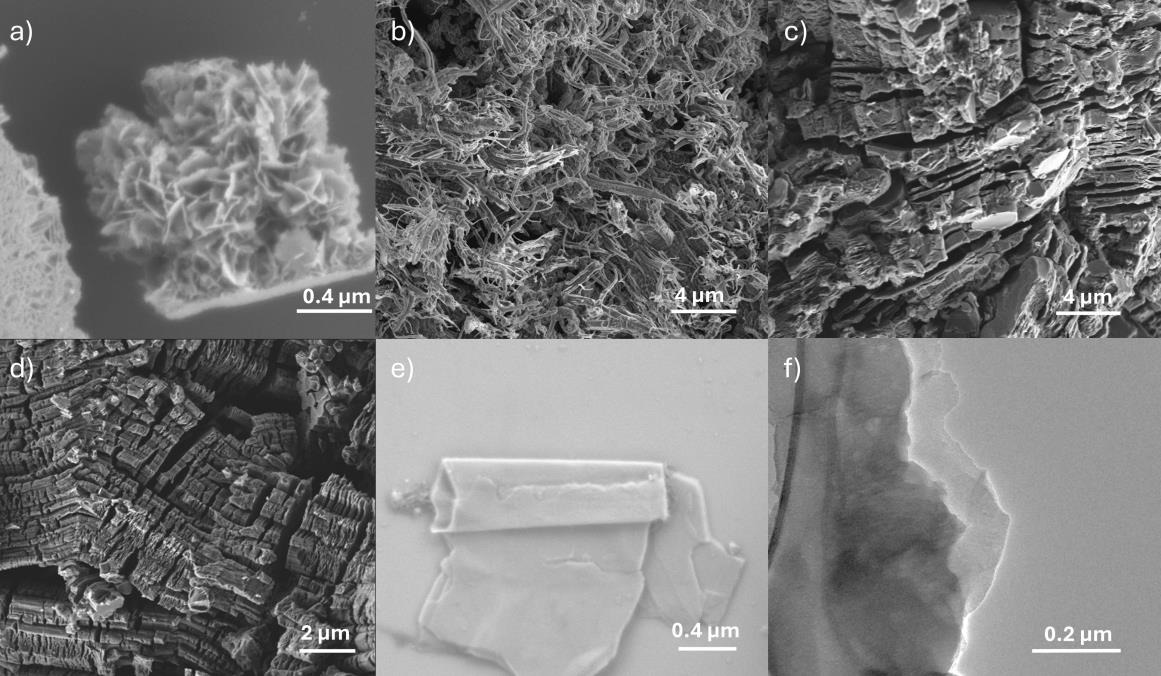
Morphological evolution from crystalline boron to layered boron nanosheets via the metallurgical top-down synthesis route. a) Scanning electron microscopy (SEM) image of crystalline boron precursor, b) SEM image of the Lix–B1-x alloy, c) SEM image of the non-exfoliated boron nanosheets after H2O treatment of Lix–B1-x alloy, d) SEM image of the non-exfoliated boron nanosheets after HCl acid treatment, e) SEM image of isolated exfoliated boron nanosheets deposited on a Si wafer and f) Transmission electron microscopy (TEM) image of the exfoliated boron nanosheets.
A recent study published in the journal npj 2D Materials and Applications presents a scalable route for producing amorphous, B/O-rich two-dimensional boron nanosheets from bulk crystalline boron. The researchers developed a metallurgical process that first forms a lithium–boron alloy and then removes lithium to create a layered boron precursor. The resulting material can also be processed into coatings, creating opportunities for various energy applications.
Overcoming the Scale-Up Challenge for Boron Nanosheets
Two-dimensional (2D) boron materials have attracted interest because of their distinctive electronic, thermal, and chemical properties. Borophene has potential in areas such as sensing, electrocatalysis, energy storage, and solar-energy technologies. However, producing these materials in useful quantities remains difficult.
Most established borophene synthesis methods use bottom-up growth on metal substrates. These processes can produce well-defined two-dimensional structures, but they require controlled environments, specialized equipment, and carefully prepared substrates. Strong interaction with the substrate can also limit material recovery and processing. These restrictions make large-area production and solution-based applications difficult.
Bulk boron does not naturally contain the weakly bonded layered structure found in materials such as graphite. Direct exfoliation therefore cannot easily separate bulk boron into thin sheets. Earlier liquid-phase exfoliation studies demonstrated that boron nanosheets could be produced, but they did not create a deliberately layered precursor before exfoliation.
The study addresses this gap by introducing a metallurgical route that creates such a precursor. The researchers use lithium to modify the structure of crystalline boron. They then remove the lithium through controlled chemical treatment. This process produces a layered boron-rich structure that can undergo mechanical exfoliation.
Creating Layered Boron Through Metallurgical Processing
The researchers started with crystalline boron and metallic lithium and performed the alloying process inside an argon-filled glovebox to prevent exposure to oxygen and moisture. They first melted the lithium, then added crystalline boron at a Li:B molar ratio of 55:45. The mixture was heated to 500–550°C, then to 800°C, and finally cooled. The process altered the material's structure, producing a porous lithium–boron alloy with filament-like features.
Lithium was then removed through a two-step chemical treatment. The alloy was first treated with deionized water for up to 24 hours, followed by filtration and drying. Because water treatment did not fully remove residual lithium, the material was then treated with 1 M hydrochloric acid for an additional 24 hours, followed by washing, filtering, and drying. Liquid-phase exfoliation (LPE) was then used to separate the layers. Approximately 0.5 g of the precursor was dispersed in water containing 1 wt% sodium dodecylbenzenesulfonate (SDBS). The mixture underwent ultrasonication for 15 minutes, followed by high-shear homogenization at 14,000 rpm for four hours at approximately 0°C. Centrifugation separated smaller nanosheets from larger particles and aggregates. The selected fraction was then freeze-dried to produce a dispersible black powder.
The nanosheets were characterized using Scanning Electron Microscopy (SEM), Transmission Electron Microscopy (TEM), Atomic Force Microscopy (AFM), Energy-Dispersive X-ray Spectroscopy (EDS), X-ray Photoelectron Spectroscopy (XPS), Electron Energy-Loss Spectroscopy (EELS), and X-ray Diffraction (XRD) to assess their morphology, structure, and chemical composition.
Structural Transformation Enables Boron Nanosheet Formation
The metallurgical process produced a clear sequence of structural changes. Crystalline boron initially appeared as compact particles without visible layered features. After lithium alloying, the material developed a porous morphology. Water and acid treatment then transformed the alloy into a lamellar structure with partially separated layers.
The non-exfoliated precursor had a specific surface area of 32.4 m²/g. After liquid-phase exfoliation, microscopy showed thinner sheet-like structures alongside smaller fragments and thicker stacked regions. AFM measurements identified apparent feature heights between 5 and 35 nm, although the researchers caution that these values include overlapping sheets and aggregates.
Liquid-phase exfoliation also reduced the average lateral size of the material. The chemically treated precursor had an average lateral dimension of 10.7 μm. After exfoliation, the distribution shifted toward smaller structures with an average of 4.3 μm. TEM and STEM analysis showed an amorphous or disordered structure. XRD results showed that the characteristic crystalline reflections of the lithium–boron alloy disappeared after lithium removal, indicating a substantial loss of long-range crystalline order.
Surface-sensitive analysis also showed pronounced oxidation and residual lithium- and sulfur-containing species, meaning the final material is best described as an amorphous or disordered B/O-rich boron nanosheet material rather than chemically pure crystalline borophene.
The researchers then demonstrated a practical application by incorporating the nanosheets into a silicon carbide matrix. Spray-coated films showed approximately 96% solar absorptance and 0.85 thermal emittance. Although solar absorptance was high, the relatively high thermal emittance means the coating was not yet an optimized spectrally selective absorber. Reducing coating thickness from 20 μm to 600 nm increased spectral selectivity from 1.13 to 4.80, primarily by lowering thermal emittance while maintaining similar solar absorptance.
Thermal aging tests indicated that the boron nanosheet/SiC composite coatings maintained relatively stable optical performance at 500 and 600°C. At temperatures of 700°C and above, solar absorptance progressively declined, and thermal emittance increased. The strongest degradation occurred at 800°C. Because post-aging XRD, XPS, and SEM analyses were not performed, the researchers could not experimentally determine the specific degradation mechanisms.
Towards Scalable Two-Dimensional Boron Materials
The study demonstrates a practical route for converting crystalline boron into processable, amorphous, B/O-rich two-dimensional boron nanosheets. This approach differs from conventional borophene synthesis, which often relies on specialized substrate-based growth. The resulting nanosheets can be collected as a dry powder and dispersed for solution-based processing. The successful fabrication of solar-absorbing composite coatings also shows that the nanosheets can retain useful properties after processing.
However, the study demonstrates a reproducible laboratory-scale baseline process rather than a fully optimized manufacturing route. The quantitative yield of the selected exfoliated nanosheet fraction was not determined because exfoliation and centrifugation also act as fractionation steps.
The approach could expand the use of boron-based two-dimensional materials in energy and photonic applications. The high solar absorptance and relatively stable optical performance of the composite coatings at 500–600°C support further investigation for solar-thermal absorber technologies. Future research should focus on improving exfoliation efficiency and nanosheet yield, removing residual species, controlling surface chemistry and oxidation, conducting post-aging structural analyses, and optimizing coating thickness and microstructure. Overall, the study provides a potentially scalable route for producing amorphous boron nanosheets through metallurgical processing and top-down exfoliation, while leaving substantial scope for process and coating optimization.
Disclaimer: The views expressed here are those of the author expressed in their private capacity and do not necessarily represent the views of AZoM.com Limited T/A AZoNetwork the owner and operator of this website. This disclaimer forms part of the Terms and conditions of use of this website.
Source:
- Nosan, M., Veliscek, Z., et al. (2026). Scalable metallurgical route for top-down production of amorphous two-dimensional boron nanosheets. npj 2D Materials and Applications. DOI: 10.1038/S41699-026-00732-Y, https://www.nature.com/articles/s41699-026-00732-y