From self-assembling molecules to lipid carriers and carbon nanomaterials, researchers are uncovering how nanoscale structure can shape the safety, imaging capabilities, and therapeutic performance of multifunctional medicines.
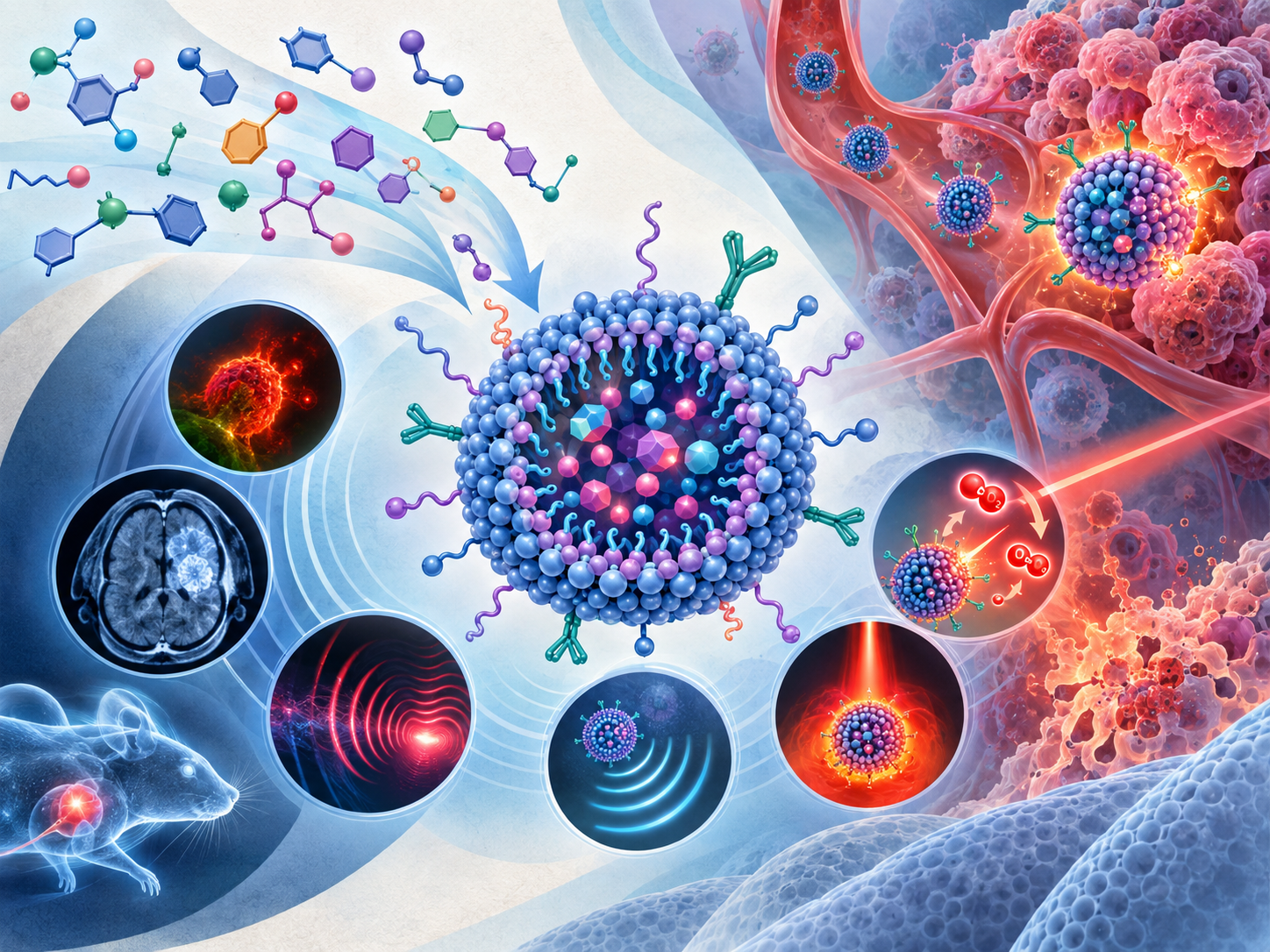
Paper: Organic-based nanoparticles for theranostic uses. AI-generated abstract conceptual image created using ChatGPT/OpenAI
A recent review published in the journal Biomedical Materials Science explores how organic-based nanoplatforms could advance safer and more effective theranostic nanomedicine. The review examines self-assembled organic molecules, polymeric nanoparticles, lipid-based nanostructures, carbon nanoparticles, and hybrid organic/inorganic platforms. It focuses on how chemical composition and nanoscale organization influence drug loading, targeting, imaging, controlled release, biodegradation, and therapeutic performance.
Addressing the Safety Challenges in Theranostic Nanomedicine
Theranostic nanomedicine integrates diagnostic and therapeutic functions within a single nanoscale platform. An ideal theranostic system should selectively reach the pathological site, provide information about its location and biological environment, deliver an effective therapeutic response, and undergo degradation or be efficiently cleared after treatment.
Inorganic nanomaterials have traditionally dominated theranostic research because they offer strong imaging contrast and intrinsic therapeutic properties. Magnetic nanostructures can support magnetic resonance imaging (MRI) and magnetothermal therapy, while noble-metal nanoparticles can generate heat via photothermal conversion. Yet poor biodegradability, tissue accumulation, and potential toxicity raise safety concerns, driving interest in organic and hybrid systems with improved biocompatibility, chemical flexibility, and control over drug delivery and degradation.
Organic-based nanomaterials include synthetic and natural polymers, lipids, amphiphilic molecules, supramolecular assemblies, and carbon-based materials. The review examines various organic nanoplatforms based on their structure, diagnostic functions, therapeutic mechanisms, and translational potential.
Engineering Organic Nanoplatforms for Multifunctional Theranostics
The review covers several major classes of organic-based theranostic systems and examines how their architectures influence biological and therapeutic performance. Self-assembled molecular systems form nanoparticles through non-covalent interactions such as π–π stacking, hydrophobic interactions, hydrogen bonding, and electrostatic forces. Cyanines, porphyrins, phthalocyanines, squaraines, croconaines, and aggregation-induced emission luminogens demonstrate how molecular structure can directly generate imaging and therapeutic functions.
Polymeric nanoplatforms allow extensive control over nanoparticle architecture and drug delivery. Micelles, dendrimers, polymersomes, nanospheres, nanocapsules, and nanogels offer different structures for encapsulating therapeutic agents and imaging probes. Researchers can modify polymer composition, molecular weight, branching, and crosslinking to control drug loading, degradation, targeting, circulation, and stimuli-responsive release.
Lipid-based systems offer another flexible platform, including niosomes, liposomes, solid lipid nanoparticles (SLNs), and nanostructured lipid carriers (NLCs). Their amphiphilic nature drives self-assembly into structures that support drug encapsulation, biological interactions, and controlled release. Carbon nanoparticles add functionality because their carbon structures possess intrinsic optical and therapeutic properties.
The review also examines hybrid organic/inorganic platforms that combine biodegradable organic matrices with inorganic components such as gadolinium, iron oxide, and gold. Organic matrices improve dispersion, targeting, drug loading, and biological interactions, while inorganic components provide imaging contrast or externally triggered therapeutic functions.
Material Structure Determines Imaging and Therapeutic Performance
The reviewed studies show that the chemical structure and nanoscale organization of organic materials strongly influence their theranostic behavior. Self-assembled cyanine and porphyrin systems can combine fluorescence or photoacoustic imaging with photothermal or photodynamic therapy. Porphysomes provide a notable example in which porphyrin packing controls optical behavior. Disassembly in the biological environment can restore fluorescence and enable activatable imaging.
Polymeric systems provide broad control over theranostic functions. Amphiphilic polymers form micelles that efficiently carry poorly water-soluble drugs, while dendrimers provide multiple functional groups for attaching imaging probes, targeting ligands, and therapeutic molecules. Crosslinked nanogels enable drug release in response to pH, temperature, or redox conditions. Polydopamine offers an additional strategy because the polymer itself provides photothermal activity, surface functionality, and biocompatibility, and polydopamine-based systems can support photoacoustic imaging.
Lipid architecture displays good control over drug delivery and imaging performance. Liposomes use phospholipid bilayers to accommodate hydrophilic and hydrophobic cargo, while SLNs provide a solid lipid matrix that improves drug stability and supports sustained release. NLCs introduce liquid lipid domains that increase drug-loading capacity and allow greater control over release. Researchers have combined these systems with fluorescence, radionuclide, ultrasound, and photoacoustic imaging, as well as chemotherapy, gene delivery, photothermal therapy, and stimuli-responsive drug release.
Carbon nanoparticles derive their multifunctionality directly from their carbon structures. Graphene provides a large surface area for drug loading and efficient photothermal conversion, while fullerene structures promote the generation of reactive oxygen species for photodynamic therapy. Carbon nanotubes combine high loading capacity with photothermal activity and intrinsic imaging properties. Nanodiamonds provide photoluminescence and favorable biocompatibility, whereas carbon dots combine ultrasmall size, tunable fluorescence, and potential for rapid clearance.
Hybrid platforms further demonstrate how organic and inorganic components can complement each other. Gadolinium provides MRI contrast, iron oxide supports MRI and magnetic hyperthermia, and gold nanostructures provide photothermal conversion and multi-modal imaging. The organic matrix improves drug delivery, targeting, dispersion, and biological interactions. Yet the persistence of inorganic components continues to create concerns about long-term safety.
Across these systems, several material characteristics consistently influence performance, including molecular architecture, supramolecular organization, surface chemistry, drug-loading capacity, biodegradation, optical properties, stimulus responsiveness, and biological interactions. These findings support a more structure-guided approach to nanoplatform design.
Advancing Organic Nanotheranostics Toward Clinical Translation
Organic-based theranostic platforms offer strong potential for safer and more versatile precision nanomedicine, but clinical translation remains constrained by challenges in reproducible synthesis, large-scale manufacturing, cost, regulatory assessment, and incomplete understanding of biodistribution, clearance, immune interactions, and long-term safety. The review highlights that molecular structure and nanoscale organization strongly influence biological performance, governing drug loading, targeting, imaging, therapeutic activity, biodegradation, and clearance. The authors also argue that growing evidence shows organic and hybrid systems can match, and in some cases exceed, the theranostic performance of inorganic platforms, while offering more favorable biodegradation and safety profiles.
Future research should prioritize the development of biodegradable and metabolizable nanoplatforms, as well as naturally derived lipids, proteins, and polysaccharides, and bioinspired or cell-derived nanocarriers. Stimuli-responsive polymers and supramolecular assemblies could enable more precise therapeutic responses, while future designs could reduce reliance on persistent inorganic components. Integrating nanotheranostics with artificial intelligence and advanced imaging could support real-time monitoring, adaptive treatment, and prediction of nanoparticle behavior in vivo.
Overall, successful translation will require stronger links between chemical structure, physicochemical properties, and biological function, supported by standardized characterization, safety evaluation, and large-scale manufacturing. These advances could help establish biodegradable, structure-guided organic nanotheranostics as a promising direction for precision nanomedicine.
Disclaimer: The views expressed here are those of the author expressed in their private capacity and do not necessarily represent the views of AZoM.com Limited T/A AZoNetwork the owner and operator of this website. This disclaimer forms part of the Terms and conditions of use of this website.