Researchers test whether adding strontium sulfite to lipid nanoparticles can improve mRNA delivery, raise p53 expression, and slow tumor growth in breast cancer models.
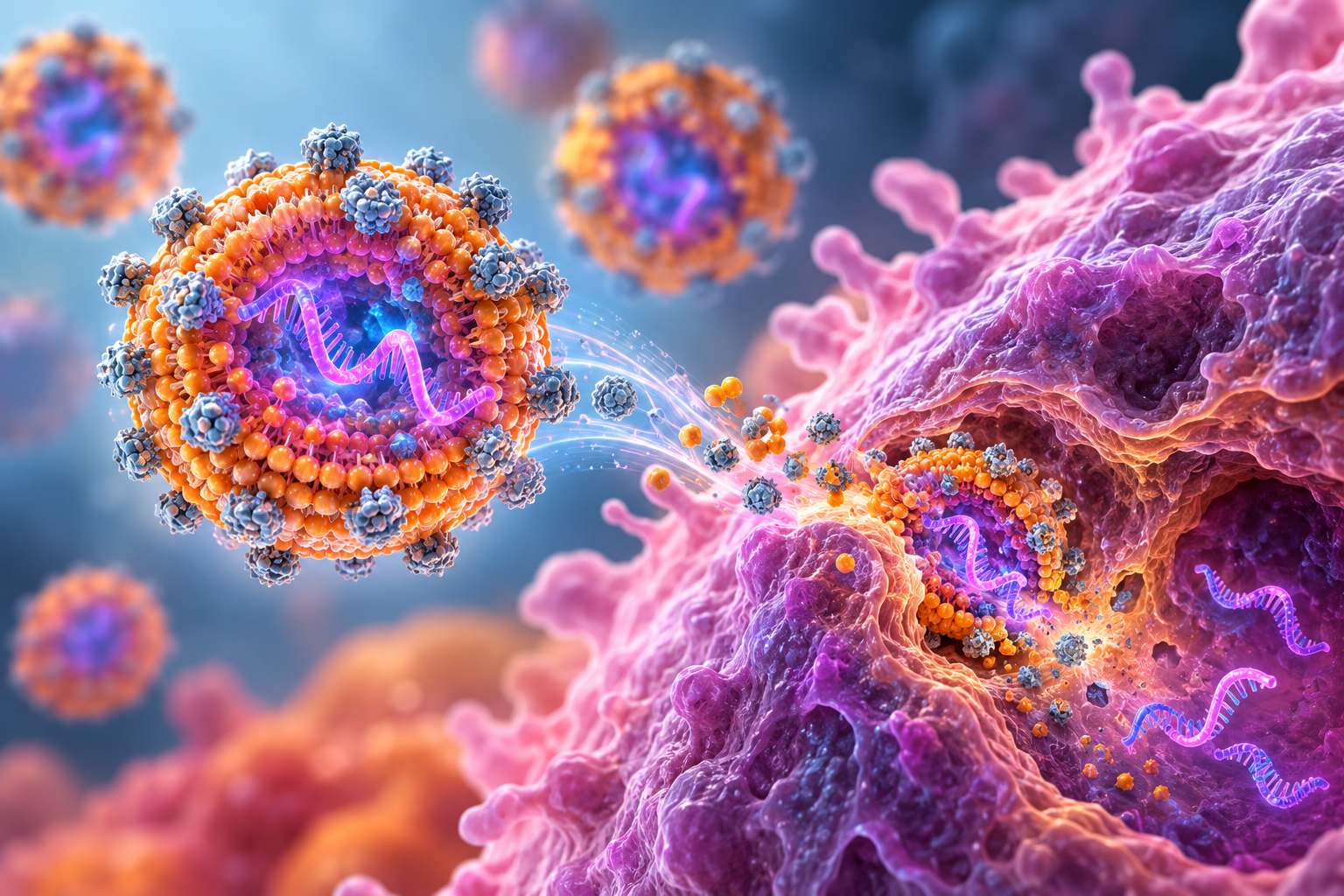
Paper: Restoration of p53 function via hybrid strontium sulfite nanoparticles modified LNP improves the antitumor efficacy in breast cancers. AI-generated abstract conceptual image created using ChatGPT/OpenAI
A recent study in the journal Cancer Gene Therapy describes a hybrid nanocarrier designed to improve therapeutic mRNA delivery for breast cancer treatment. The researchers modified conventional lipid nanoparticles (LNPs) with strontium sulfite nanoparticles (SSNs) to increase cargo delivery and examine how the modification affected circulation and tumor distribution.
Overcoming the Barriers to mRNA-Based Cancer Therapy
mRNA therapeutics offer one approach to cancer treatment by instructing cells to produce therapeutic proteins. One target is p53, a tumor-suppressor protein that regulates DNA repair, cell-cycle arrest, and programmed cell death. When p53 loses function, damaged cells can keep dividing and drive tumor progression. Delivering functional p53 mRNA could help restore these protective cellular responses.
But effective delivery remains a major challenge. Enzymes can rapidly degrade mRNA, and the molecules must cross cellular barriers to produce the intended proteins. LNPs protect mRNA and support cellular uptake, but systemic delivery creates other obstacles. Rapid clearance, accumulation in unintended tissues, and inefficient release of mRNA inside cells can limit therapeutic effectiveness.
To address these challenges, the researchers combined LNPs with strontium sulfite nanoparticles (SSNs). Earlier studies had explored strontium-based nanoparticles for nucleic acid delivery and tumor-targeting applications.
The team investigated whether incorporating SSNs into a lipid-based carrier could improve mRNA delivery and restore p53 expression in breast cancer cells. This approach combines nanoscale material engineering with a therapeutic strategy centered on p53 replacement.
Engineering Hybrid Nanocarriers for mRNA Delivery
The researchers synthesized strontium sulfite nanoparticles (SSNs) by combining strontium chloride and sodium sulfite in an aqueous solution containing sodium chloride and glucose.
Separately, they prepared LNPs using DOTAP, a positively charged lipid, and a cholesterol derivative. They then combined the two components to form hybrid SSN-LNP complexes and screened different formulations for suitable physicochemical properties and nucleic acid-binding performance.
The team used atomic force microscopy coupled with infrared spectroscopy (AFM-IR) to examine particle morphology, mechanical properties, and chemical composition. This analysis helped identify how the inorganic and lipid components contributed to the hybrid structure.
The researchers measured nucleic acid-binding efficiency and release behavior to determine how effectively the carrier retained and released genetic material.
DLS measured a hydrodynamic diameter of about 946 nm for the hybrid particles in suspension, while AFM-IR and STED microscopy showed primary particles around 10 to 20 nm. This difference reflects what each method measures and how particles associate in suspension.
To evaluate cellular delivery, they used fluorescently labeled mRNA to compare hybrid nanoparticles with conventional LNPs. Luciferase reporter assays measured subsequent gene expression, allowing the researchers to assess whether the delivered mRNA remained functional and supported protein production.
They then investigated p53 mRNA delivery and its biological effects in breast cancer models. They also evaluated the platform with epidermal growth factor receptor (EGFR)-targeting small interfering RNA (siRNA) to explore its potential for delivering different types of genetic material.
The study profiled proteins adsorbed to the particles in bovine serum and mouse plasma because these protein coronas can influence circulation and biodistribution, helping interpret later mouse distribution experiments. The experiments examined how nanoparticle structure influences cargo binding, cellular uptake, gene expression, and antitumor activity.
Improved Cellular Delivery and p53 Transcript Expression
AFM-IR analysis revealed distinct mechanical properties within the hybrid nanoparticles: the lipid component was softer, while the strontium sulfite component was more rigid. The measurements supported the researchers' proposed core-shell structure, with an LNP-rich core and an SSN-containing outer region. Infrared spectra also supported the presence of both materials.
The selected formulation showed effective nucleic acid binding, achieving about 70% binding efficiency in siRNA experiments. For the selected hybrid formulation, siRNA release rose to around 90% at pH 5.5, supporting a possible pH-responsive release mechanism. Because these binding and release tests used siRNA as a model nucleic acid, they did not establish equivalent values for therapeutic p53 mRNA.
Fluorescence microscopy showed stronger signals in breast cancer cells treated with fluorescently labeled mRNA delivered by SSN-LNPs than in cells treated with conventional LNPs.
Luciferase reporter assays recorded threefold higher gene expression in MCF-7 cells when the hybrid carrier delivered capped mRNA rather than conventional LNPs, indicating that the delivered reporter mRNA remained functional and drove higher reporter-protein expression.
The paper also reports that adding a cap analog and poly(A) tail increased transfection by more than 400% compared with unmodified mRNA-nanoparticle complexes, showing that mRNA design also contributed strongly to reporter expression.
The therapeutic experiments then focused on p53 mRNA. In MCF-7 cells, SSN-LNP delivery of p53 mRNA produced about threefold higher p53 transcript levels than conventional LNP delivery. Flow cytometry also found a higher proportion of apoptotic cells with the hybrid p53 formulation. RT-PCR measured p53 RNA, so this experiment did not directly measure p53 protein production or complete restoration of p53 signaling.
The mouse biodistribution tests used fluorescent siRNA rather than p53 mRNA and assessed the animals four hours after intravenous administration.
SSN modification alone did not markedly change tumor targeting. With PEG added to both carriers, the SSN-LNP formulation showed greater tumor-associated fluorescence and less signal in other major organs than PEGylated LNPs, while PEG increased plasma siRNA levels for both formulations.
In a separate 4T1 mouse tumor experiment, two intravenous doses of SSN-LNP/p53 mRNA inhibited tumor growth. At day 26, average tumor volume was about 260 mm³, compared with 436 mm³ for LNP/p53 mRNA and 1,100 mm³ in untreated mice, a 76% reduction relative to the untreated group.
Each treatment group contained four mice. Body weight did not change significantly during the study, though the experiment did not include a comprehensive toxicology assessment.
The results show that SSN-LNPs can bind siRNA, increase mRNA uptake and reporter-gene expression, and slow tumor growth in the tested models. Reporter gene expression and animal-model results do not establish clinical effectiveness.
Further research must clarify the delivery mechanism, evaluate long-term safety, and determine whether the platform performs consistently across different breast cancer types.
Advancing Hybrid Nanomaterials for Cancer Gene Therapy
The study shows how inorganic nanoparticles can modify established lipid-based carriers for therapeutic gene delivery, with the hybrid carrier associated with higher p53 transcript levels and apoptosis in cultured cells. The study's main functional outcomes are increased reporter gene expression and reduced tumor volume.
SSN-LNPs produced higher cellular uptake and reporter-gene expression than conventional LNPs in the tested models. The platform could also support broader nucleic acid delivery applications, but researchers must refine and test each application independently. In the study, co-delivery of p53 mRNA with EGFR-targeting siRNA did not produce a significant extra antitumor effect in the cell or mouse models.
Further work needs to assess the formulation's biocompatibility, degradation behavior, clearance pathways, and potential to trigger inflammation. It must also establish reproducible manufacturing processes and control nanoparticle distribution throughout the body. The study did not test whether p53 mRNA would work equally well in tumors with different p53 mutations or defects elsewhere in the p53 pathway.
The results warrant continued preclinical study of hybrid strontium sulfite-lipid nanoparticles as an mRNA delivery approach. The cell and mouse experiments highlight priorities for that work, including delivery performance, biodistribution, safety, manufacturing, and testing across additional breast cancer models, before drawing any conclusions about clinical use.
Disclaimer: The views expressed here are those of the author expressed in their private capacity and do not necessarily represent the views of AZoM.com Limited T/A AZoNetwork the owner and operator of this website. This disclaimer forms part of the Terms and conditions of use of this website.
Source:
- Karim, M. E., Holl, M. M. B., et al. (2026). Restoration of p53 function via hybrid strontium sulfite nanoparticles modified LNP improves the antitumor efficacy in breast cancers. Cancer Gene Therapy, 1-19. DOI: 10.1038/s41417-026-01085-w, https://www.nature.com/articles/s41417-026-01085-w