The Autosorb 3300 chemisorption analyzer provides fully automated catalyst characterization, allowing essential measurements to be performed dependably, rapidly, and with outstanding ease of use. Its intuitive, ergonomic interface simplifies operation, while a liquid-cooled furnace enables safe performance at temperatures up to 1200 °C.
Measurement modes include TPR, TPO, TPD, TPSR, acid and basic site analysis, and pulse titration for determining active metal area and dispersion. Four integrated titration loops facilitate method optimization, and a durable four-filament TCD delivers high sensitivity and long-term reliability. With 12 gas inputs and two mass flow controllers, the system can produce up to 36 gas mixtures for maximum flexibility.
- Fully automated pulse chemisorption and TPR/TPO/TPD measurements
- High-sensitivity chemisorption analyzer equipped with a four-filament TCD
- Accurate gas blending for up to 36 mixtures
- Safe-touch furnace capable of temperatures up to 1200 °C
- Four integrated precision titration loops for consistent injections
Key Features
Essential Chemisorption Done Right: No Guesswork, No Hassle
This chemisorption analyzer simplifies operation with a workflow that removes nearly all manual steps. From automatic cell connection and leak testing to fully automated furnace positioning and loop selection, the instrument eliminates the need for hands-on adjustments.
Operators place the sample cell assembly into the furnace and press start. This significant reduction in touchpoints speeds up training, minimizes user-to-user variability, and helps laboratories operate efficiently without continuous operator supervision.
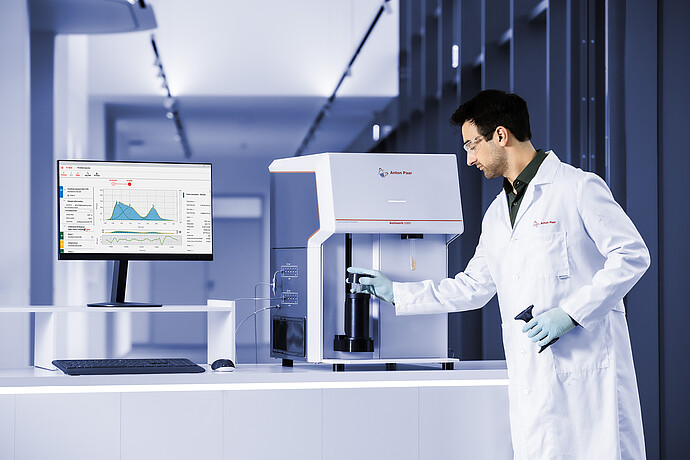
Image Credit: Anton Paar GmbH
Lowest Operating Costs in Its Class
Designed to provide reliable results in both R&D and QA/QC environments, the Autosorb 3300 significantly lowers the cost per analysis by eliminating unnecessary consumables and reducing gas consumption. Built-in gas blending significantly decreases the number of cylinders and regulators needed.
A regenerable zeolite vapor trap eliminates the need for liquid nitrogen cooling during TPR, while optimized flow pathways allow reduced gas flow rates and more rapid gas exchange. Because there are no septa, syringes, ferrules, or O-rings to replace and compressed air is not needed for cooling, laboratories experience lower ongoing operating costs and fewer interruptions to routine workflows.
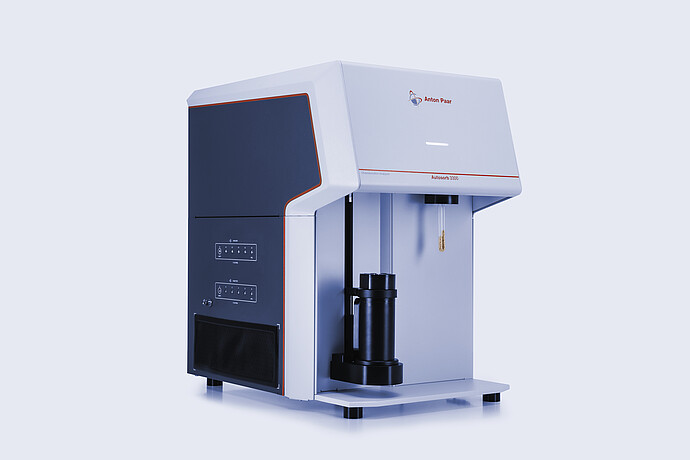
Image Credit: Anton Paar GmbH
The Same Conditions and Results: Precision Every Time
Uncompromised repeatability is necessary for accurate catalyst characterization. This is automatically provided by the Autosorb 3300 chemisorption analyzer via an integrated, pre-calibrated loop system that offers real temperature- and pressure-controlled injection volumes independent of environmental fluctuations.
The Autosorb 3300’s high-sensitivity, current-controlled four-filament TCD ensures precise detection across all temperature-programmed methods. It resolves small titration peaks and quantifies active areas down to 0.03 m2 (H2 on platinum at 313 K), enabling reliable catalyst characterization at very low metal loadings.
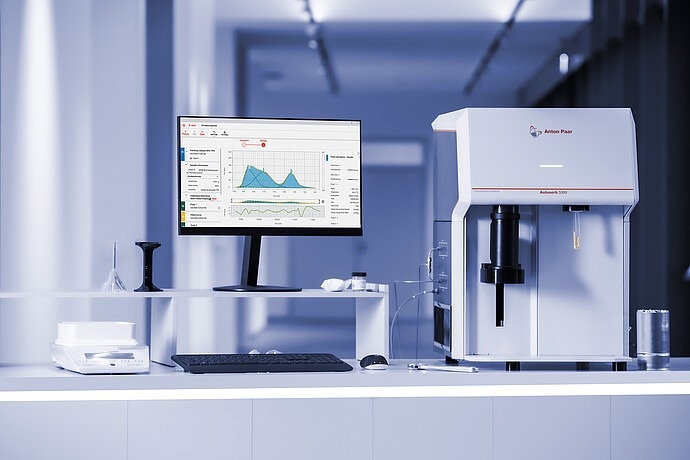
Image Credit: Anton Paar GmbH
Thermal Power That Outpaces Every Legacy System
The increased thermal performance of the Autosorb 3300 improves productivity and clarity of analysis. It delivers rapid temperature ramps, reaching 800 °C at rates up to 100 °C/minute and 1200 °C at rates up to 25 °C/minute. Fast cooldown to 50 °C in as little as 30 minutes further increases throughput without compromising safety.
The small furnace design of this chemisorption analyzer allows for very responsive temperature management, which is necessary for TPR, TPO, and TPD measurement. This allows for linear temperature ramps, accurate hold segments, and stable baselines.
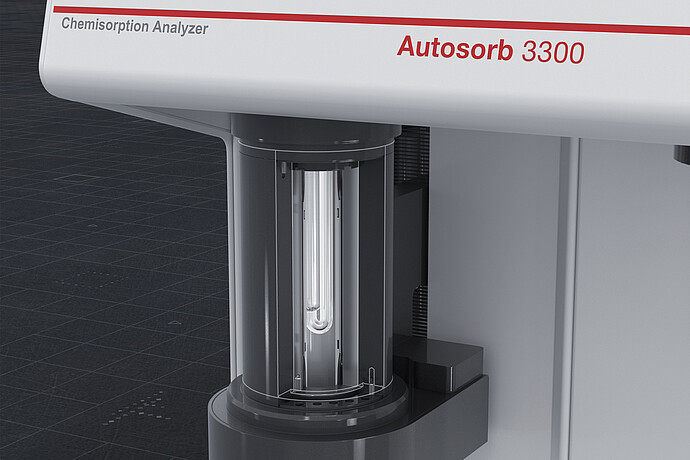
Image Credit: Anton Paar GmbH
Engineered for Maximum Safety
For demanding chemisorption applications, the Autosorb 3300 chemisorption analyzer is designed to provide regulated heating and cooling profiles. The safe-touch design helps to assure operator safety during high-temperature tests by keeping the exterior surface within 34 °C of the ambient temperature despite its high working temperatures.
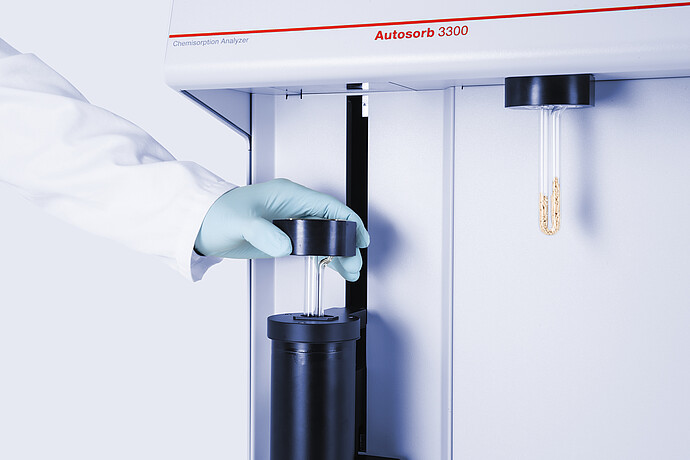
Image Credit: Anton Paar GmbH
Powerful Software for Catalyst Characterization
The workflow-focused Kaomi React software, which supports consistent method execution, powers Autosorb 3300. The software includes guided procedures for peak deconvolution and pulse titration, a method and sequence editor, and real-time instrument viewing.
Rapid and reliable data are generated for active metal area, dispersion, and other catalyst characteristics.
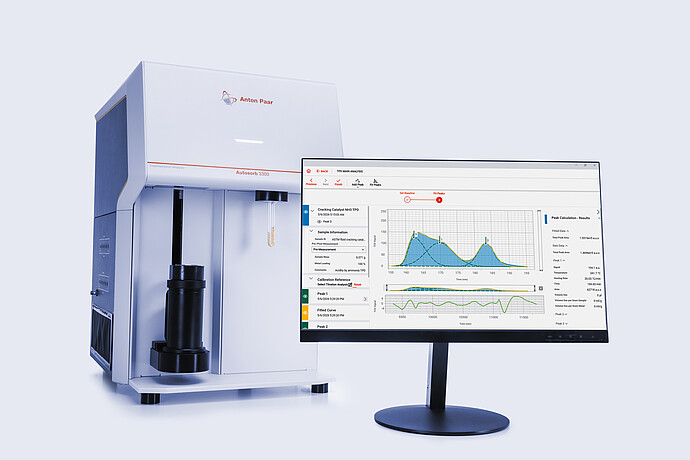
Image Credit: Anton Paar GmbH
Specifications
Source: Anton Paar GmbH
| Applications |
| Petrochemical catalysts |
Petroleum cracking, oxidation, hydrocarbon reforming, steam reforming, water-gas shift |
| Catalyst regeneration |
Coked and sintered (used) catalysts |
| Hydrogen generation |
Ammonia decomposition, electrolysis electrodes |
| Fuel cells |
Redox electrodes |
| CO2 capture and utilization |
Solid bases (e.g., amine-functionalized, hydrogenation catalysts) |
| Performance Specifications |
| Measurement types |
TPR, TPO, TPD, TPSR, pulse titration, breakthrough curves |
| Analysis types |
Active metal area, dispersion, crystallite size, activation energy, acid site strength, quantitative desorption, peak fitting, and deconvolution |
| Injection repeatability |
<0.4% of loop volume |
| Peak temperature reproducibility |
<0.8% (Zeolite ammonia TPD) |
| Active area reproducibility |
4% (measured on 2% platinum on alumina reference sample) |
| Technical Specifications |
| Furnace |
Safe touch (surface temperature never more than 34 °C above ambient) |
| Sample temperature range |
40 °C to 1200 °C |
| Furnace heating rates |
40 °C to 800 °C: Up to 100 °C/minute
800 °C to 1000 °C: Up to 50 °C/minute
1000 °C to 1200 °C: Up to 25 °C/minute |
| Minimum heating rate |
0.08 °C/minute |
| Furnace cooling type |
Closed-circuit liquid circulation |
| Cooling rate |
800 °C to 50 °C in 26 minutes, 500 °C to 50 °C in 22 minutes
400 °C to 50 °C in 20 minutes, 100 °C to 40 °C in 12 minutes |
| Detector |
Four-filament W/Re TCD (ammonia- and oxidation-resistant) with bypass valve |
| Injector loops |
Four integrated loops (145 μL, 275 μL, 525 μL, 1125 μL nominal) |
| Gas blending |
Built-in using two MFCs (50 sccm each) |
| Analysis/carrier gas inputs |
Six (one inert, four standard, one PFE) |
| Injector/blend gas inputs |
Six (one inert, four standard, one PFE) |
| Gas input compatibility |
Inert: He, Ar, and other inert gases
Standard: Inert + N2, CO2, CO, H2, O2, N2O
PFE: Standard + CH4, NH3 |
| Heated valve box |
50 °C (stability ±0.3 °C) |
| Sample cell |
Quartz U-tube with 3 mL sample capacity, with bypass valve |
| Vapor trap |
Standard dry absorber, with bypass valve |
| Accessories |
Cold trap, mass spectrometer, vacuum pump |
| RoHS 3 compliant, CE certified |
✓ |