Autosorb instruments are high-vacuum physisorption and chemisorption analyzers that can measure BET surface area, active area, and pore size distributions.
Independent analysis stations, proprietary TruZone active coolant control, and accessible Kaomi software enable users to meet current measurement requirements while adapting to future ones through factory- and field-upgradeable options. Absolute Autosorb is the clear choice for the most significant gas-sorption measurements.
Autosorb 6100
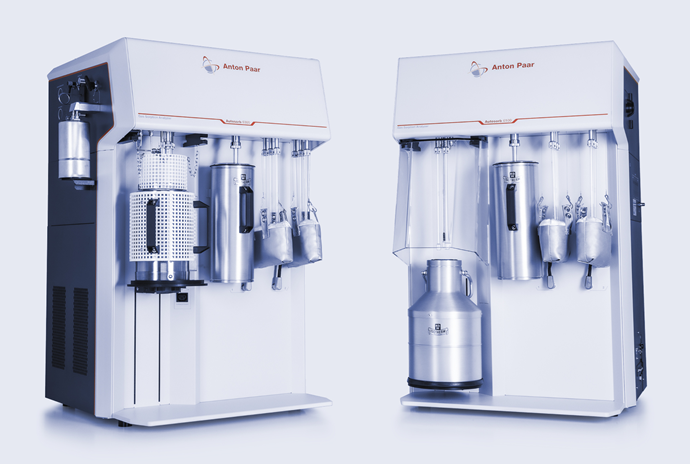
Image Credit: Anton Paar GmbH
- Precise high-vacuum physisorption evaluations of surface area and micropores
- Enhanced measurement protocols are facilitated through DoseWizard point selection and PowderProtect
- A maximum of three samples, three gases, and three temperatures can be analyzed concurrently using independent analysis stations
Autosorb 6200
- Precise physisorption and chemisorption evaluations for enhanced catalyst characterization.
- Selection of chemical compatibility tailored to meet your measurement requirements.
- Expandable to incorporate TCD, an integrated mass spectrometer, and vapor options.
Autosorb 6300
- Comprehensive chemisorption and physisorption functionalities are integrated into a single instrument package.
- Improved chemical resistance enables the analysis of a broader spectrum of gases and applications.
- Conduct a thorough characterization of catalysts using the provided TCD, pulse titration loop, and integrated vapor source.
Key Features
A Gas Sorption Analyzer That is Absolutely Accurate
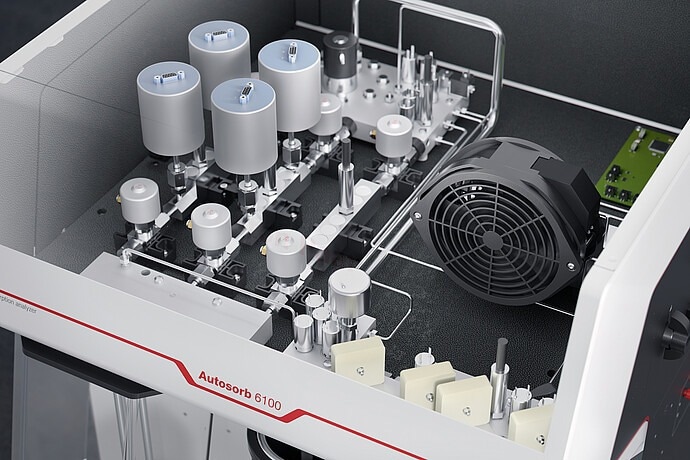
Image Credit: Anton Paar GmbH
- Obtain highly precise physisorption measurements at relative pressures lower than 10-7 for nitrogen
- Utilize accurate manifold temperature regulation within the range of 35 °C to 50 °C
- Depend on TruZone active coolant level management for reliable data, even during extended analyses
- Attain exceptional high vacuum performance (38 % improvement compared to earlier generation instruments) through precision-engineered manifolds and premium pneumatic valves
Independent Stations Ensure Users are Absolutely Agile
- Conduct an analysis of up to three distinct samples using three different analysis gases at three varying temperatures concurrently, utilizing independent analysis stations and proprietary temperature control accessories
- Execute the most demanding physisorption measurements with the 90-hour Dewar.
- Enhance the throughput with six built-in degassing stations
- Rapidly transition to the 1100 °C furnace for sophisticated temperature programmed analyses, pulse titrations, or chemisorption isotherms.
Intuitive Software Makes Every Analysis Absolutely Accessible
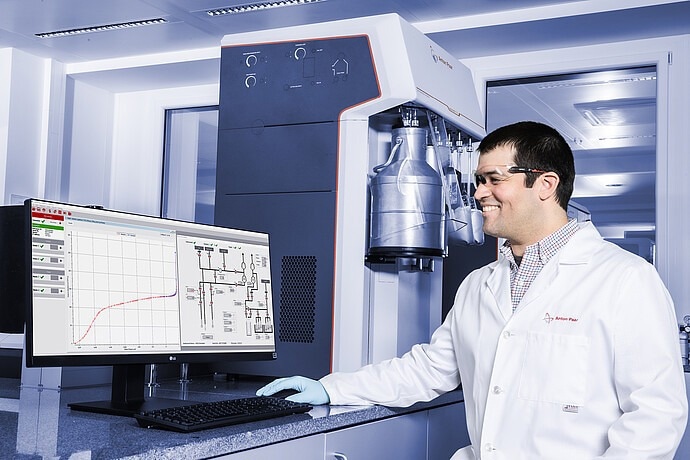
Image Credit: Anton Paar GmbH
- Experience a refreshed and efficient version of Kaomi software, designed to simplify the entire measurement process more than ever before
- Enhance measurement specifications to meet the requirements with DoseWizard’s newly introduced standard and advanced modes
- Minimize downtime with PowderProtect, which safeguards against unintentional powder loss in the instrument
Customization Options Keep Users Absolutely Adaptable
- The Autosorb, equipped with three instruments and modular upgrades, is designed to meet the precise analytical needs of your porous solids and catalysts
- As the research evolves, the instrument's physisorption and chemisorption capabilities can be upgraded in the field to accommodate new materials and applications
- Surpass conventional measurements with improved chemical resistance, an integrated vapor source, a thermal conductivity detector, or even a fully integrated mass spectrometer
Compliance and Quality are Absolutely Assured
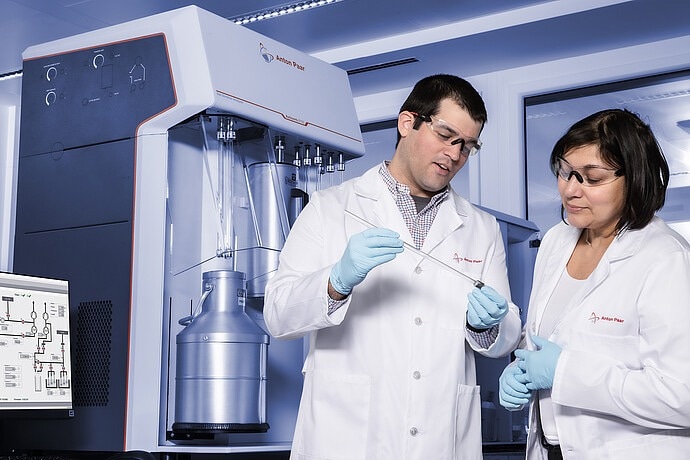
Image Credit: Anton Paar GmbH
- Adhere to over 20 ASTM, DIN, and ISO standards for the characterization of catalysts and the assessment of porous materials
- Enjoy the assurance of a three-year warranty, allowing you to prevent unexpected expenses.
Specifications
Measurement Specifications. Source: Anton Paar GmbH
| |
Autosorb 6100 |
Autosorb 6200 |
Autosorb 6300 |
| Measurement principle |
- Vacuum Volumetric Physisorption
|
- Vacuum Volumetric Physisorption
- Vacuum Volumetric Chemisorption
- Dynamic Flow Chemisorption (Optional)
|
- Vacuum Volumetric Physisorption
- Vacuum Volumetric Chemisorption
- Dynamic Flow Chemisorption
|
| Analysis gas compatibility |
|
|
|
| N2, Ar, Kr, CO2, H2, and other non-corrosive gases |
Included |
Included |
Included |
| CH4, C2H6, C3H8, other alkanes, C6H6, C8H10 |
Included |
Dependent on instrument configuration |
Included |
| NH3, C5H5N, C3H6O, and other reactive gases |
N/A |
Dependent on instrument configuration |
Included |
| Physisorption analysis stations |
Number: 1, 2, or 3
Independence: Up to 3 gases at 3 analysis temperatures can be used concurrently,
1 analysis of gas and temperature per station |
| Chemisorption analysis stations |
N/A |
1 |
| Independent p0 station |
Yes (dedicated cell and transducer) |
| Pressure |
- Range: 2x10⁻⁵ to 1100 Torr (2.6x10⁻⁸ to 0.997 p/p0 for N2 77K)
- Resolution (MP): 2x10⁻⁵ Torr (2.6x10⁻⁸ p/p0 for N2 77K)
- Resolution (XR): 1x10⁻⁶ Torr (1.3x10⁻⁹ p/p0 for N2 77K)
|
| BET surface area |
- Absolute detection limit: 0.1 m2 (N2 77K)
- Specific detection limit: 0.01 m2/g (N2 77K)
- Typical reproducibility: 1 % (measured on BAM P115)
- Reproducibility limit: 2 % with 2 m2 in the cell
|
| Pore size |
- Range: 0.35 nm to 500 nm (diameter)
- Typical reproducibility: 0.5 % (measured on BAM P115)
|
| Active area |
N/A |
- Absolute detection limit: 0.03 m2 (H2 on Platinum 313 K)
- Specific detection limit: 0.003 m2/g (H2 on Platinum 313K)
- Typical reproducibility: 2 % (measured on 2% Platinum on Alumina reference sample)
|
| TruZone |
Yes (active coolant level control) |
| PowderProtect |
Yes (prevents sample elutriation) |
| Analysis dewar |
- Duration: 90+ hours with liquid nitrogen
- Refill during analysis: Yes
- Volume: 3 L
|
| Analysis furnace |
N/A |
- Maximum temperature: 1,100 °C
- Maximum Ramp Rate: 50 °C per minute
- Furnace cooling by built-in fan
|
| Sample preparation |
- Integrated degassing stations: 6
- Temperature control: 2 independent heating zones, ambient to 450 °C
- Dedicated cold trap: Yes
- Available methods: flow and vacuum, programmable multi-step degassing profiles, test for completion routines, pressure-controlled heating
|
| Additional capabilities |
|
|
|
| Vapor source |
Optional |
Optional |
Included |
| CryoSync control |
Optional |
Optional |
Optional |
| TCD and loop injector |
N/A |
Optional |
Included |
| Mass spectrometer |
N/A |
Optional |
Optional |
Kaomi software features. Source: Anton Paar GmbH
| |
Autosorb 6100 |
Autosorb 6200 |
Autosorb 6300 |
| Instrument connection |
Control up to 4 instruments from 1 PC |
| DoseWizard |
- 45+ built-in analysis profiles aligned with ASTM, DIN, and ISO
- Standard profiles with easy measurement selection
- Advanced profiles with full control of experimental procedures
- Dose templates for rapid measurement based on previous analyses
|
| Physisorption methods |
- Surface area and pore volume: Alpha-s, BET, DR, Gurvich pore volume, Langmuir, t-plot (STSA)
- Pore size and pore volume distributions: NLDFT, QSDFT, GCMC, Kr(87) thin-film, BJH, DH, DA, HK, SF, MP
- Other: summary reports, overlays, average particle size, average pore size, fractal dimensions (NK, FHH), heat of adsorption
|
| Chemisorption methods |
N/A |
- Static measurements: extrapolation, bracketing, Langmuir, Temkin, Freundlich, heat of adsorption
- Dynamic flow measurements: TPx (TPR,TPO,TPD) peak deconvolution, pulse titration analysis, activation energy
|
| Available languages |
|
|
Chinese, English, French, German, Japanese, Korean, Portuguese, Spanish |
Technical Specifications. Source: Anton Paar GmbH
| |
Autosorb 6100 |
Autosorb 6200 |
Autosorb 6300 |
Dimensions
(W x D x H) |
79.5 cm x 70.1 cm x 107.9 cm (31.3 in x 27.6 in x 42.5 in) dependent on instrument configuration |
| Weight |
136.4 kg (300 lbs), dependent on instrument configuration |
| Operating environment |
- Temperature: 15 °C to 35 °C (59 °F to 95 °F)
- Humidity: 20 % RH to 80 % RH, non-condensing
|
| Gas distribution manifold elastomers |
FKM |
FKM or EPDM (dependent on instrument configuration) |
PFE |
| Analysis manifold construction |
Vacuum-brazed manifold block in stainless steel |
| Analysis manifold temperature |
- Range: user adjustable 35 °C to 50 °C
- Stability: ±0.05 °C
|
| Analysis of manifold valves |
- Type: stainless steel, air-operated bellows valve
- Cycle life: 5,000,000 cycles
- External leak rate: 5x10-12 Pa m3/sec
- Seat leak rate: 5x10-12 Pa m3/sec
|
| Pressure transducer (1550 Torr) -Analysis and degas |
- Number: 3 to 5 (dependent on instrument configuration)
- Accuracy: ±0.065 % full scale* (*This value incorporates precision, linearity, and hysteresis for the entire pressure measurement system)
- A/D data acquisition: 32-bit
|
| Pressure transducer (10 Torr) – MP or XR |
- Number: 1 to 3 (dependent on instrument configuration)
- Accuracy: ±0.15 % reading up to 10 Torr
- Resolution: 0.002 % full scale
|
| Pressure transducer (1 Torr) – MP only |
- Number: 1 to 3 (dependent on instrument configuration)
- Accuracy: ±0.15 % reading up to 1 Torr
- Resolution: 0.002 % full scale
|
| Pressure transducer (0.1 Torr) – XR only |
- Number: 1 to 3 (dependent on instrument configuration)
- Accuracy: ±0.15 % reading up to 0.1 Torr
- Resolution: 0.001 % full scale
|
| Pirani vacuum gauge – Degas only |
- Number: 1
- Accuracy:
5×10⁻⁴ to 1x10⁻³ Torr: ±10 % of reading
1×10⁻³ to 100 Torr: ±5 % of reading
- 100 Torr to atmosphere: ±25 % of reading
|
| Vacuum system |
- Turbo molecular drag pump and dry diaphragm pump
- Manufacturer’s specification: 5x10⁻¹⁰ mbar
- Typical pressure at analysis port: 2.67x10⁻⁵ mbar
|
| Thermal conductivity detector (TCD) |
N/A |
- Two-filament TCD with rhenium/tungsten filaments (optional)
- Detection Limit: 0.5 μL (air injected into helium)
|
- Two-filament TCD with rhenium/tungsten filaments (standard)
- Detection Limit: 0.5 μL (air injected into helium)
|
| Gas ports |
- 7 ports standard (5 analysis, 1 helium, 1 degas/backfill)
- 7 additional analysis ports are optional
|
- 7 ports standard (5 analysis, 1 helium, 1 degas/backfill)
- 7 additional analysis ports are optional
- 1 titration gas port optional
|
- 15 ports standard (12 analysis, 1 helium, 1 degas/backfill, 1 titration)
|
| Gas supply |
- Purity: 99.999 %
- Input pressure: 8 psig to 10 psig (0.55 bar to 0.69 bar)
|
| Air |
- Input pressure: 50 psig to 100 psig (3.45 bar to 6.9 bar)
|
| Electrical |
- Supply: 100 to 240 VAC ±10 %, 50 or 60 Hz
- Maximum consumption: 1600W (dependent on instrument configuration)
|
| PC connection |
Ethernet |
| RoHS3 compliant |
Yes |
| CE / UKCA certified |
Yes |
| Indoor/outdoor use |
For indoor use only |