Researchers deposited silver, zinc, and copper nanoparticles directly onto starch-based films to test whether surface treatment could overcome key weaknesses in biodegradable plastics.
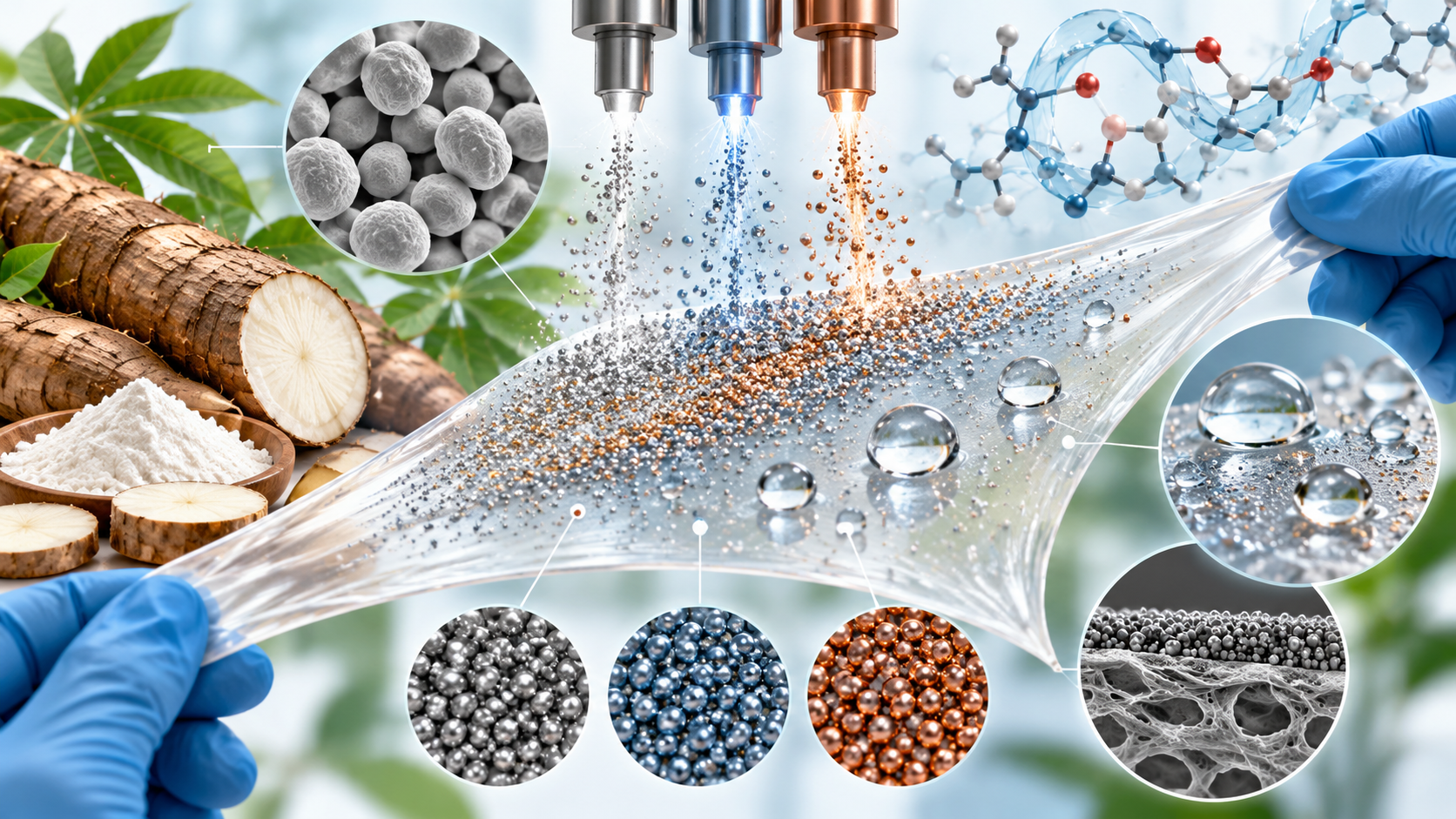
Paper: Sparking Nanometal Oxides for Modifying Surface Properties of Thermoplastic Starch/Carboxymethyl Cellulose Blends. AI-generated abstract conceptual image created using ChatGPT/OpenAI
A paper recently published in the journal Polymers reported developing a novel thermoplastic starch/carboxymethyl cellulose (TPS/CMC) blend surface-modified with nanometal oxide particles (NOPs) produced by spark discharge.
TPS Limitations and CMC
TPS can be a sustainable substitute for petroleum-based plastics because it is renewable, non-toxic, and biodegradable. Researchers can synthesize it using plasticizers such as sorbitol, glycerol, or water to achieve suitable elasticity and processability. Traditional polymer-processing equipment can process TPS.
TPS's inherent brittleness and hydrophilicity limit its water resistance and mechanical strength. Reinforcing agents and compatibilizers can strengthen adhesion between components and improve overall material performance.
Other additives, like CMC, have been reported to alter the water resistance, thermal behavior, morphology, and mechanical properties of TPS composites.
CMC has been used extensively as a film-forming agent, stabilizer, and thickener because it is water-soluble and hydrophilic, and it can alter the mechanical and rheological behavior of polymer systems.
CMC is also increasingly used in developing green polymers and biobased composites because it is renewable and environmentally friendly.
Role of Nanotechnology
Nanomaterials with 1–100 nm particle sizes possess distinct surface reactivity and a high surface-area-to-volume ratio, which can increase antimicrobial activity and alter thermal and mechanical behavior. Sparking nanoparticle technology can produce NOPs.
In this technology, high-voltage electrical sparks generate fine metal particles that can oxidize and form NOPs. NOPs produced using this process have been reported to increase functionality, stability, and strength.
Yet, few studies have examined the sparking process for direct surface modification using nanometal particles. The relation between surface deposition, metal species, polymer functional groups, and the resulting thermal, wettability, and mechanical properties remains insufficiently understood.
The Proposed Sparking-Based Approach
In this work, researchers characterized a TPS/CMC blend with NOPs produced using sparking technology. Unlike traditional bulk blending of metal-containing particles into TPS/CMC composites, the researchers deposited the particles directly on the film surface.
This approach targets mechanical and surface properties without intentionally incorporating particles throughout the polymer matrix. Cassava starch was the main polymer matrix. CMC was included because its main chain retains carboxyl-related functional groups.
Through sparking treatment, NOPs were deposited on the TPS/CMC surface to study changes in morphology, wettability, and mechanical properties. Copper (Cu), zinc (Zn), and silver (Ag) were selected for their distinct physicochemical properties and potential functional benefits.
Research Methodology
Cassava starch, CMC, glycerol, Zn, Cu, and Ag served as the starting materials.
First, cassava starch was blended with glycerol at a 70/30 wt% ratio, and 200 mL of distilled water was added. The mixture was heated in a beaker at 80 °C for 30 min to prepare TPS. CMC was then added to the prepared TPS at a 95/5 wt% TPS/CMC ratio, and mixing continued for 10 min.
The mixture was placed in a heat incubator at 60 °C for 24 h. Researchers prepared the TPS/CMC and TPS samples using a two-roll mill at 130 °C for 10 min. The samples were then molded in a hot press for 5 min at 130 °C under 7000 psi.
Researchers used an untreated TPS/CMC sample prepared with the same molding process, without sparking treatment, as the control. Cu, Ag, and Zn wires measuring 0.5 mm in diameter were employed for sparking at a current of 3 mA and an applied voltage of 3 kV for 30 min.
The samples measured 5 × 5 cm and were 1 mm thick. One side of each sample was treated, covering an area of 25 cm².
Study Findings
Sparking deposited metal-containing nanoparticles on the surfaces of the TPS/CMC and TPS samples.
SEM-EDS mapping showed metal-containing particles distributed across the examined surfaces, with a relatively continuous distribution on TPS/CMC and no obvious agglomeration in the reported images.
FTIR analysis suggested interactions between the deposited particles and the –COOH groups of CMC and –OH (hydroxyl) groups of TPS. The authors proposed that these interactions helped the deposited particles adhere to the polymer surface and contributed to the measured changes in tensile strength.
Sparking the TPS/CMC surface with nanometal oxides increased tensile strength, but the size of the change varied by metal.
Untreated TPS/CMC measured 2.2 MPa, compared with 5.0 MPa after Ag treatment, 4.2 MPa after Zn treatment, and 3.0 MPa after Cu treatment.
Treated TPS alone also became stronger, but its elongation at break (how far a material stretches before breaking) fell from 78% to 21–30%, a much smaller trade-off than the TPS/CMC samples.
Spark-deposited nanometal oxides increased the contact angle of TPS/CMC and reduced surface wettability. After 10 min, untreated TPS/CMC had a contact angle of 41.3°, compared with 91.6° for Ag, 89.3° for Zn, and 95.1° for Cu. These measurements indicate lower surface wettability under the test conditions, but do not prove long-term moisture-barrier performance.
Thermal analysis showed that CMC lowered TPS's degradation-onset temperature from 292.0 °C to 259.5 °C. Sparking caused further metal-dependent changes in degradation behavior; the authors suggested that Zn may act as a stronger degradation catalyst than Ag and Cu.
The sparked samples also showed color changes linked to changes in light scattering and brightness caused by the nanoparticles.
The proposed ionic interactions between CMC –COOH groups and nanometal oxides matched the authors' interpretation of stronger adhesion between the deposited particles and the polymer surface, as well as the higher tensile strengths reported for the TPS/CMC samples. FTIR supported this interpretation, but the study did not directly establish the precise bonding mechanism.
Sparking modified the TPS/CMC surface by depositing nanometals directly, increasing tensile strength and reducing surface wettability through surface treatment rather than bulk incorporation. The authors identify sustainable packaging as a possible application, but testing water-vapor transmission, nanoparticle migration, long-term stability, and biodegradation would be needed to assess practical packaging performance.
Disclaimer: The views expressed here are those of the author expressed in their private capacity and do not necessarily represent the views of AZoM.com Limited T/A AZoNetwork the owner and operator of this website. This disclaimer forms part of the Terms and conditions of use of this website.
Source:
- Kodsangma, A. et al. (2026). Sparking Nanometal Oxides for Modifying Surface Properties of Thermoplastic Starch/Carboxymethyl Cellulose Blends. Polymers, 18(20), 2571. DOI: 10.3390/polym18202571, https://www.mdpi.com/2073-4360/18/20/2571