By targeting two linked drivers of immune dysfunction and tracking the effects from macrophages to the gut microbiota, researchers tested whether one nanotherapy could tackle several layers of sepsis at once.
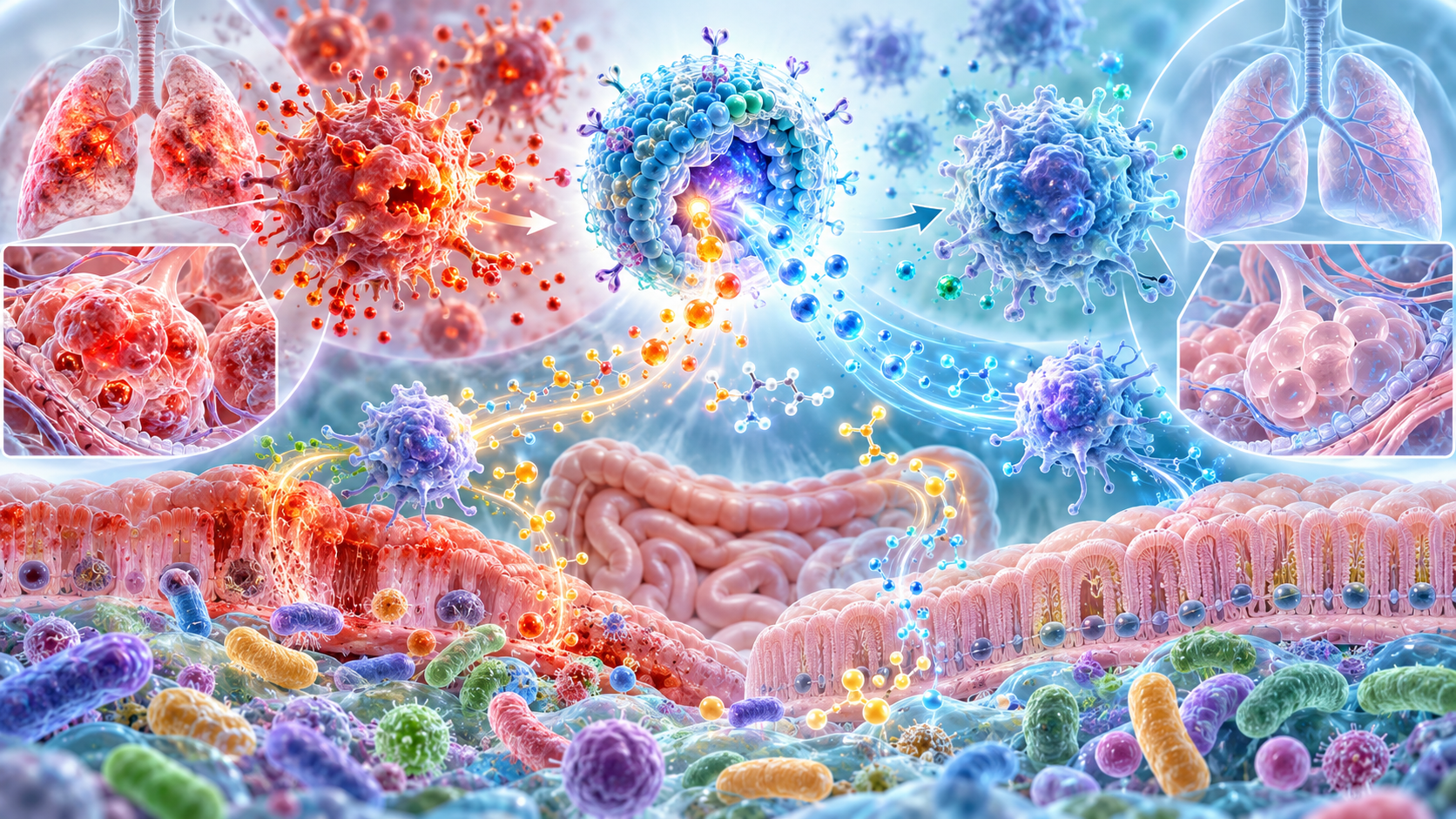
Paper: Nanotherapeutic macrophage reprogramming through immunometabolic and microbial modulation for sepsis treatment. AI-generated abstract conceptual image created using ChatGPT/OpenAI
In a recent article in the journal Signal Transduction and Targeted Therapy, researchers developed a glutathione-responsive nanoparticle platform that co-delivers STING and DHODH inhibitors to reprogram macrophage immunometabolism, which links immune activity to cellular metabolism, and to alter gut microbial metabolism in experimental models of sepsis.
Sepsis Pathways and Targets
Sepsis is a critical condition marked by a dysregulated immune response that can drive widespread inflammation, metabolic disturbance, organ injury, and death. Existing treatment centers on infection control and supportive care, yet these approaches cannot directly correct the complex immune dysfunction that develops during sepsis.
Macrophages help initiate and sustain inflammatory responses, which makes them attractive therapeutic targets. Earlier nanomedicine strategies for sepsis have focused on individual inflammatory pathways, toxin neutralization, or removal of harmful molecules.
Such approaches can affect selected parts of the inflammatory response while leaving broader changes in macrophage metabolism and the tissue environment largely untouched.
Recent research has linked the STING pathway and the mitochondrial enzyme DHODH to inflammatory regulation. STING promotes type I interferon signaling, while DHODH supports de novo pyrimidine synthesis in activated cells. Gut microbial metabolites can also influence macrophage behavior and inflammatory tone.
Few therapies address immune signaling, cellular metabolism, and microbiota-associated effects together. The researchers developed a nanotherapeutic platform that combines these targets and tested whether it could shift macrophages toward a less inflammatory state in experimental sepsis.
Design and Synthesis of EONPs
The researchers linked the STING inhibitor 4-octyl itaconate (4-OI) to polyethylene glycol (PEG) through disulfide bonds, creating an amphiphilic prodrug that could self-assemble into nanoparticles.
These particles, called OINPs, were loaded with EA6, a DHODH inhibitor, to form EONPs. The researchers measured particle size, stability, drug loading, and glutathione-triggered drug release using transmission electron microscopy, light-scattering measurements, and chromatography.
Cell experiments used lipopolysaccharide-stimulated bone marrow-derived macrophages to examine inflammatory signaling and macrophage phenotype. Animal experiments used a cecal ligation and puncture (CLP) mouse model of polymicrobial sepsis to study biodistribution, organ injury, inflammatory responses, and survival. An LPS challenge served as a second model of acute systemic inflammation.
Transcriptomic, metabolomic, and metagenomic analyses examined cellular and whole-animal responses. Fecal microbiota transplantation and gut microbiota depletion were used to test how much microbial communities contributed to the observed effects.
Macrophage Reprogramming and Microbiota Modulation
The self-assembled particles were spherical and measured about 150 to 180 nm in diameter, with good stability under the tested physiological conditions. In laboratory release tests, higher glutathione concentrations caused particle disassembly and increased release of both 4-OI and EA6. The authors propose that particles first passively accumulate in inflamed tissues and then release their cargo under reducing conditions.
Dual inhibition shifted macrophages away from a pro-inflammatory state and toward a more anti-inflammatory phenotype in vitro. Transcriptomic analysis of blood mononuclear cells from septic mice showed increased activity in STING-related inflammatory signaling and in the pathway cells use to make pyrimidine nucleotides, supporting the choice of both targets.
In septic mice, EONPs accumulated preferentially in inflamed lung and ileum tissue and improved short-term survival compared with EA6 or OINPs alone.
EONPs reduced organ injury and inflammatory responses more effectively than a matched combination of free 4-OI and EA6.
Treatment lowered the pro-inflammatory cytokines TNF-α, IL-6, and IL-1β; reduced type I interferon levels; and raised IL-10. Tissue analysis showed less lung and intestinal injury, along with lower serum markers associated with liver and kidney damage.
The researchers then examined whether treatment changed the gut microbial community. EONPs partly reversed sepsis-associated dysbiosis, increased microbial diversity by the Shannon index, and enriched bacterial taxa linked to anti-inflammatory responses. Treatment also increased 5-hydroxyindoleacetic acid (5-HIAA), a serotonin metabolite associated with gut microbial activity and anti-inflammatory macrophage responses.
Microbiota depletion and fecal transplantation supported a contributing role for gut microbes, but did not show that microbial changes were required for the treatment effect. Blocking 5-HIAA synthesis or aryl hydrocarbon receptor (AhR) signaling reduced part of the benefit.
These experiments support the authors' view that direct macrophage modulation is the principal mechanism, with microbiota-associated 5-HIAA signaling adding a second layer of immune regulation.
The particles combined immune signaling, cellular metabolism, and microbial effects into a single experimental treatment strategy.
Therapeutic Implications of EONPs
The study describes a glutathione-sensitive nanoplatform that delivers STING and DHODH inhibitors to complementary inflammatory and metabolic targets.
The findings suggest that targeting inflammatory signaling and cellular metabolism simultaneously may control more aspects of the dysregulated immune response in experimental sepsis than either approach alone. EONPs did not significantly reduce bacterial burden in blood or peritoneal fluid, so the therapeutic benefit was more likely tied to host immune regulation than direct antibacterial activity.
The 5-HIAA experiments point to a supporting role for communication among gut microbes, microbial or host metabolism, and immune cells. The partial loss of benefit after 5-HIAA synthesis or AhR signaling was blocked shows that this pathway accounts for only part of the treatment response.
By combining immune signaling blockade, mitochondrial metabolic regulation, and microbiota-associated effects, the researchers addressed several interacting features of sepsis across a coordinated set of preclinical models. The findings are limited to cultured cells and mice. Treatment was given immediately after CLP surgery or LPS challenge, and survival was followed for up to 72 hours.
Further testing is needed to assess delayed treatment, use alongside antibiotics, longer follow-up, long-term safety, pharmacokinetics, and relevance to human sepsis. The study also could not determine whether the microbial changes arose from a direct effect of EONPs on gut bacteria or followed reduced intestinal inflammation.
Source:
- Lu X., Wang W., et al. (2026). Nanotherapeutic macrophage reprogramming through immunometabolic and microbial modulation for sepsis treatment. Signal Transduction & Targeted Therapy 11, 467. DOI: 10.1038/s41392-026-02947-3, https://www.nature.com/articles/s41392-026-02947-3