A new review examines why measuring nanoparticles becomes more complicated as particle size, analytical technique, and biological environment shape what scientists observe.
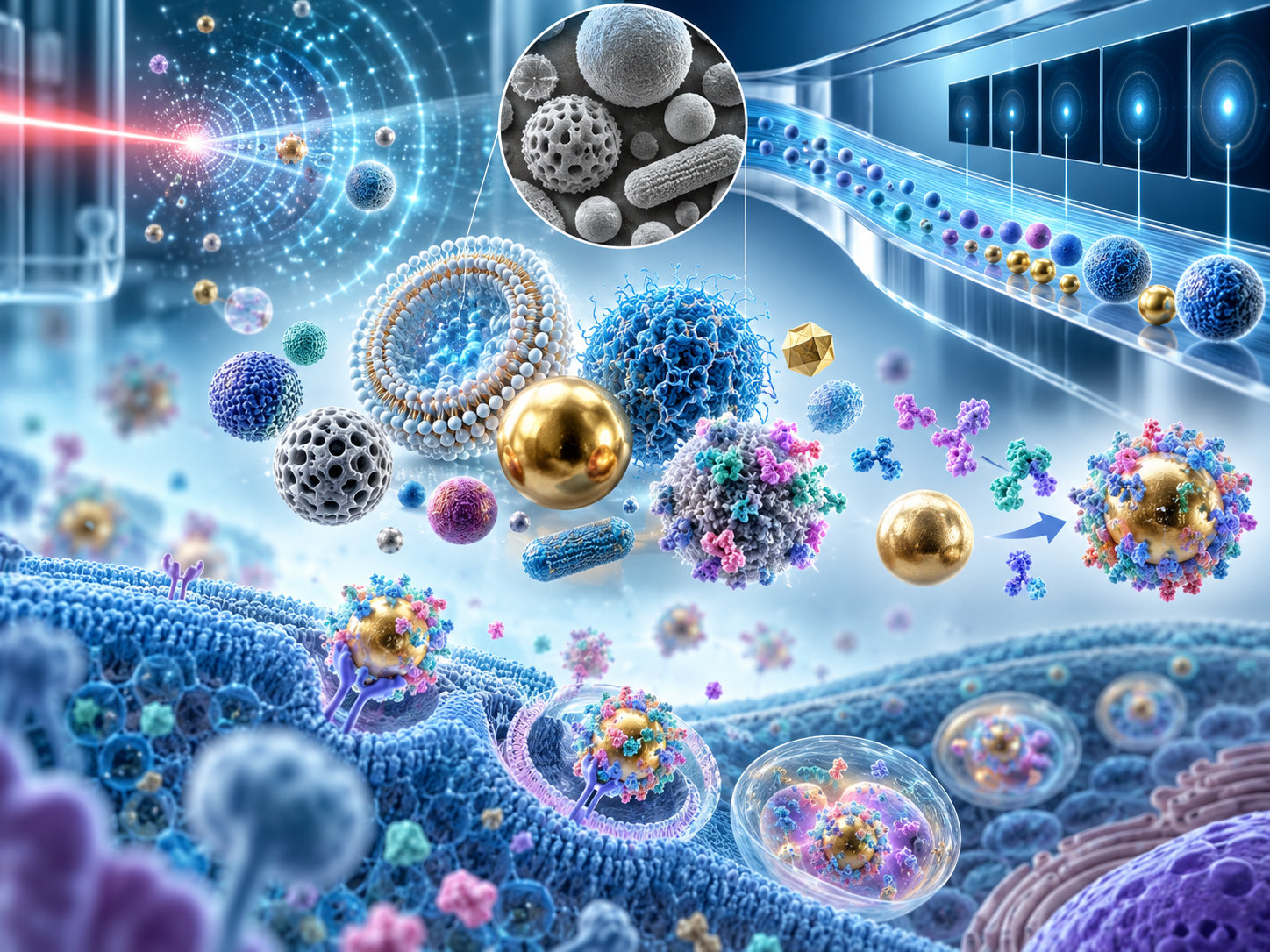
Paper: From Micromeritics to Nanomeritics: A Review and Integrative Framework for Bridging the Physicochemical-Biological Continuum. AI-generated abstract conceptual image created using ChatGPT/OpenAI
In a recent review published in the journal Pharmaceutics, researchers developed an integrative structure for nanomeritics, a concept first introduced in 2024, that extends traditional pharmaceutical micromeritics to support broader characterization of nanoparticles and their physicochemical and biological behavior.
The need for nanomeritics in nanomedicine
Nanomedicine has created new possibilities for targeted and efficient drug delivery, yet relatively few nanoparticle-enabled medicinal products (NEPs) have successfully reached patients.
The authors identify inadequate characterization as one reason for this limited translation, alongside manufacturing, biological and regulatory challenges: techniques developed for larger pharmaceutical particles do not always capture what happens when materials shrink to the nanoscale.
Their review sets out “nanomeritics” as an approach for the systematic study of pharmaceutical particles and structures approximately 5 to 1000 nm in size. At these dimensions, size, shape, surface chemistry and intermolecular forces can strongly influence stability and biological behavior.
Building the nanomeritics approach
The review examines established pharmaceutical micromeritics and compares its principles and analytical tools with those required for nanoscale systems. The authors evaluate methods for determining particle size, size distribution, morphology, surface properties, and dispersion behavior, while considering how these measurements relate to biological performance.
A major focus is DLS, a light-scattering method widely used for its speed, accessibility, and relatively low cost. DLS measures hydrodynamic diameter rather than simply the physical nanoparticle core. The measured dimension can include the surrounding solvent layer and material adsorbed on the surface.
A further limitation is that light scattering is highly sensitive to larger particles, so even small quantities of aggregates can distort measurements in samples containing particles of different sizes. The authors warn against treating a DLS-derived particle diameter as a complete description of a nanoformulation.
Their proposed strategy is orthogonal characterization, in which measurements based on different physical principles are combined. DLS can be supported by nanoparticle tracking analysis (NTA) and electron microscopy (EM). Asymmetric flow field-flow fractionation (AF4), coupled with multi-angle light scattering (MALS), provides another complementary method.
For example, AF4 can separate particles by size prior to subsequent analysis, improving resolution in heterogeneous samples. In the review's analysis of 210 primary studies published from 2016 to 2025, 76.2% used DLS as the sole sizing technique, which the authors cite as evidence that orthogonal methods remain underused.
Electron microscopy can independently reveal morphology and physical dimensions. The same approach also extends characterization to biological media, where nanoparticles may change upon encountering proteins and other physiological components.
Rethinking nanoparticle characterization
The review treats nanoparticles as systems whose behavior changes with scale. At the nanoscale, gravitational effects become less important while surface and intermolecular forces, including van der Waals, electrostatic, and capillary interactions, become increasingly dominant.
The large rise in surface area relative to mass means that surface phenomena can determine stability and performance. Traditional micromeritic measurements developed for powders can give inadequate or misleading results when transferred directly to nanomaterials.
Particle size also becomes a biological variable. The article discusses studies showing that particles made from the same material can interact very differently with cells depending on their dimensions and geometry. In one study cited in the review, 50-nm spherical gold nanoparticles showed the highest intracellular uptake among the sizes and shapes tested in HeLa cells.
The finding shows why reporting chemical composition alone provides an incomplete picture of a nanomedicine. At this scale, physical architecture can influence how a particle encounters cell membranes and enters cells.
A nano-specific issue arises when particles meet biological fluids. Plasma proteins can adsorb onto the nanoparticle surface, producing a protein corona. This newly acquired biological coating can change hydrodynamic diameter, surface charge, and hydrophilicity, and may conceal targeting molecules deliberately placed on the nanoparticle.
These surface changes can affect cellular uptake, macrophage clearance, immune activation, pharmacokinetics, pharmacodynamics, efficacy, and toxicity. The particle administered to a patient can quickly acquire properties that differ from those measured in its original formulation.
This changing behavior supports the authors’ case for nanomeritics. No single analytical technique can provide all the information needed to assess such systems reliably. DLS is convenient but relatively low-resolution.
Transmission electron microscopy provides valuable structural information, yet sample preparation and dehydration can alter delicate surface layers. Cryo-TEM can better preserve hydrated structures but requires specialist equipment and demanding preparation. AF4, NTA, and other complementary methods measure different properties of the same sample.
The review asks researchers to interpret differences between techniques by considering what each method measures, then combine independent methods to build a more reliable nanoscale picture.
Measurement choices also matter during development and regulatory review. Insufficient assessment can allow aggregation, instability, batch variation, or biologically important surface changes to remain undetected during development.
Using standardized nanomeritic methods could reveal such problems earlier, improve reproducibility, and provide stronger evidence for regulators. The authors note that complex nanomedicines increasingly require multiple complementary methods to assess size distribution, morphology, aggregation, and concentration, as well as tests in biological environments.
Advancing nanomedicine through nanomeritics
The article presents careful nanoparticle assessment as an important part of nanomedicine development. The proposed nanomeritics framework views nanoparticles as dynamic systems whose size, morphology, surface properties, and biological identity can vary with their environment.
As medicines become smaller and more structurally complex, their analysis must become more thorough. The authors argue that standardized nanomeritic practices could reduce measurement-related barriers between promising nanoscale research and clinically viable nanomedicines. They present characterization as one part of the solution, alongside better manufacturing, more predictive biological models, and clearer regulation.