AquaFluoSense pairs metal-specific aptamers with fluorescent quantum dots and portable electronics to detect trace lead and arsenic, bringing laboratory-grade water monitoring closer to on-site use.
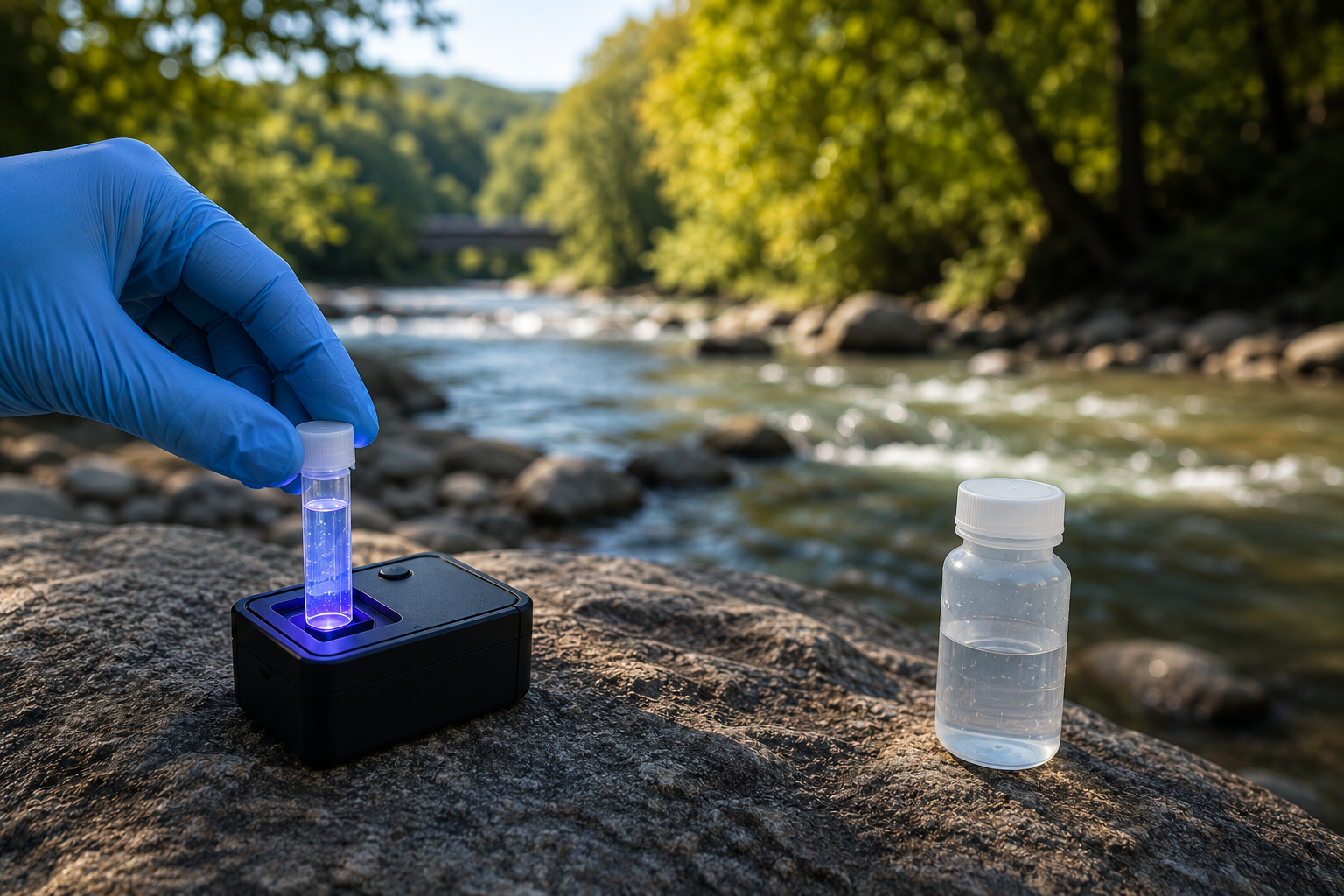
A portable fluorescence biosensor tests water for trace lead and arsenic contamination in a field setting. AI-generated conceptual image created using ChatGPT/OpenAI. Study: Nano-optical transduction sensor for ultra-sensitive detection of lead and arsenic using quantum dot nanoprobes
In a recent research article available as an 'Article in Press' in the journal Scientific Reports, researchers developed AquaFluoSense, a portable nano-optical biosensor using cadmium telluride quantum dot nanoprobes functionalized with metal-specific DNA aptamers for ultra-sensitive detection of lead and arsenic ions in environmental water samples.
Heavy Metal Detection Challenges
Heavy metal contamination in water, particularly lead (Pb²+) and arsenic (As³+), is a critical public health concern globally, with acute challenges in regions such as North India. Traditional detection methods such as atomic absorption spectroscopy (AAS) and inductively coupled plasma mass spectrometry (ICP-MS) offer high sensitivity but have drawbacks, including high costs, time-consuming analysis, the need for specialized laboratories, and trained personnel.
These limitations have driven the quest for portable, cost-effective, and highly sensitive detection platforms. Nanotechnology offers promising solutions through quantum dots (QDs), which exhibit size-tunable fluorescence, high photostability, and efficient optical signal transduction.
When combined with aptamers, which are synthetic single-stranded DNA molecules with high target specificity and stability, QDs enable highly selective sensing of metal ions via fluorescence modulation. However, the challenge remains to integrate these nanoscale materials into compact, robust devices suitable for real-world, field-based applications.
Aptamer-QD Sensor Fabrication
The study introduces AquaFluoSense, a portable nano-optical sensor designed for ultra-sensitive detection of lead and arsenic ions in environmental water samples.
The central sensing element involves cadmium telluride quantum dots capped with mercaptopropionic acid (CdTe-MPA QDs), synthesized via a controlled aqueous route that produced QDs with good colloidal stability and a relatively uniform size distribution. These QDs serve as fluorescent nanoprobes, functioning as nanoscale transducers by emitting fluorescence upon UV excitation.
Functionalization of the QDs was achieved by conjugating metal-specific DNA aptamers to the carboxyl groups of the MPA capping ligands through EDC/NHS chemistry. Aptamers were selected for their high specificity to Pb²+ and As³+ ions, enabling selective binding and subsequent conformational changes that affect the QD fluorescence signal.
Analytical characterization involved spectroscopic examination of absorption and fluorescence patterns to confirm successful nanoparticle formation and aptamer conjugation. The concentration-dependent fluorescence response upon metal ion binding was quantitatively measured.
The sensor apparatus integrates a UV LED as the excitation source, a system of biconvex lenses and optical filters for fluorescence collection and spectral isolation, and a photodiode detector linked to an Arduino Uno microcontroller for signal acquisition and processing. This configuration allows real-time fluorescence intensity measurements displayed on an LCD screen, facilitating on-site analysis without laboratory infrastructure.
Calibration and validation were performed using spiked laboratory water samples across nanomolar concentrations of Pb²+ and As³+. Real environmental samples were collected from multiple locations with varying contamination levels.
Corresponding metal ion concentrations were also measured using ICP-MS to assess the sensor’s accuracy and reliability. Fluorescence-based binding assays were used to estimate aptamer-metal ion dissociation constants, while the methods also describe electrophoretic mobility shift assays as an additional ligand-binding approach.
Sensor Performance and Validation
The synthesized CdTe-MPA QDs exhibited expected size-dependent optical properties, including progressive redshifts in absorption and emission spectra, consistent with controlled growth during synthesis.
Mercaptopropionic acid capping provided colloidal stability essential for downstream bioconjugation with aptamers and supported reproducible fluorescence behavior. FTIR and photoluminescence analyses supported successful aptamer attachment to the QD surface while preserving useful optical functionality.
Upon binding with Pb²+ or As³+ ions, the aptamer-functionalized QDs exhibited clear, concentration-dependent fluorescence modulation. The authors propose that target-induced changes in the aptamers alter the local QD environment and may modulate fluorescence through non-radiative pathways such as Förster resonance energy transfer or photoinduced electron transfer.
The sensors displayed detection limits of 1.2 nM for lead and approximately 0.45 nM for arsenic, demonstrating nanomolar sensitivity sufficient to detect concentrations below WHO drinking-water guideline levels.
Integration into the AquaFluoSense platform enabled rapid signal detection in a portable configuration. The optical pathway efficiently directs excitation light and captures emitted fluorescence using compact, inexpensive components, with optical isolation and filtering designed to reduce background noise and improve the signal-to-noise ratio during operation.
The microcontroller-based signal processing delivered real-time quantitative outputs that correlated strongly with ICP-MS reference data, with coefficients of determination (R²) exceeding 0.98, indicating strong analytical agreement between the two methods.
Testing of environmental water samples from locations including Amritsar and Bathinda revealed heterogeneity in contaminant levels, which the sensor also tracked, supporting its potential for field deployment. Crucially, the aptamer-QD sensing chemistry showed little cross-reactivity to the tested non-target metal ions. Environmental matrix constituents also did not appear to substantially interfere with sensor performance. This highlights the advantage of using nanoscale aptamer conjugates in conferring target specificity in complex environmental samples.
Field Deployment and Future Prospects
This research successfully demonstrates the development of a portable nano-optical biosensor leveraging CdTe quantum dots functionalized with metal-specific DNA aptamers for ultra-sensitive, selective detection of lead and arsenic ions in water. The findings support practical field use, although AquaFluoSense remains a prototype platform requiring further development and broader validation.
Future enhancements incorporating automated calibration, multiplex sensing, wireless communication, and artificial intelligence">AI-assisted processing could further develop this nanosensor into a next-generation tool for widespread heavy metal monitoring.
Overall, this work exemplifies how nano-enabled biosensors can bridge the gap between laboratory research and practical, field-based environmental monitoring, addressing urgent societal needs with portable and accessible sensing technologies.
Source:
- Khajuria A., Pothal P., et al. (2026). Nano-optical transduction sensor for ultra-sensitive detection of lead and arsenic using quantum dot nanoprobes. Scientific Reports. DOI: 10.1038/s41598-026-65438-z, https://www.nature.com/articles/s41598-026-65438-z