Researchers examine how hollow carbon architecture, pore structure, and slurry behavior influence ion transport and energy use in a continuously recirculating desalination system.
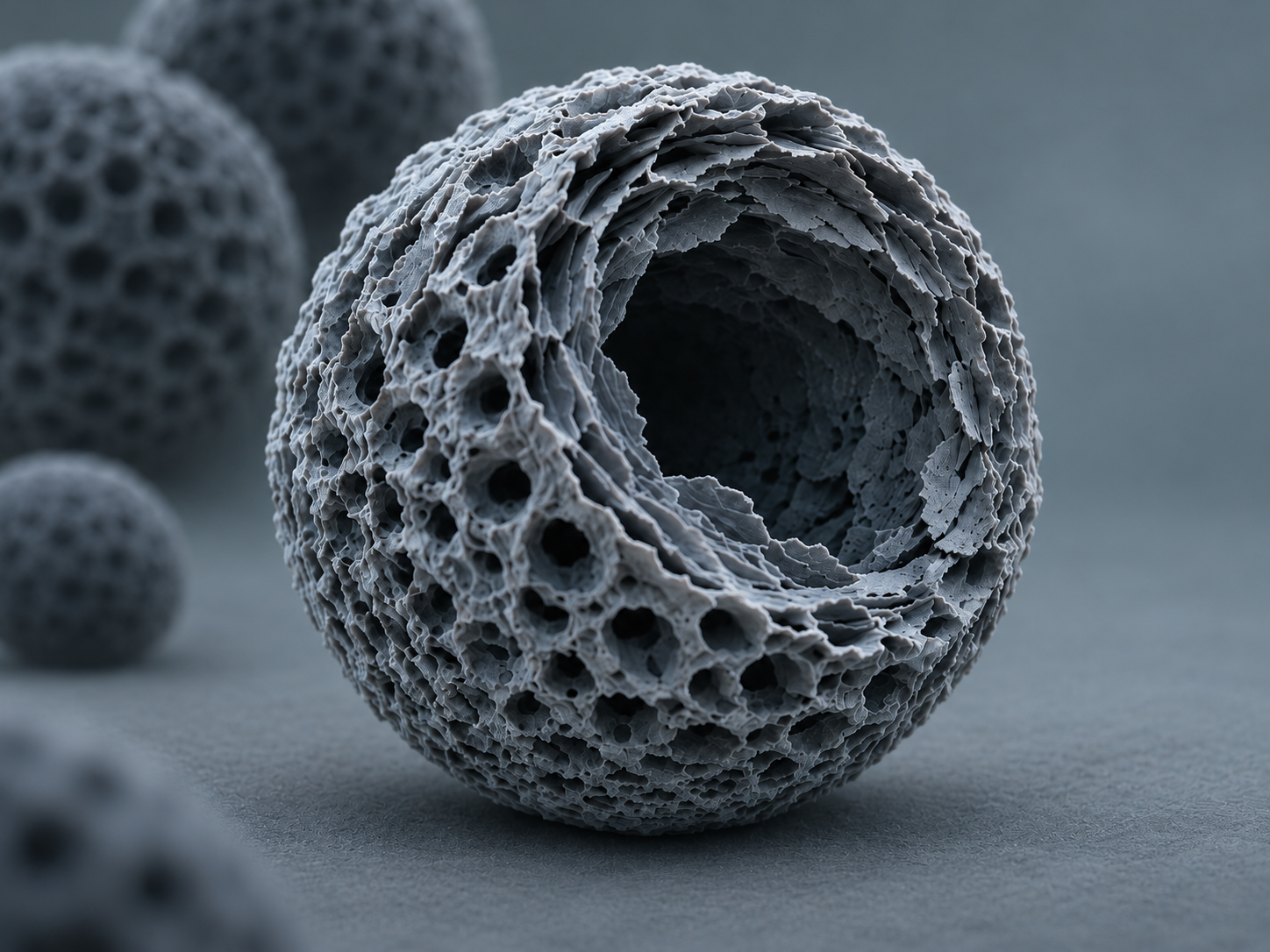
Paper: Hierarchical hollow carbon spheres as advanced flow electrodes for high-efficiency capacitive desalination. AI-generated abstract conceptual image created using ChatGPT/OpenAI
In a recent research article published in the journal npj Materials Sustainability, researchers synthesized and applied hierarchical hollow carbon nanospheres as advanced flow-electrode materials, improving desalination performance and short-term operating stability in flow-electrode capacitive deionization for water desalination.
Flow-electrode material challenges
Freshwater scarcity is a pressing global challenge intensified by population growth and climate change. Desalination technologies have become increasingly important in addressing this issue. Among them, capacitive deionization (CDI) has drawn attention for its relatively low energy consumption, operational simplicity, and eco-friendliness.
Conventional CDI relies on static porous electrodes to cyclically adsorb and release ions, but intermittent operation, finite ion storage capacity, and reduced effectiveness at high salinities limit its applications.
To address these constraints, flow-electrode capacitive deionization (FCDI) has emerged, using electrically conductive carbon slurry electrodes that flow continuously, enabling persistent ion adsorption and regeneration. The performance of FCDI is largely governed by the intrinsic physicochemical properties of the flow-electrode materials.
Activated carbon (AC), a commonly used material, faces issues such as particle aggregation, inadequate electronic connectivity, poor dispersion stability, and slow ion transport due to its predominantly microporous structure. Refining the micro- and nanostructure of carbon particles in flow electrodes is needed to improve FCDI efficiency.
Synthesis and characterization techniques
HCNSs were synthesized via controlled templating and pyrolysis processes to achieve a well-defined hollow spherical morphology with a hierarchical pore size distribution. For comparison, commercial activated carbon (AC) and hollow mesoporous carbon nanospheres (HMCNs) were employed as benchmarks.
The morphologies and internal nano-architectures were investigated using scanning electron microscopy (SEM) and transmission electron microscopy (TEM).
SEM revealed particle size, uniformity, and shape, while TEM revealed hollow structures and the distribution of nanoscale pores. Nitrogen adsorption/desorption isotherms characterized surface area and pore size distribution, with attention to microporous, mesoporous, and macroporous contributions.
Flow electrodes were prepared by dispersing the carbon materials into aqueous slurries at different weight percentages to investigate rheological properties and identify an effective carbon loading. Rheological behavior was analyzed using the power-law model to understand shear-thinning properties relevant to slurry circulation.
Electrochemical behavior was evaluated by assembling an FCDI cell in short-circuited closed-cycle (SCC) mode, in which the electrode slurry is recirculated and regenerated during operation, applying voltages between 1.0 and 1.6 V, and varying parameters such as carbon content and salt concentration.
Key performance metrics included average salt removal rate (ASRR), charge efficiency (CE), energy consumption (Em), and salt removal efficiency (SRE), quantified from concentration changes, current profiles, and voltage measurements during operation.
Desalination performance and analysis
SEM images showed that, unlike irregular, micron-sized AC particles, HCNSs had uniform spherical nanoscale morphologies around 660 nm in diameter, with a shell thickness of about 205 nm.
TEM images confirmed the hollow core-shell architecture of HCNSs, with radially aligned carbon nanosheets in the outer shell and a microporous inner shell. Contrast variations in the shell's middle suggested the possible presence of window-like macropores.
This hierarchical pore structure was absent in commercial AC and only partially present in HMCNs, which had predominantly mesoporous shells and smaller particle sizes (~560 nm). Combined microscopy and nitrogen adsorption analyses supported a hierarchical pore network in HCNSs spanning micropores, mesopores, and larger pores or voids.
The researchers linked HCNSs' nanoscale hierarchical porosity to improved ion accessibility and transport pathways. They proposed that the hollow interior lowers mass-transfer resistance, while the macro- and mesopores provide faster ion-diffusion pathways and support charge transfer.
Rheological tests showed that slurries containing HCNSs had the lowest viscosity of the three materials tested, and all three slurries showed shear-thinning behavior. A 5 wt% HCNS loading produced the best balance of salt removal and energy use among the carbon loadings tested.
Electrochemical analyses indicated that HCNS-based flow electrodes outperformed those with HMCNs and AC in the study's direct comparison. Under the selected conditions of 1.2 V and 5 wt% carbon content, HCNSs achieved an ASRR of 66.86 μg cm−2 min−1, a 31.7% improvement over HMCNs and significantly higher than AC.
The charge efficiency reached 91.03%. The researchers attributed the strong desalination results to improved electron and ion transport associated with the hierarchical pores and hollow geometry.
Under these conditions, energy consumption was low (~0.037 kWh mol−1), 5.4% lower than for HMCNs. AC used slightly less energy but removed salt much more slowly, so HCNSs provided a better overall balance of removal rate and energy use.
HCNSs also maintained stable salt removal over six consecutive cycles, and post-cycle characterization showed preserved microstructure. In a separate 12-hour closed-loop recirculation test, the system sustained an ASRR of 57.85 μg cm−2 min−1.
Operational parameter studies revealed that increasing carbon content beyond 5 wt% had diminishing returns. The researchers suggested that partial blockage of the flow channels at 7.5 wt% may have limited effective use of the suspended carbon particles.
Higher NaCl concentrations increased ASRR, which the authors linked to reduced internal resistance and faster ion transport, but decreased charge efficiency.
The paper proposed that increased Faradaic reactions and ion leakage through the ion-exchange membranes at higher ionic strengths may have contributed to this decline. Increasing the applied voltage improved salt removal but increased energy consumption, which the authors linked to Faradaic side reactions, such as water electrolysis, at higher voltages.
The experiments used laboratory-prepared NaCl solutions representing simulated brackish water, with concentrations from 1000 to 5000 mg L−1. They did not test natural seawater, real brackish water, or wastewater containing multiple salts and other constituents.
Structural advantages and applications
The study found that hierarchical hollow carbon nanospheres produced better overall salt removal than the AC and HMCN benchmark electrodes under the tested conditions, with performance linked to their hierarchical pore structure and hollow spherical morphology. HMCNs had a higher specific surface area and specific capacitance than HCNSs, yet HCNSs achieved a higher desalination rate.
This result suggests that ion transport, pore accessibility, electrical resistance, and slurry flow can matter more in FCDI than maximizing surface area or static capacitance alone.
HCNSs provide a material design for further FCDI research on efficient, durable flow electrodes.
Further work is needed to assess longer-term durability, the practical implications of the synthesis process, performance in real water sources, and whether the material can be produced economically at larger scale. This study provides design data linking pore architecture, slurry rheology, electrical resistance, and desalination performance in nanostructured carbon flow electrodes.
Source:
- Tan Z., Wang K., et al. (2026). Hierarchical hollow carbon spheres as advanced flow electrodes for high-efficiency capacitive desalination. npj Materials Sustainability 4, 44. DOI: 10.1038/s44296-026-00130-x, https://www.nature.com/articles/s44296-026-00130-x