A hybrid cell-membrane coating and enzyme-responsive antibiotic carrier aim to address several drivers of periodontal damage in a single treatment platform.
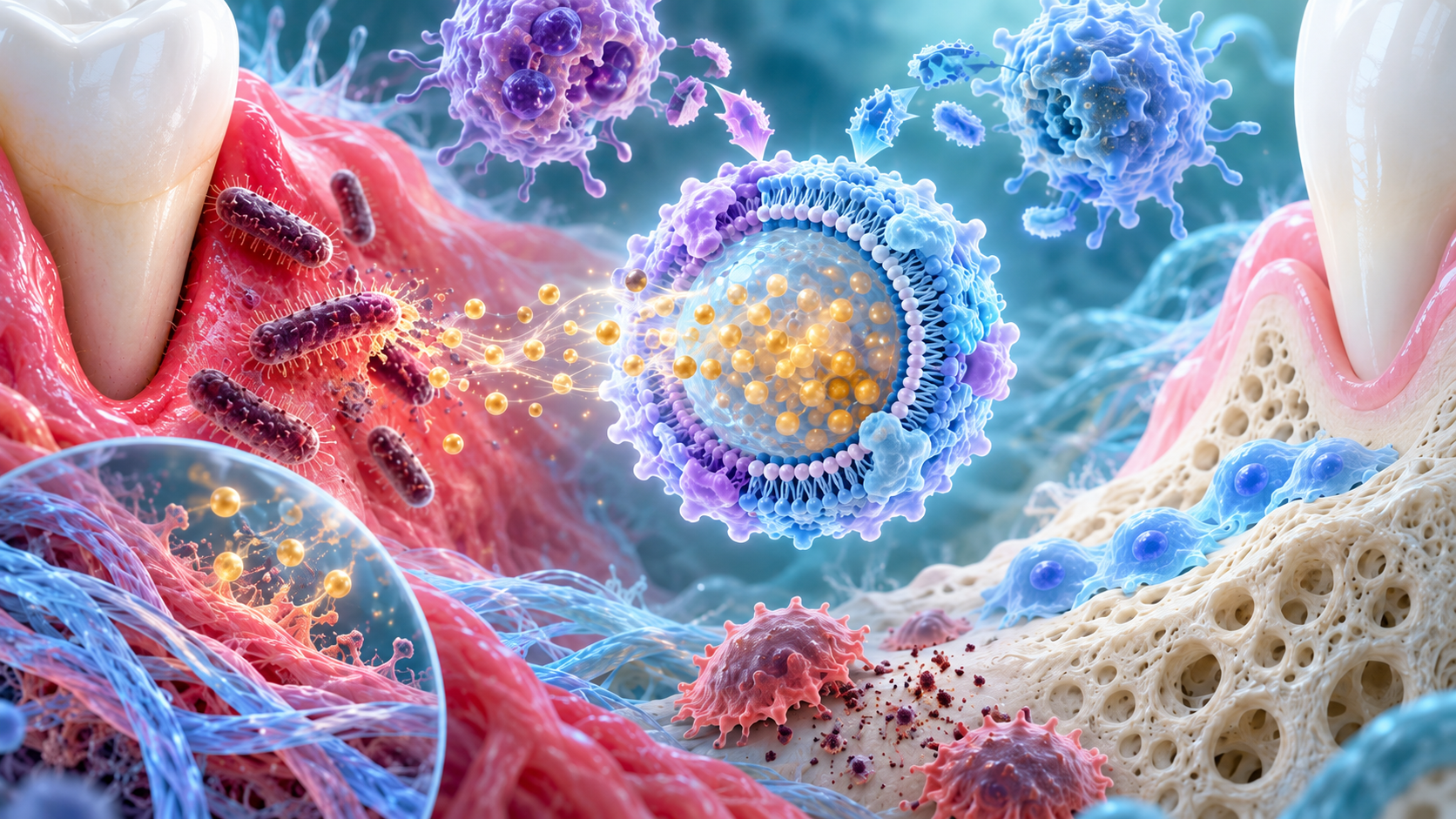
Paper: A biomimetic nanoparticle coordinates antibacterial and immunomodulatory functions to promote periodontal regeneration. AI-generated abstract conceptual image created using ChatGPT/OpenAI
A recent study in the International Journal of Oral Science describes a biomimetic nanoparticle platform designed to treat periodontitis by combining antibacterial activity, immune regulation, and tissue regeneration.
The researchers developed a minocycline-loaded gelatin nanoparticle coated with a hybrid neutrophil–macrophage membrane.
In laboratory experiments, the nanoparticles showed strong antibacterial activity, reduced inflammatory responses, increased osteogenesis-associated activity, and suppressed osteoclast differentiation.
In a rat periodontitis model, treatment also reduced inflammatory markers, improved collagen organization, and limited alveolar bone loss.
Addressing the Multiple Challenges of Periodontal Disease
Periodontitis is a chronic inflammatory disease that damages the tissues supporting the teeth, including the gingiva, periodontal ligament, and alveolar bone. Bacterial infection, persistent inflammation, and an imbalance between bone formation and resorption drive disease progression. Porphyromonas gingivalis, a major periodontal pathogen, promotes chronic inflammatory responses in periodontal tissues.
Conventional treatments primarily target bacterial infection, but controlling the pathogen alone may not resolve the inflammation that drives ongoing tissue damage. Persistent immune activation can stimulate osteoclast formation and accelerate alveolar bone loss. The authors argue that effective treatment should address infection, inflammation, and tissue destruction simultaneously.
In this study, researchers developed a biomimetic drug delivery system that combines neutrophil and macrophage cell membranes with a biodegradable nanoparticle carrier. By incorporating minocycline, an antibacterial agent with reported immunomodulatory activity, the platform aims to control infection, regulate inflammation, and support periodontal repair.
Engineering a Biomimetic Nanoparticle for Responsive Drug Delivery
The researchers developed NMm@MINO by loading minocycline into gelatin nanoparticles and coating them with hybrid neutrophil–macrophage membranes.
Gelatin provides a biodegradable carrier that responds to proteolytic enzymes found in inflamed tissues, while the hybrid membrane coating adds biological functionality to the nanoparticle surface. The coating was designed to support inflammation-associated interactions, but the study did not directly measure whether it improved active targeting in vivo.
The team isolated neutrophil membranes from rat bone marrow using gradient centrifugation and obtained macrophage membranes from cultured macrophages. They combined the two membrane sources to prepare the hybrid coating. Fluorescence colocalization and protein electrophoresis helped verify membrane integration and composition.
The researchers then refined the minocycline-to-gelatin ratio and characterized the resulting nanoparticles.
The nanoparticles measured 261.53 ± 11.59 nm in hydrodynamic diameter, with a membrane shell thickness of around 21 nm. They also remained colloidally stable for 30 days in aqueous dispersion. In gelatinase-containing conditions, the formulation released 50% of its loaded drug within two hours and approached release equilibrium around eight hours.
These results demonstrate enzyme-responsive drug release under the tested conditions, but studies in periodontal tissues are still needed to establish how well this mechanism operates in vivo.
The team evaluated the formulation's antibacterial activity, effects on macrophage responses, bone-forming cell activity, osteoclast differentiation, and fibroblast behavior. Finally, they tested NMm@MINO in a rat model of ligature-induced periodontitis to assess inflammation, collagen remodeling, and alveolar bone loss.
Coordinating Antibacterial Activity with Immune Regulation
NMm@MINO eliminated more than 99% of P. gingivalis and Staphylococcus aureus under the tested laboratory conditions. The antibacterial results indicate that minocycline drove bacterial killing, while the hybrid membrane alone showed little bactericidal activity and served mainly as a biomimetic carrier in the antibacterial experiments.
The formulation also altered macrophage-associated inflammatory responses. Persistent pro-inflammatory M1-associated activity can contribute to tissue damage, whereas M2-associated responses often support inflammation resolution and repair. NMm@MINO reduced the expression of M1-associated markers, including Nos2, Tnf, Il1b, and Cd86, while increasing M2-associated markers such as Mrc1, Arg1, and Tgfb1.
Immunofluorescence analysis further showed reduced iNOS and increased CD206 signals, consistent with a shift toward a less inflammatory macrophage profile. The authors attributed most of the polarization effect to minocycline. The hybrid membrane contributed less. Separate cytokine-neutralization tests suggested that membrane-coated nanoparticles could sequester IL-1β and IL-6 under the test conditions.
Bone-metabolism experiments showed that treatment increased the expression of osteogenesis-associated genes, including Alpl, Spp1, and Runx2, indicating a stronger osteogenic response. Reduced tartrate-resistant acid phosphatase (TRAP) staining and lower expression of Acp5, Tnfrsf11a, Ctsk, Fos, and Mmp9 indicated decreased osteoclast-associated activity.
The formulation also supported soft-tissue repair processes. Laboratory experiments showed improved fibroblast migration and increased collagen I immunofluorescence, suggesting greater cellular activity associated with periodontal tissue remodeling. These findings show effects beyond antibacterial action.
Improving Periodontal Outcomes in an Animal Model
The researchers tested NMm@MINO in rats with ligature-induced periodontitis at three disease stages. They maintained ligatures for 3, 7, or 14 days before removal, then injected therapeutic agents locally every three days.
Immunohistochemical analyses showed lower interleukin-6 (IL-6) and C-reactive protein (CRP) signals following treatment. Il6, Crp, and Il1b expression also declined, consistent with reduced inflammation.
Hematoxylin and eosin (H&E) and Masson's trichrome staining revealed improved tissue organization and collagen remodeling. Increased Col1a1 expression further supported the formulation's potential to promote collagen-associated repair. The researchers used micro-computed tomography (micro-CT) to assess alveolar bone structure.
Micro-CT measurements included the distance between the cementoenamel junction and alveolar bone crest (CEJ–ABC), bone volume fraction (BV/TV), trabecular number (Tb.N), trabecular thickness (Tb.Th), and trabecular separation (Tb.Sp).
The results showed that NMm@MINO mitigated alveolar bone loss and improved bone microarchitecture measures compared with untreated disease conditions. Cell viability and blood compatibility tests, along with animal safety observations, were consistent with short-term biocompatibility at the tested doses, but long-term safety and repeated-dose effects remain unknown.
Toward Multifunctional Nanotechnology for Periodontal Regeneration
The study presents a biomimetic nanoparticle platform that combines antibacterial drug delivery, immune regulation, and tissue-repair functions. Its hybrid membrane and minocycline-loaded gelatin core were designed to address several connected mechanisms of periodontal damage.
NMm@MINO showed strong antibacterial activity, reduced pro-inflammatory macrophage markers, promoted osteogenesis-associated responses, and suppressed osteoclast differentiation. In rats, treatment reduced inflammatory markers, improved collagen remodeling, and limited alveolar bone loss. The findings support pro-regenerative effects but do not establish complete restoration of mature, functional periodontal tissues.
The animal model does not establish efficacy in humans. Future studies need to assess long-term safety, repeated dosing, antibiotic resistance, and effects on the oral microbiome.
Researchers also need to measure active targeting and periodontal retention, clarify membrane-related mechanisms, and compare NMm@MINO directly with established local drug-delivery treatments. Other barriers to clinical translation include reproducible membrane preparation, manufacturing scale-up, storage stability, and batch consistency.
These findings provide a basis for further study of NMm@MINO to combine infection control, inflammation modulation, and periodontal tissue repair.
Disclaimer: The views expressed here are those of the author expressed in their private capacity and do not necessarily represent the views of AZoM.com Limited T/A AZoNetwork the owner and operator of this website. This disclaimer forms part of the Terms and conditions of use of this website.
Source:
- Tang, Y., Xu, J., et al. (2026). A biomimetic nanoparticle coordinates antibacterial and immunomodulatory functions to promote periodontal regeneration. International Journal of Oral Science, 18, 67. DOI: 10.1038/s41368-026-00459-y, https://www.nature.com/articles/s41368-026-00459-y