
A material’s mechanical properties influence how it can be processed, how it performs in service, and how long it lasts. Understanding these properties is therefore crucial to making effective design decisions.
Polymers are particularly complicated because their mechanical behavior is affected by chemical composition, processing conditions, and thermal-mechanical history. Their response also depends on factors such as parent-chain type and length, branching, cross-linking, strain, temperature, and frequency, many of which interact with one another. Mechanical behavior may additionally be affected by volume constraints.
For this reason, a polymer may behave differently as a thin film than it does as a large block, since restricted molecular mobility can alter its response. To obtain meaningful information for polymer design, mechanical properties should be measured on a representative sample under conditions relevant to the intended application. Nanoindentation makes this type of application-specific testing more practical because it requires only small, minimally prepared specimens.
Polymers are widely used because they can both store and dissipate energy. The complex modulus represents both of these capabilities as a phase vector:
The real component, E', is the storage modulus and describes the material’s capacity to store energy elastically. When damping is minimal, the storage modulus is essentially equivalent to Young’s modulus. The imaginary component, E'', is the loss modulus and describes the material’s capacity to dissipate energy.
Nanoindentation can determine the complex modulus by applying an oscillation to an indenter while it remains in contact with the specimen. A force oscillation of amplitude (F0) is applied, while the resulting displacement amplitude (z0) and phase shift (Φ) are measured. The storage modulus is largely determined by the real component of the amplitude ratio:
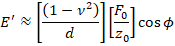 |
(2) |
The loss modulus is largely determined by the imaginary component of the amplitude ratio:
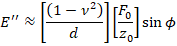 |
(3) |
In Equation 3, v is the Poisson’s ratio of the tested material and d is the contact diameter; both remain constant for a given specimen. The dimensionless loss factor is independent of contact geometry because it is defined as the ratio of loss modulus to storage modulus:
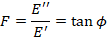 |
(4) |
This work applies the technique to characterize four types of polyethylene, the most widely used plastic worldwide. The materials examined were high-density polyethylene (HDPE), linear low-density polyethylene (LLDPE), low-density polyethylene (LDPE), and very-low-density polyethylene (VLDPE, where π = 0.87 g/cm3).
Experimental Procedure
The HDPE, LLDPE, LDPE, and VLDPE specimens were obtained from a petrochemical company. Each specimen was prepared as an approximately 1-mm-thick disk with an 8-mm diameter. The samples were attached to an aluminum puck with a glass surface, which provided a smooth, disposable testing area.
Testing was performed using a Nano Indenter® G200 equipped with an XP actuator and the continuous stiffness measurement (CSM) option. The XP actuator generates force electromagnetically and measures displacement with a three-plate capacitive gauge. The CSM capability enables an oscillating force to be superimposed on the applied load.
Flat-ended cylindrical tips are useful for polymer testing for two reasons: they tend to produce deformation consistent with the assumption of linear viscoelastic behavior, and their contact area is known and does not vary with indentation depth. Although two different tips were used, both were flat-ended cylinders.
Table 1. Summary of Experimental Conditions. Source: KLA Instruments™
| Material |
Temp (°C) |
Frequency Range (Hz) |
Punch diameter (µm) |
Force Amplitude F0 (µN) |
| VLDPE |
27.3 |
1–45 |
107.1 |
70 |
| LDPE |
26.8 |
1–45 |
21.15 |
445 |
| LLDPE |
27.3 |
1–45 |
21.15 |
750 |
| HDPE |
27.1 |
1–45 |
21.15 |
2200 |
Results and Discussion
Table 2 presents the results for all materials at 1 Hz. The frequency-dependent results are shown in Figures 1 and 2. Each plotted value is the average of all measurement locations for a given material and frequency, while the error bars represent one standard deviation.
Table 2. Summary of Experimental Results
| Material |
E’ @ 1 Hz (MPa) |
LF @ 1 Hz (Hz) |
| VLDPE |
16.2 ±0.052 |
0.043 ±0.0010 |
| LDPE |
260 ±17.4 |
0.197 ±0.0010 |
| LLDPE |
481 ±15.1 |
0.150 ±0.0020 |
| HDPE |
1554 ±7.4 |
0.108 ±0.0012 |
Two key trends are evident in the storage modulus results shown in Figure 2.
First, across the tested frequency range, the storage moduli show only a weak dependence on frequency.
Second, the storage moduli follow the expected order based on the materials’ chemistry. Different polymerization methods produce substantially different properties, partly because they create different levels of branching from the parent chain. Branching occurs when a polymer chain replaces an atom in the parent chain.2
HDPE has relatively little branching, allowing its polymer chains to pack closely. This produces higher density, stronger intermolecular forces, and, on a macroscopic scale, a higher storage modulus. LLDPE, LDPE, and VLDPE show increasing levels of branching, respectively, resulting in weaker intermolecular forces. Consequently, these materials exhibit progressively lower storage moduli and greater ductility during forming.
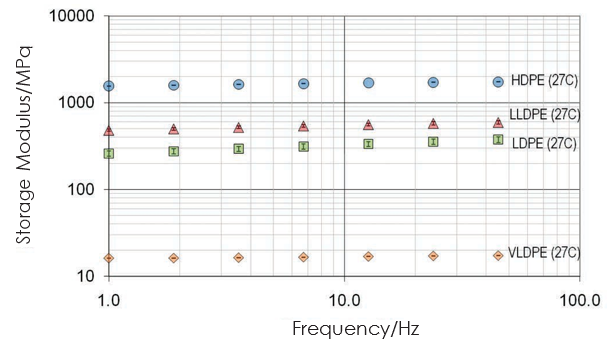
Figure 1. Storage modulus vs. frequency for the four polyethylene samples shown in Figure 1. Storage moduli are ordered as expected by density. Image Credit: KLA Instruments™
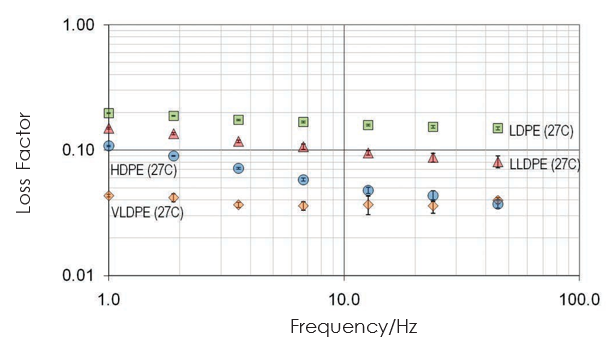
Figure 2. Loss factor (tanφ) vs. frequency for the four polyethylene samples. A decrease in frequency points to a phase transition at a lower frequency. Image Credit: KLA Instruments™
References and further reading
- Hay, J.L. (n.d.) Using instrumented indentation to measure the complex modulus of highly plasticized polyvinyl chloride. Application Note. Milpitas, CA: KLA Instruments. Available at: https://assets.toyo.co.jp/files/user/img/product/microscopy/pdf/5990-6330EN.pdf.
- Hiemenz, P.C. and Lodge, T.P. (2007) Polymer chemistry. 2nd edn. Boca Raton: CRC Press, pp. 3–9.
- Hay, J.L. and Herbert, E.G. (2013) Measuring the complex modulus of polymers by instrumented indentation testing, Experimental Techniques, 37(3), pp. 55–61. DOI:10.1111/j.1747-1567.2011.00732.x. https://onlinelibrary.wiley.com/doi/abs/10.1111/j.1747-1567.2011.00732.x.

This information has been sourced, reviewed, and adapted from materials provided by KLA Instruments™.
For more information on this source, please visit KLA Instruments™.