In this interview, industry expert Bryan Crawford explains how the KLA Instruments' SRX™ option enables reliable high-strain-rate nanoindentation, helping researchers better understand material behavior under real-world dynamic loading while streamlining advanced mechanical testing workflows.
Could you briefly introduce yourself and your role at KLA Instruments?
I’m Bryan Crawford, the Product Marketing Manager for KLA Instruments’ Nano Indenter® product line. In my role, I spend a lot of time with industry leaders, academic researchers, and professionals across various markets to understand the evolving landscape of localized mechanical testing.
I focus particularly on situations where micro- and nanoscale mechanics provide critical insights into material performance, reliability, and processing.
A key part of my responsibility is translating these insights into our product development cycle to ensure we not only meet current customer needs but also anticipate future requirements. What I find most rewarding about this work is discussing meaningful problems with researchers, where small-scale mechanical behavior makes a real-world difference, whether in advanced alloys, semiconductors, or everyday materials.
What specific challenges in nanoindentation or high-strain-rate testing led you to develop the SRX™ option?
The development of the SRX option was motivated by a persistent gap we repeatedly heard from the field. For decades, many materials labs have been limited to quasi-static nanoindentation conditions, as high-strain-rate testing has often been inaccessible due to equipment complexity, difficult signal interpretation, or the cost and expertise required to reliably reconstruct high-rate data.
The challenge is that materials can behave very differently under dynamic or transient loading compared to quasi-static conditions. In real-world applications such as impact events, crash conditions, or short-duration mechanical shocks, materials don’t always fail through the same mechanisms you’d infer from slow testing.
As a result, there is growing recognition among advanced indentation researchers that quasi-static data alone is often insufficient to understand performance and failure in high-strain-rate environments. The SRX option was developed to bridge that gap, enabling more accessible and reliable high-strain-rate testing.
At a high level, which previously inaccessible capabilities does SRX bring to nanoindentation, and what fundamental limitations in existing techniques were you most focused on overcoming when it was conceived?
At a high level, the SRX option expands nanoindentation into the realm of transient deformation behavior under dynamic loading, capabilities that historically were limited to a small number of specialized, high-end labs.
It enables researchers to quantify how a material responds when pushed toward its limits as strain rate changes, providing critical insight into rate-dependent strengthening, deformation mode transitions, and failure risk in real-world loading conditions.
When SRX was conceived, the fundamental limitation we focused on overcoming was not simply “going faster”; rather, it was achieving high-rate testing with confidence in the measurement. Achieving this required addressing several fundamental limitations inherent in traditional testing.
The first of these is the control bandwidth limitation, which makes it hard to maintain a consistent target strain rate at high speeds. Secondly, displacement measurement time constants often blur fast transient responses, reducing data fidelity.
Finally, synchronization between load and displacement signals reduces the need for complex post-processing or reconstruction steps after the experiment.
By overcoming these constraints, SRX delivers a seamless workflow for measuring strain-rate sensitivity, lowering the expertise barrier while preserving data quality for advanced users.
How does the SRX option enable researchers to probe material responses relevant to extreme environments, such as high-impact conditions, compared to conventional nanoindentation approaches?
Extreme events with high impact are defined by transient deformation at very high strain rates. Materials tested with quasi-static conditions often fail in these real-world conditions due to mechanisms that are not observable during traditional testing.
The SRX option enables researchers to probe material response within the deformation regime that more closely resembles real-world conditions, rather than extrapolating from slow traditional testing.
Conventional nanoindentation is typically performed under quasi-static conditions, where materials have sufficient time to activate deformation mechanisms that accommodate stress through plastic flow. Under rapid loading, some of these mechanisms are effectively suppressed or arrested, fundamentally altering how materials redistribute stress and can shift behavior toward localization or fracture.
SRX helps researchers see this rate-dependent behavior in real time, reducing the “blind spot” associated with relying solely on quasi-static metrics.
From a technical standpoint, what are the key performance or system-level innovations behind SRX that make this new testing regime possible, particularly in terms of timing, control, and data fidelity?
SRX is enabled by system-level innovations in timing, measurement fidelity, and control, paired with software workflows that make the results actionable across user experience levels. Contact a KLA Instruments representative to receive a demo of the new SRX option.
Can you walk through a representative use case in which a materials R&D team leverages SRX, from test design through data interpretation, and explain how the resulting insights would change material selection, processing decisions, or modeling compared with standard nanoindentation?
A representative example is material selection for protective or energy-absorbing structures designed for high-energy impact environments. In this scenario, a materials R&D team may be developing a metallic component intended to withstand rare but critical short-duration loading events.
The objective is to ensure that the material can absorb energy through controlled plastic deformation rather than failing through sudden fracture, which could lead to localized material breakup.
In standard nanoindentation testing, multiple candidate alloys may exhibit similar hardness values, making it difficult to distinguish performance under application-relevant loading conditions. With SRX, the team can run a targeted strain-rate sweep and reveal differences in strain-rate sensitivity that are invisible under quasi-static conditions.
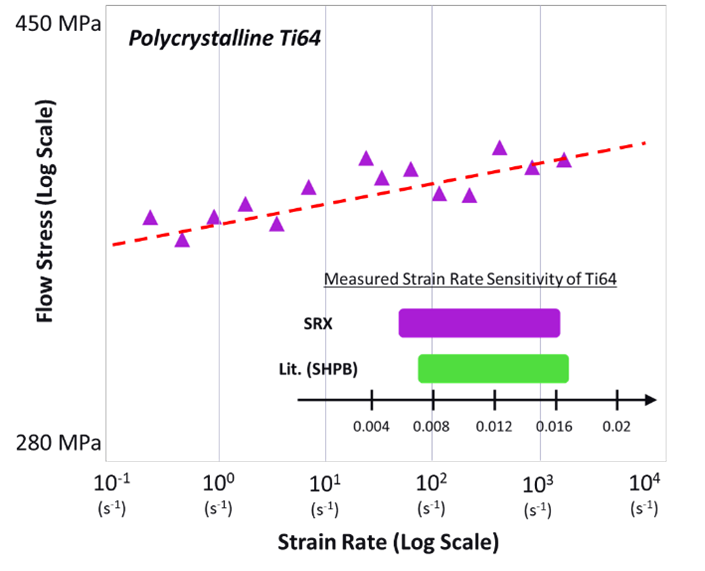
Image Credit: KLA Instruments™
A strain rate sweep shows SRX-measured hardness vs. log strain rate for Ti-64 with direct comparison to data from literature.
For example, SRX may identify specific alloy formulations whose hardness response remains relatively stable as strain rate increases. This is a more consistent indicator of distributed plastic flow and reduced risk of localized failure under high-impact loading.
These insights can guide material selection toward compositions that balance strength and rate response more effectively. In parallel, the SRX data can inform processing or heat-treatment optimization and improve the quality of inputs for impact-response models, helping teams narrow candidates earlier, before committing to costly large-scale testing.
For labs already using KLA nanoindentation systems, how does SRX integrate into existing workflows in terms of software, automation, and throughput, and what design choices were made specifically to minimize barriers to adoption for both academic and industrial users?
SRX is intentionally designed to fit naturally into existing nanoindentation workflows. In practical terms, it can be run as an additional array alongside tests users already set up, and the workflow is structured to automatically sample strain-rate sensitivity across multiple orders of magnitude, including regimes above 1000 s-1, without requiring users to become experts in high-rate controls.
The single biggest adoption barrier we eliminated is native signal synchronization. In many high-rate approaches, users must reconstruct data after the test by aligning load and displacement signals, modeling time constants, and managing offsets. This requires a significant amount of specialized expertise that many labs may not have.
With SRX and the supporting iQWave2™ controller, synchronization is intrinsic, and the test method plus software workflow handle acquisition and analysis steps that previously required specialized knowledge.
For both academic and industrial labs, the intent is straightforward: make high-rate results trustworthy, repeatable, and easy to produce, while keeping the workflow compatible with automation and throughput expectations.
What broader trends in materials research is SRX particularly well-suited to support, especially as researchers focus on extreme loading conditions, automation and data-driven materials design? How do you see SRX evolving as those needs continue to advance?
One major trend is the growing focus on designing metallic and ceramic systems specifically for rare, high-consequence loading scenarios, where materials must balance competing behaviors under high-rate, transient loading. In these environments, there is often a fine line between leveraging rate-dependent strengthening to resist deformation and avoiding responses that increase brittleness and fracture risk.
Understanding and deliberately tuning strain-rate sensitivity is becoming central to modern materials design in these extreme-use applications.
At the same time, research is becoming more automation- and data-driven. High-throughput formulation approaches, such as combinatorial materials development, are generating large numbers of candidate material compositions that must be screened efficiently.
The SRX option is well positioned to support this shift because nanoindentation requires very small material volumes and can generate statistically meaningful datasets quickly. This makes it an efficient tool for early-stage, high-throughput screening of strain-rate-dependent behavior to down-select candidates.
Looking ahead, SRX does not replace larger-scale high-rate tests needed for final qualification, but it can significantly reduce cost and cycle time by filtering out formulations with limited potential, allowing downstream testing to focus on the most promising options.
If a researcher takes away only one new way of thinking about material performance after seeing SRX data, what do you hope that is?
I hope SRX encourages researchers to stop treating quasi-static performance as the whole story. The key takeaway is that rate dependence is not a secondary consideration. Rather, it should be considered as a governing factor in how materials behave in real applications.
SRX makes rate-dependent deformation behavior accessible and reliable to researchers at many levels, so material selection and design decisions can be informed not just by how strong a material is under slow loading, but by how it responds when loading becomes fast, transient, and failure-critical.
About the Interviewee
Bryan Crawford, Nanoindentation Product Marketing Manager, KLA Instruments

Bryan Crawford is the Nanoindenter Product Marketing Manager for KLA Instruments. He has worked in the field of nanoindentation for over 20 years as an Applications Engineer at Agilent/MTS, Director of Analytical Services at Nanomechanics, Inc., and Sales Engineer at KLA Instruments. He also managed materials science labs at Johns Hopkins University.
Bryan lives in Baltimore, Maryland, with his wife and two daughters.

This information has been sourced, reviewed, and adapted from materials provided by KLA Instruments™.
For more information on this source, please visit KLA Instruments™.
Disclaimer: The views expressed here are those of the interviewee and do not necessarily represent the views of AZoM.com Limited (T/A) AZoNetwork, the owner and operator of this website. This disclaimer forms part of the Terms and Conditions of use of this website.