A coaxial polymer architecture withstands temperatures and deformation that challenge conventional battery separators, while revealing why the history of mechanical strain matters.
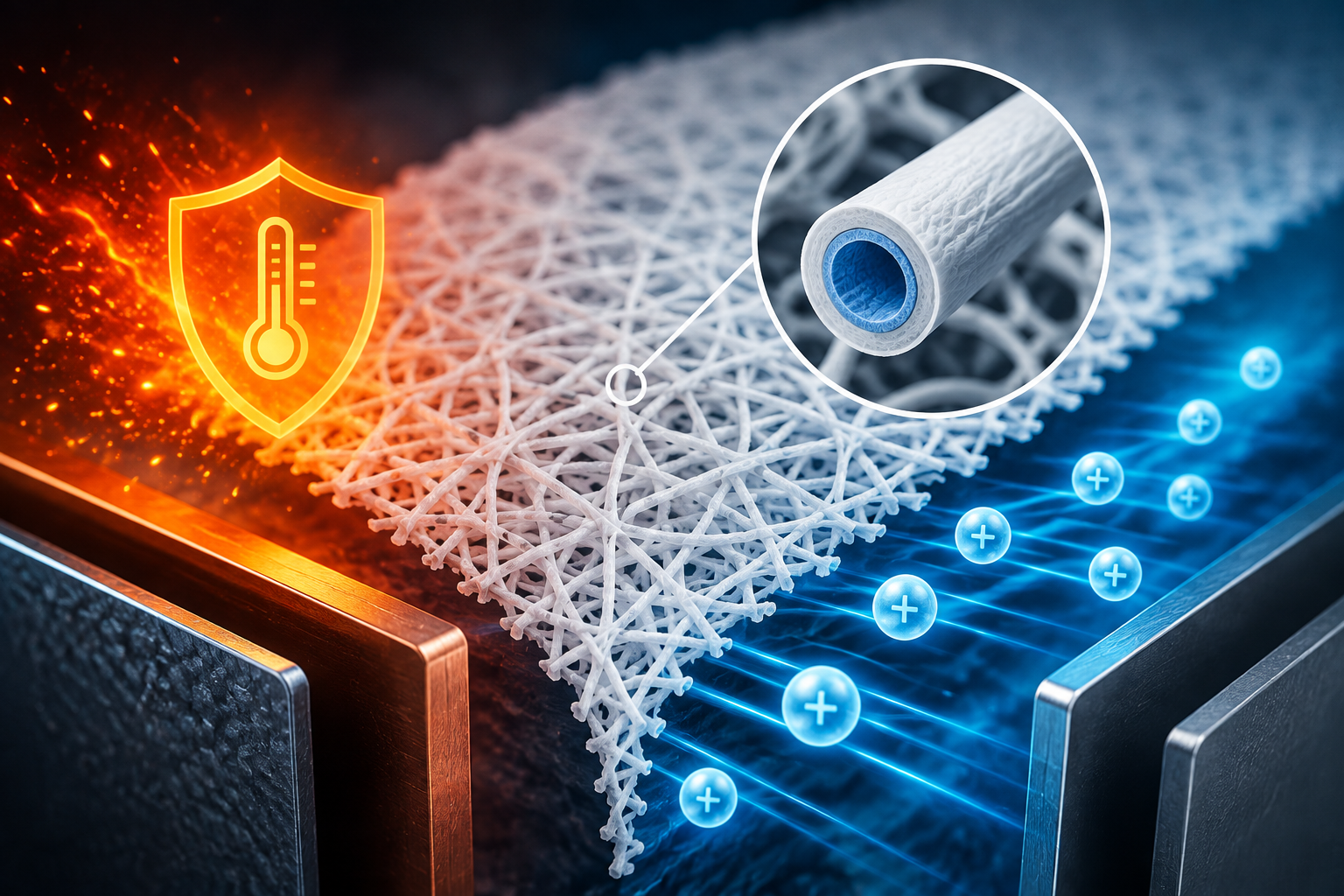
Paper: Core-shell nanofiber separators for heat-resistant and stretch-tolerant lithium-ion batteries. AI-generated conceptual image created using ChatGPT/OpenAI
Researchers in South Korea have developed a heat-resistant, stretchable membrane that shrinks by just 4.03% at 150 °C, compared to 96.14% for a commercial polyethylene separator, while achieving 66.6% strain at approximately 7.6 MPa in a representative stress-strain test. Their work, published in the journal npj Flexible Electronics, showed how a core-shell polymer nanofiber architecture can combine thermal stability and mechanical flexibility in high-energy lithium-ion batteries.
Challenges in Current Battery Separator Technology
Lithium-ion battery separators act as safety barriers, keeping the positive and negative electrodes apart while allowing lithium ions to move between them during charge and discharge cycles. The industry primarily uses microporous polyolefin films made from polyethylene and polypropylene for their low cost and chemical stability. However, these materials have low melting points (135-165 °C). Under excessive heat or short circuits, they can undergo rapid thermal contraction, increasing the risk of battery failures.
Conventional separators also have limited mechanical flexibility, creating challenges for batteries used in bendable and wearable electronics. Although heat-resistant polymers like polyimide can withstand high temperatures, their nanoscale fiber networks are often brittle and prone to tearing under strain. Developing a separator that combines high-temperature dimensional stability with mechanical flexibility has remained a significant challenge.
Coaxial Electrospinning: A Core-Shell Fabrication Approach
To address these limitations, researchers developed a coaxial electrospinning method that integrates two polymers into a core-shell nanofiber network. The outer shell consists of pure, heat-resistant polyimide, which comes in direct contact with the liquid electrolyte and electrodes. The inner core contains a blend of polyimide and thermoplastic polyurethane, with the polyimide shell providing thermal and chemical stability while the flexible core absorbs mechanical stress and distributes strain throughout the fiber network.
The fabrication process used a dual-channel coaxial spinneret mounted on a precision two-axis movement system. The outer channel delivered an 18 wt% polyimide solution at 0.6 milliliters per hour, while the inner nozzle delivered a 13 wt% polymer blend at 0.2 milliliters per hour under an applied voltage of 8.5 kilovolts. The resulting nonwoven mats were dried in a vacuum oven at 100 °C for 48 hours to remove residual solvent and then roll-pressed to achieve a uniform thickness of approximately 16 micrometers, within the range commonly used for commercial lithium-ion battery separators.
Microscopic analysis showed that the composite fibers had an outer diameter of 1.03 micrometers, a core diameter of 0.54 micrometers, and a shell thickness of 0.25 micrometers. Gel permeation chromatography confirmed that the mild, non-thermal fabrication process preserved polymer chain integrity without significant degradation.
Enhanced Performance Metrics of the Core-Shell Separator
Structural analysis demonstrated that the core-shell nanofiber membrane had an average pore size of 0.82 micrometers and a total porosity of 94.78%, more than twice that of the commercial polyethylene separator. This porous structure enabled an electrolyte uptake of 1011.80%, approximately eleven times higher than that of the commercial PE separator.
Rapid capillary action allowed electrolyte droplets to fully wet the nanofiber surface within 5 seconds. The separator also exhibited a room-temperature ionic conductivity of 6.14 millisiemens per centimeter, compared to 1.52 millisiemens per centimeter for the commercial PE separator.
Thermal analysis showed no discernible thermal transition between 0 and 300 °C, with only 4.47% dimensional shrinkage after one hour at 200 °C. In coin-cell tests at 25 °C, the coaxial separator achieved a capacity retention of approximately 93.3% after 100 cycles, compared with 88.9% for polyethylene, and retained 92.5% after 200 cycles.
Under more severe conditions at 90 °C, cells with the nanofiber separator retained 53.8% of their initial capacity after 100 cycles, compared to 43.6% for polyethylene-based cells. Cells using 60% pre-stretched separators delivered 73.7 milliampere-hours per gram after 100 cycles at 90 °C. The one-time 60% stretched separator outperformed cyclically fatigued samples, with the larger single strain partially reopening the pore network through fiber rupture and rearrangement, whereas repeated 30% stretch-relaxation led to progressive pore collapse, fiber bundling, and severe losses in ion transport and electrochemical performance.
Applications in High-Safety Energy Storage
This dual-property nanofiber architecture has potential for next-generation flexible electronics and high-performance energy storage systems. Researchers integrated the separator into pouch-type flexible batteries using stainless steel wire-mesh current collectors. The prototype cells powered light-emitting diodes during folding, diagonal folding, unfolding, and other bending deformations. In separate electrochemical tests, cells maintained at an approximately 90-degree bent state showed stable cycling and high coulombic efficiency.
Beyond flexible electronics, the core-shell membrane may be relevant to other lithium-ion battery systems subjected to elevated temperatures or mechanical loading, although these applications were not directly tested in the study. Its resistance to strain and high temperatures may help maintain separator integrity during combined heat and strain, limiting separator shrinkage and the associated risk of internal short circuits.
Future Directions for Separator Manufacturing
In summary, this study shows that elastomeric flexibility and high-temperature stability can be combined within a single core-shell nanofiber separator. This suggests a potentially scalable design strategy for thermally stable, mechanically compliant lithium-ion battery separators. The polyimide shell and ductile elastomeric core work together to help preserve separator geometry and ion-transport pathways under thermal stress and mechanical deformation. However, the study also showed that repeated stretch-relaxation can cause substantial pore collapse and degradation of transport properties.
Future work should focus on translating coaxial electrospinning from laboratory-scale production to continuous roll-to-roll manufacturing and improving solvent management, including solvent recovery, to reduce costs. Further studies on long-term mechanical fatigue and repeated stretching will also be needed to address the transport losses observed after repeated deformation and to assess the commercial potential of durable separators for flexible and wearable electronics.
Disclaimer: The views expressed here are those of the author expressed in their private capacity and do not necessarily represent the views of AZoM.com Limited T/A AZoNetwork the owner and operator of this website. This disclaimer forms part of the Terms and conditions of use of this website.