A point-line network of carbon fillers gives researchers a new way to control pressure response, while larger sensor arrays introduce a second challenge: separating real tactile signals from electrical crosstalk.
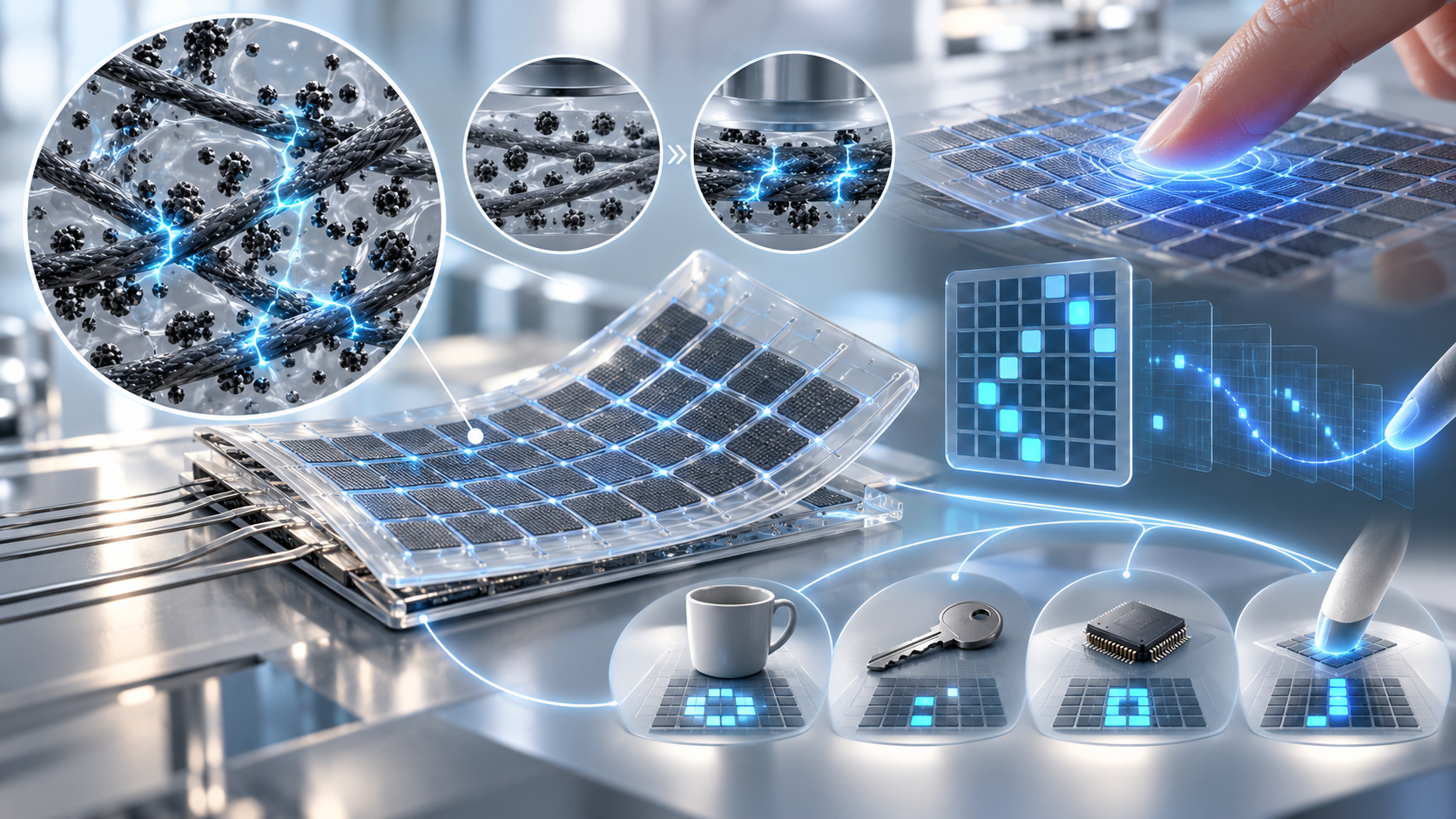
Paper: Architected conductive networks enabling tunable pressure sensitivity in stretchable sensor arrays for intelligent tactile perception. AI-generated abstract conceptual image created using ChatGPT/ OpenAI
In a recent Microsystems & Nanoengineering article, researchers developed a stretchable, pressure-sensitive composite based on carbon nanofibers and carbon black nanoparticles and integrated it into flexible sensor arrays. The mixed-dimensional conductive network provided tunable sensitivity, a broad sensing range, and high-fidelity tactile perception.
Engineering Mixed-Dimensional Conductive Networks
Stretchable pressure sensors are becoming important components of wearable electronics, soft robotics, and human–machine interfaces, but achieving high sensitivity without sacrificing sensing range or flexibility remains difficult.
The work addresses this challenge by controlling the conductive network at the nanoscale rather than relying on complex surface patterns or porous structures. Their design combines zero-dimensional carbon black (CB) nanoparticles with one-dimensional carbon nanofibers (CNFs) inside a flexible polydimethylsiloxane (PDMS) matrix. The authors focus on composition-dependent control of the point-line network rather than on introducing previously unexplored carbon fillers.
The design relies on complementary filler shapes. CNFs create long conductive pathways, while nanoscale CB particles bridge gaps between the fibers. This mixed-dimensional “point-line” network broadens the controllable percolation transition, allowing pressure-induced electrical changes to be tuned while retaining mechanical compliance and providing a material-level route toward more capable tactile sensor arrays.
Building the Hybrid Nano-Sensor
The researchers engineered the sensing material by dispersing CB and CNFs in PDMS, focusing on overcoming two nanoscale processing problems: CB agglomeration and CNF entanglement. Xylene was used as a solvent and dispersion aid, while ultrasonication helped break apart agglomerates and create a more homogeneous hybrid filler system.
The mixture was then incorporated into PDMS, combined with a curing agent, degassed, and cured to form the pressure-sensitive composite. Scanning electron microscopy (SEM) was used to examine the distribution of particulate CB and fibrous CNFs throughout the polymer.
The study systematically compared CB/PDMS and CNF/PDMS composites at different filler concentrations to establish their mechanical, electrical, and percolation behavior. The comparison mattered because the two carbon nanomaterials perform different functions.
High-aspect-ratio CNFs can span longer distances and form conductive networks at lower concentrations, whereas nanoscale CB particles create localized conductive contacts and tunneling bridges. By changing their proportions, the researchers could regulate how pressure forms and disrupts electrical pathways.
The sensor-array formulation contained 7 wt% CNFs and 5 wt% CB. The researchers then integrated the composite into flexible sensor arrays using Ag-sputtered PET electrodes and an additional conductive interfacial layer. They fabricated arrays of 4 × 4, 8 × 8, and 16 × 16 pixels.
Because large resistive matrices suffer from electrical crosstalk, the researchers paired the nanocomposite hardware with a row-column scanning system and an equivalent-circuit model based on Kirchhoff’s Current Law.
Tuning Sensor Response Through Nanostructures
CNF-based materials established long-range conductive pathways at lower concentrations and responded strongly at low pressures, but saturated earlier than CB-based composites.
At the nanoscale, the mechanism resembles an adjustable electrical circuit. CNFs form the structural conductive skeleton, while CB nanoparticles occupy spaces between fibers and act as local tunneling regulators.
Without pressure, gaps between fillers restrict electron transport. Compression deforms the PDMS and pushes the carbon components closer together. CB particles then reduce the tunneling distances between neighboring CNFs, rapidly opening additional conductive routes and lowering electrical resistance.
At higher pressure, increasingly dense pathways form until the network approaches resistance saturation. The material design converts small pressure-driven changes in nanoscale spacing into measurable electrical signals.
This formulation operated close to the percolation transition and delivered a broad 0–500 kPa sensing range. It could detect pressure as low as 0.3 kPa and produced distinguishable resistance responses across 5–350 kPa.
The device responded in about 86 ms and recovered in 97 ms, making it fast enough for many tactile and human-activity sensing applications. It also maintained a stable resistance response over 3500 loading cycles under 250 kPa compression at 2 Hz.
The findings show that nanomaterial composition can engineer sensitivity, rather than relying exclusively on complicated microstructured surfaces.
Increasing filler loading also stiffened the composites and reduced stretchability, with CNF-filled PDMS becoming stiffer than CB-filled PDMS at higher loadings. Altering the CB/CNF ratio changes initial resistance, local sensitivity, sensing range, and saturation behavior. Moving from an individual sensor to an array introduced another challenge: crosstalk.
Electrical changes at one sensing pixel can influence measurements elsewhere in the row-column network. The team's equivalent-circuit model and normalization strategy compensated for these interactions.
Simulations showed that normalization reduced the effect of differences in starting resistance. The model could still identify the pressure application location when individual sensing elements had abnormally low resistance or when baseline values varied randomly across two orders of magnitude.
Using an 8 × 8 array, the team demonstrated tactile mapping and trajectory tracking. Local pressure generated clearly identifiable resistance changes, repeated loading between 5 and 40 kPa produced stable responses, and the system could spatially track sequential pressure events.
In handwriting experiments, the array reconstructed the trajectories of the letters “Z”, “J”, and “U”, and mapped the spatial outlines of objects, including a cup, key, and chip.
Toward Intelligent Tactile Sensing
The results show how nanoscale architecture can shape the performance of stretchable tactile electronics. Instead of depending on a single conductive filler, the researchers combined CNF skeletons with CB nanoparticle tunneling bridges, creating a pressure-responsive network whose sensitivity and operating range can be tuned through composition.
The work connects nanoscale conductive-network design with array-level signal processing for pressure mapping and trajectory reconstruction, with potential applications in wearable devices, human–machine interfaces, and soft robotic sensing systems.
Source:
- Zhu J., Zhang H., et al. (2026). Architected conductive networks enabling tunable pressure sensitivity in stretchable sensor arrays for intelligent tactile perception. Microsystems & Nanoengineering 12, 336. DOI: 10.1038/s41378-026-01454-3, https://www.nature.com/articles/s41378-026-01454-3