A temperature-responsive fluoronetwork alters how the material contacts rough surfaces, providing researchers with a new way to examine the trade-off among heat transfer, adhesion, and mechanical protection.
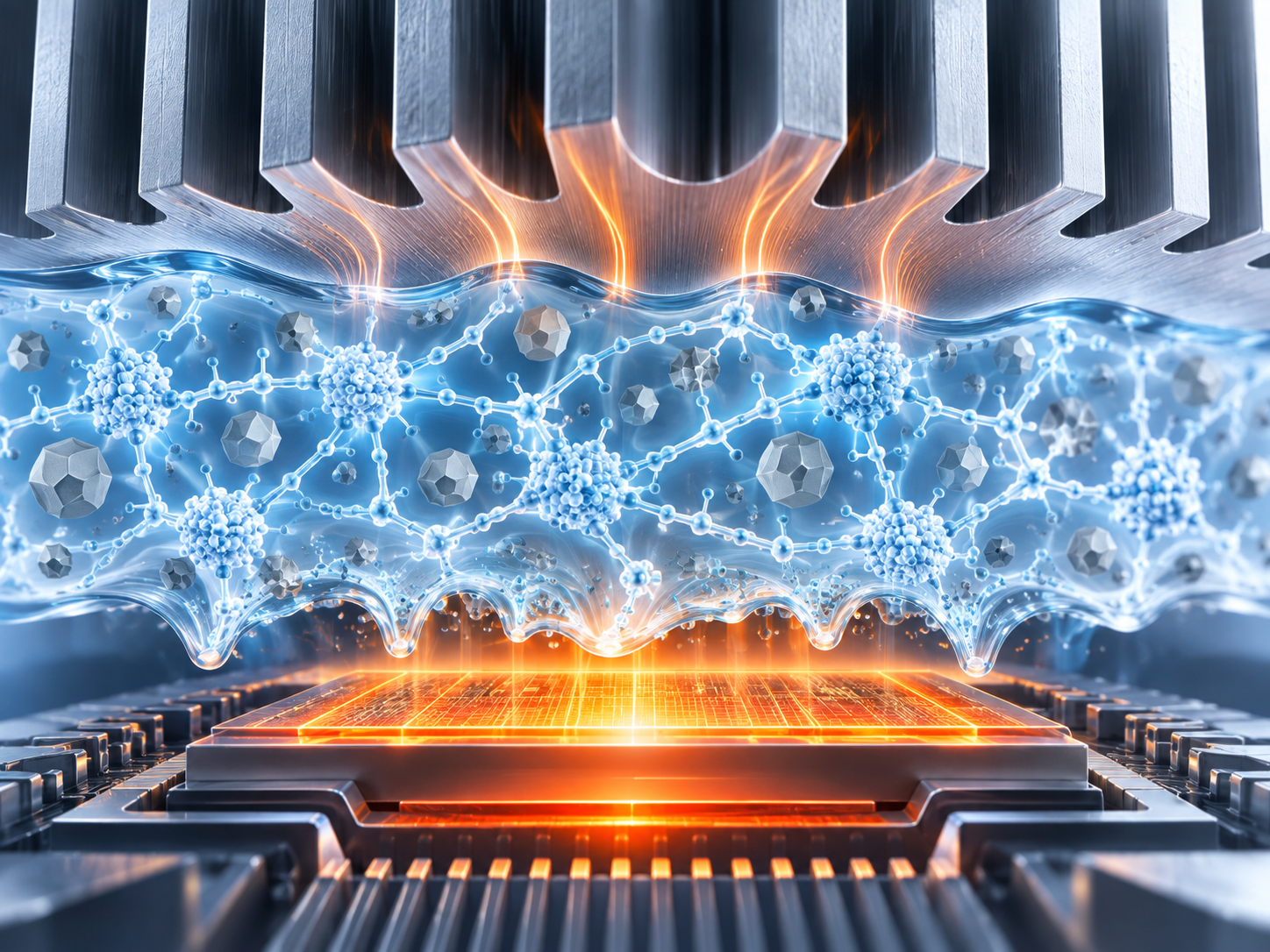
Paper: Branched-type nanocluster-junction fluorofluidic-gels for interface-adaptive thermal conduction and mechanical resistance. AI-generated abstract conceptual image created using ChatGPT/OpenAI
A paper available as an Article in Press in Nature Communications reported a thermal interface fluorofluidic-gel nanocomposite (TIF) with a branched nanocluster-junction fluoronetwork for high mechanical resistance and interface-adaptive thermal conduction.
Thermal management in microelectronic devices
Efficient thermal management is increasingly necessary as microelectronic devices shrink and become more highly integrated, helping maintain operational reliability.
Thermal interface materials (TIMs) form a thermal bridge that conducts heat between heat sinks and heat sources and are widely used to support the stability and service life of electronic devices with high heat flux.
Recent studies on TIMs have primarily focused on improving inherent thermal conductivity. The thermal conductivity of a TIM can be improved by increasing compatibility between the matrix and thermally conductive fillers or by refining the thermally conductive components.
Researchers can create an anisotropic thermally conductive network by using external fields, such as shear force, electric fields, and magnetic fields, to orient thermally conductive components and direct internal heat flow.
Limits of TIMs
Most TIMs with high thermal conductivity still exhibit some thermal interfacial mismatch at the TIM-substrate interface, limiting heat-transfer efficiency in real-world applications.
For thermal interface pads and greases, interfacial adaptability is also tied to electrical insulation, mechanical resistance, and adhesion strength.
An adaptive thermally conductive material could help address the current trade-off between contact thermal resistance and thermal conductivity in conventional TIMs for highly integrated electronic devices.
The proposed solution: TIF
In this work, the authors developed a TIF with a branched-type nanocluster-junction fluoronetwork that combines interface-adaptive thermal conduction with strong mechanical resistance.
They constructed the fluoronetwork through the urethanization of perfluoropolyether (PFPE) precursors with isophorone diisocyanate (IPDI). In the resulting topological fluoronetwork, HO-PFPE-OH-derived fluorochains formed the flexible connecting backbones, and PFPE-OH2-derived oligomeric fluorochains formed pendant branched segments; the urethane-rich nanoclusters served as physical junctions.
Because of the polarity difference between the PFPE matrix and the urethane groups, the urethane groups assembled into hydrogen-bonding nanoclusters. Below the glass transition temperature (Tg), these junctions kept the material in a quasi-solid state. Heating above Tg caused the hydrogen-bonding nanoclusters to dissociate and shifted the network into a more fluidic state, enabling it to infiltrate microscopic surface gaps.
Difunctional monohydroxy-terminated PFPE (HO-PFPE-OH); monofunctional dihydroxy-terminated PFPE (PFPE-OH2); 1H,1H,2H,2H-perfluorodecyltrimethoxysilane; IPDI; dibutyltin dilaurate; magnesium oxide nanoparticles; trimethylhexamethylene diisocyanate (THDI); 1,1,1-trichlorotrifluoroethane (CFC113A); and aluminum oxide microparticles were used as the starting materials in this study.
Before TIF synthesis, the Al2O3 microparticles and MgO nanoparticles were mixed in hexane and treated with the fluorosilane to prepare the micro-nano hybrid particles used as filler.
TIF and fluoroelastomer synthesis
Initially, PFPE-OH2 and HO-PFPE-OH were dried under vacuum at 70 °C for 1 h to remove trace water, then combined at the predetermined molar ratio. IPDI was then added under vigorous stirring at a 1:1.1 molar ratio of alcohol to isocyanate functional groups.
To 3 g of this precursor mixture, the authors added 1.5 g of CFC113A as a cosolvent, varying amounts of micro-nano hybrid particles, and 0.05 g of dibutyltin dilaurate. After thorough blending, the CFC113A was evaporated at 30 °C for 1 h. The remaining material was then reacted for 12 h at 80 °C under vacuum to produce TIF.
For fluoroelastomer synthesis, HO-PFPE-OH was dried at 70 °C under vacuum for 1 h. THDI was then added under vigorous stirring at a 1:1.1 molar ratio of alcohol to isocyanate functional groups.
The authors added 1.5 g of CFC113A to 3 g of the precursor mixture as a cosolvent, together with 4.5 g of micro-nano hybrid particles and 0.05 g of dibutyltin dilaurate. After blending and solvent evaporation under the same conditions, the material was reacted for 12 h at 80 °C under vacuum to form the fluoroelastomer.
The authors then carried out molecular simulations and measured the TIF's mechanical, thermal, wetting, impact, and energy-absorption properties.
Performance of the TIF
The authors tested several TIF formulations and selected TIF0.25 as the representative sample because it balanced thermo-responsive behavior, adhesion, dimensional stability, and mechanical resistance.
In the fluoronetwork, thermo-responsive hydrogen-bonding nanoclusters enabled reversible adhesion, and TIF0.25 reached an adhesive strength of 189.3 kPa and adhesion energy of 220.3 J•m-².
The selected formulation retained an adhesion strength of 145.8 kPa at −80 °C. In thermogravimetric testing, the material showed about 1% weight loss at 300 °C, whereas the practical thermal performance and cycling tests described by the authors were conducted between 20 and 85 °C.
With a 60 wt% thermally conductive nanocomposite, TIF0.25 reached a thermal conductivity of 5.89 W•m-¹•K-¹. Its contact thermal resistance fell from 0.42 cm²•K•W-¹ at 5 psi to 0.15 cm²•K•W-¹ at 50 psi.
The thermal response also varied with temperature: below about 35 °C, the material remained quasi-solid with an effective thermal resistance above 2.05 cm²•K•W-¹. Above that range, the material became more fluidic, and the value fell to 0.336 cm²•K•W-¹ and then to 0.29 cm²•K•W-¹ at 85 °C.
In a 150 W heating test, TIF0.25 reduced the thermal interface temperature to 75.0 °C, 10 °C below the value measured with commercial thermal grease. The TIF exhibited mechanical resistance and electrical insulation, with an impact resistance of about 3.91 J•cm-¹, electrical conductivity below 1.1 × 10-¹³ S/cm at 150 °C, and a breakdown strength of about 24 kV/mm at 60 wt% filler.
After 1,000 thermal cycles between 20 and 85 °C under 50 psi, the selected formulation retained a thermal conductivity of 5.86 W•m-¹•K-¹ and an adhesion strength of about 188 kPa, close to its initial values.
The study supports further investigation of adaptive TIF for thermal management in high-heat-flux electronics, especially at confined interfaces exposed to repeated thermal cycling and mechanical disturbances.
Disclaimer: The views expressed here are those of the author expressed in their private capacity and do not necessarily represent the views of AZoM.com Limited T/A AZoNetwork the owner and operator of this website. This disclaimer forms part of the Terms and conditions of use of this website.
Source:
- Tang, W. et al. (2026). Branched-type nanocluster-junction fluorofluidic-gels for interface-adaptive thermal conduction and mechanical resistance. Nature Communications (Article in Press). DOI: 10.1038/s41467-026-78046-2, https://www.nature.com/articles/s41467-026-78046-2