From graphene agglomeration to difficult carbon-aluminum interfaces and sharply different processing costs, the review examines what still stands between high-performance laboratory composites and reliable industrial production.
Paper: High-performance graphene/aluminum composites: progress and challenges from an industrial perspective. AI-generated abstract conceptual image created using ChatGPT/OpenAI
In a recent research article published in the Beilstein Journal of Nanotechnology, researchers provide a comprehensive review of the advancements and challenges in developing high-performance graphene/aluminum composites from both nanoscale and industrial perspectives.
Graphene/Aluminum Composite Foundations
Graphene/aluminum (Gr/Al) composites have emerged as a promising class of lightweight, high-performance materials with potential applications across aerospace, automotive, and electronics sectors.
The remarkable properties of graphene, including its exceptional tensile strength (~125 GPa), extraordinary thermal conductivity (~5000 W·m−1·K−1), and excellent electrical conductivity (~100·106 S·m−1), when integrated with aluminum’s favorable density and formability, present opportunities for multifunctional structural components.
Since the discovery of mechanical graphene exfoliation in 2004 and subsequent investigations into Gr/Al composites, considerable effort has been devoted to synthesizing these composites at the nanoscale.
Several key challenges remain in realizing reliable, large-scale, industrial-grade Gr/Al composites, particularly regarding nanoscale dispersion of graphene, control of interfacial bonding, and management of interfacial reactions, including the excessive formation of aluminum carbide (Al4C3), which can compromise mechanical integrity.
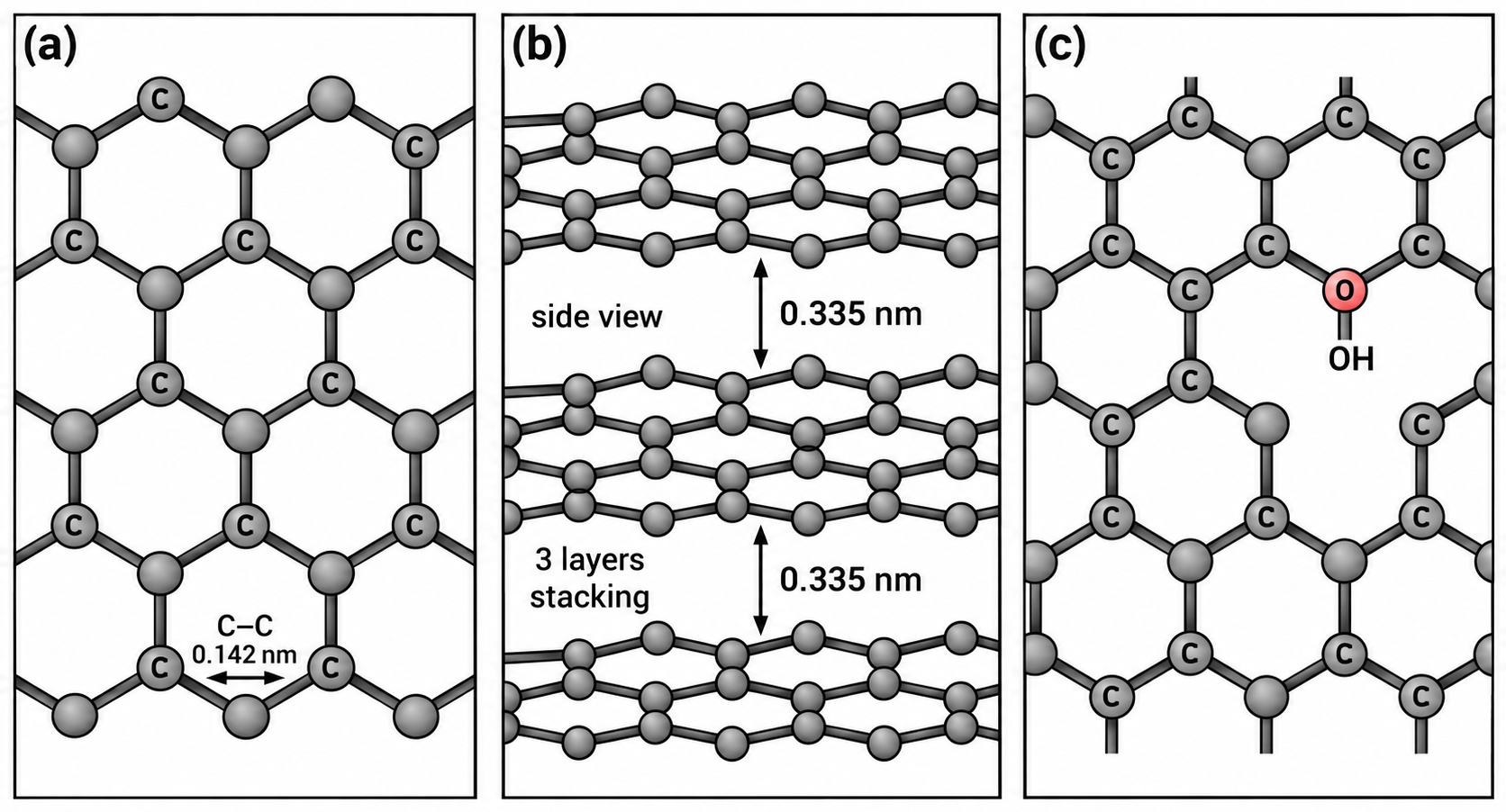
A schematic showing the crystal structure of graphene materials: (a) pristine graphene, (b) three-layer graphene, and (c) reduced graphene oxide.
Synthesis and Dispersion Advances
The review synthesizes over a decade of research, emphasizing the pivotal role of graphene synthesis, dispersion, and composite fabrication methodologies in determining composite structure and functional performance.
Graphene used in these composites ranges from single-layer sheets to few-layer graphene and functionalized derivatives such as graphene oxide (GO) and reduced graphene oxide (rGO). Top-down exfoliation and bottom-up methods such as chemical vapor deposition (CVD) provide broad routes to graphene production, while the review identifies redox-derived rGO and liquid-phase exfoliation (LPE) as the two main industrial production methods for graphene used in Gr/Al composites.
A critical focus is placed on overcoming graphene’s innate van der Waals-driven agglomeration, which forms clusters detrimental to load transfer, electrical pathways, and thermal conduction. Several dispersion and processing techniques, including ball milling, chemical or electrostatic surface treatment, and electromagnetic stirring, have been explored to promote homogeneous distribution of graphene within aluminum powders or melts.
Interfacial engineering strategies aimed at modulating the graphene-aluminum bonds have been developed to control interfacial reactions and limit excessive Al4C3 formation. The effects of Al4C3 depend on how much forms and under what processing conditions, an issue examined in greater detail below.
Fabrication technologies such as powder metallurgy coupled with spark plasma sintering (SPS) offer precise control over microstructure and interfacial characteristics, helping limit excessive Al4C3 formation through rapid, pressure-assisted sintering cycles.
Conversely, bulk processing methods like stir casting offer high-volume production and cost advantages but suffer from limited microstructural control, leading to inconsistent graphene dispersion and limited property improvement.
Emerging additive manufacturing techniques, particularly laser powder bed fusion (LPBF), exploit localized melting and rapid solidification to entrap graphene within the aluminum matrix, thereby refining grain structures and enabling interface load-sharing effects. The review places LPBF at a technology readiness level of 3 to 4, reflecting its relatively early stage of industrial development. Deformation-driven metallurgical processes further contribute by inducing grain refinement and improving mechanical performance.
Interfacial Engineering and Mechanisms
Bridging the microstructural characteristics of graphene/aluminum composites with macroscale performance requires addressing fundamental challenges intrinsic to nanomaterial integration. Uniform distribution of graphene nanosheets while limiting van der Waals-driven aggregation remains a key requirement for achieving concurrent improvements in strength, thermal conductivity, and electrical properties.
A persistent challenge is improving strength without sacrificing ductility or the electrical and thermal transport properties that make graphene attractive as a reinforcement.
Nanoscopic dispersion methods are critically scrutinized for their effectiveness in maintaining graphene integrity while promoting strong interfacial adhesion without provoking excessive interfacial reactions.
Control of Al4C3 formation at the graphene-aluminum interfaces is highlighted as a central requirement. Small, discontinuous nanoscale Al4C3 particles can serve as chemical anchoring points and enhance load transfer, whereas excessive formation promotes interfacial brittleness and moisture-related degradation. Advanced surface modification of graphene, including Cu, Ni, or Ti coatings and intermediate layers such as Al2O3 or Al4SiC4, has shown promise in reducing harmful interfacial reactions without sacrificing load transfer efficacy.
SPS’s capability to precisely control sintering parameters showcases how microstructure and interface engineering yields composites with high relative density (>99%), refined grain sizes (~0.8 µm), and improved mechanical performance suited for aerospace and electronics applications.
Cost remains a limiting factor in the production of Gr/Al composites. The review shows how techniques like stir casting, while offering lower fabrication costs of about US$1,508 per ton under the authors’ benchmark assumptions, face challenges in dispersion uniformity and interfacial control. The estimate uses Chinese-market prices, a 2,000 t/year production benchmark, 0.1-0.5 wt% few-layer graphene, and excludes the cost of aluminum.
SPS, though highly effective at microstructural and interfacial control, incurs significantly higher costs, at about US$9,660 per ton under the same benchmark, and is best suited for high-value, small-batch products. Combining rapid SPS with lower-cost casting, alongside continued development of methods such as LPBF, could support more economical production of nanostructured composites.
Industrialization Challenges and Outlook
This comprehensive review concludes that microstructure and interface engineering will remain central to the future development and industrial maturation of graphene/aluminum composites. Addressing the persistent challenges of graphene dispersion and interfacial phase control at the nanoscale is crucial to realizing the full potential of these lightweight, multifunctional materials.
Developments in graphene surface functionalization, controlled sintering processes, and combined manufacturing routes could support the transition from laboratory demonstrations to commercial applications.
Producing high-performance Gr/Al composites at low cost remains the review’s main industrialization challenge, and the unstable, difficult-to-control carbon-aluminum interface is identified as the root technical problem. Continued progress in low-cost surface modification, rapid low-temperature consolidation, and compatible casting routes could improve the prospects for wider production. Reliable, large-scale production of Gr/Al composites with well-controlled interfaces and properties could broaden their use in aerospace, automotive, electronics, and thermal-management applications.