Programmable DNA can build structures with remarkable nanoscale precision, but turning molecular instructions into predictable behavior across an entire hydrogel presents a much harder materials challenge.
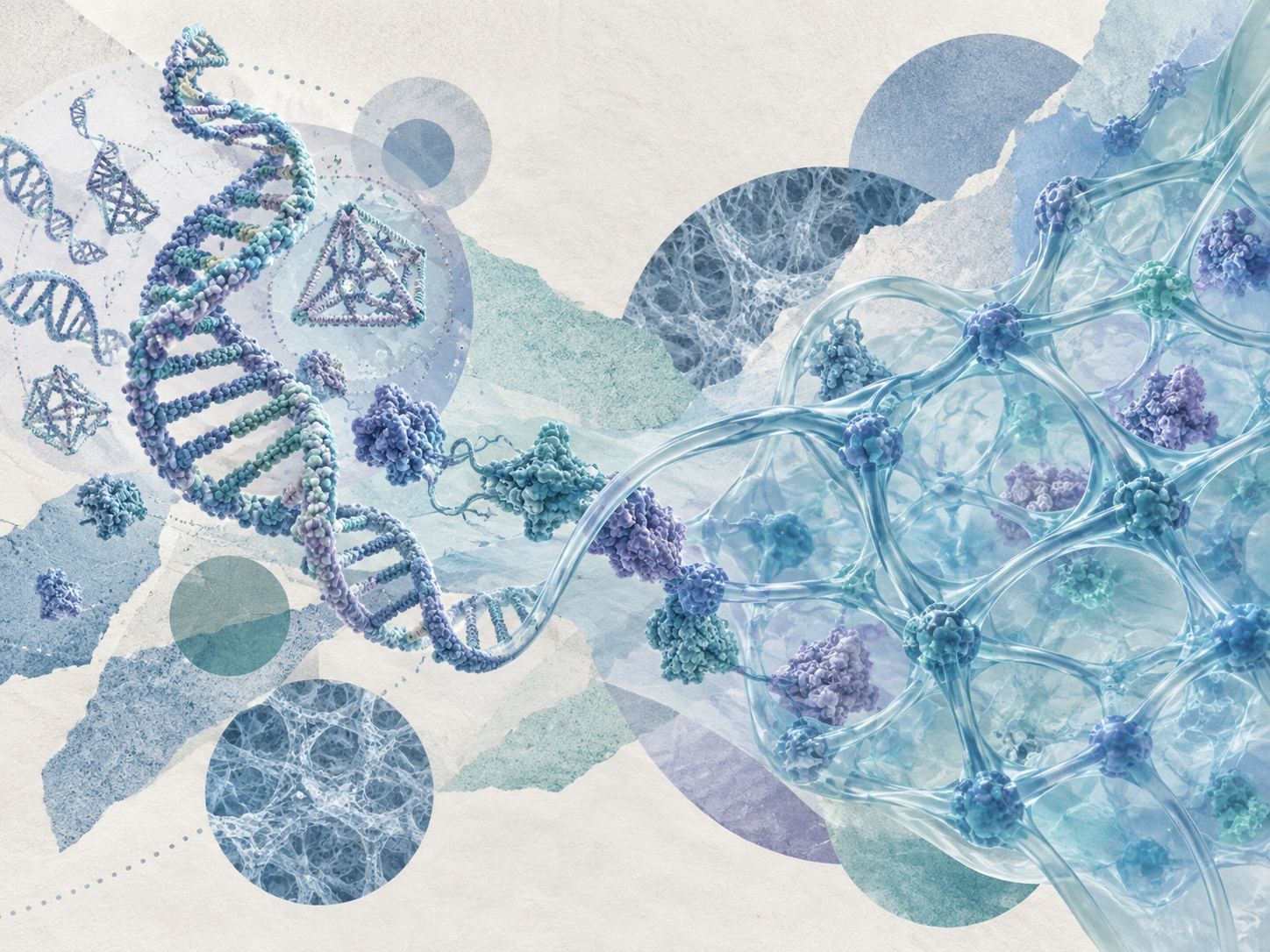
Paper: Programmable DNA–protein hydrogels: from structural DNA nanotechnology to adaptive soft matter. AI-generated abstract conceptual image created using ChatGPT/OpenAI
A recent perspective article, accepted for publication in the journal Science Bulletin, examines how DNA–protein hydrogels are expanding DNA nanotechnology from precisely organized nanoscale structures to responsive, macroscopically extended soft materials. The perspective describes how programmable DNA sequences, network architecture, and protein incorporation can generate viscoelasticity, molecular recognition, catalytic activity, environmental responsiveness, and adaptive behavior. However, researchers still cannot reliably predict how sequence-level design will translate into network structure and macroscopic material behavior.
From programmable DNA structures to adaptive hydrogels
DNA nanotechnology allows researchers to design biomolecular structures with nanometer-scale precision. By using sequence-specific base pairing, researchers can program DNA strands to assemble into well-defined architectures and precisely organize proteins, nanoparticles, ligands, and other functional components. These advances have established DNA as both a carrier of genetic information and a programmable building material for constructing functional biomolecular systems.
DNA hydrogels extend this design principle from discrete nanostructures to reconfigurable, interconnected polymer networks that operate across multiple length scales. Their properties can emerge from network topology, crosslink formation and dissociation, molecular crowding, and diffusion rather than from the geometry of individual DNA structures alone. The incorporation of functional DNA motifs, such as aptamers, further enables sequence-programmed molecular recognition, while the integration of proteins introduces catalytic activity alongside signaling and biochemical regulation.
Examples include DNA–protein hydrogels and related DNA-based soft-matter systems with functions extending beyond structural assembly, such as multivalent exosome capture, intracellular catalytic amplification, enzyme stabilization, and reversible biochemical compartmentalization. These examples illustrate DNA hydrogels as a distinct class of adaptive soft materials, in which programmable molecular interactions translate into collective network behavior and functional responses. The article examines the emerging principles underlying these systems, with particular emphasis on how molecular design, network formation, and protein incorporation shape their properties and biological functions.
Connecting molecular design with hydrogel function
DNA sequence, network assembly, and protein incorporation emerge as closely interconnected design variables. Sequence-dependent hybridization controls strand folding, chain connectivity, and the formation and dissociation of crosslinks. These molecular events determine network characteristics such as crosslink density, mesh size, topology, heterogeneity, and transport pathways, which influence stiffness, stress relaxation, swelling, responsiveness, protein accessibility, and release behavior.
Researchers can construct these networks through several strategies, including four-way junction assembly, hairpin-based clamped hybridization chain reaction, and rolling circle amplification. Each approach creates a different network architecture that influences the resulting material properties. Physical encapsulation provides straightforward protein loading but offers limited control over spatial organization.
Hybridization-mediated assembly and biorthogonal conjugation can position proteins with greater spatial control, while additional modification steps may affect protein activity. Aptamer-mediated and affinity-based interactions provide selective and potentially reversible protein association, but their performance depends on binding affinity, target accessibility, and the surrounding network structure.
The interaction between proteins and DNA networks also works in both directions. DNA architecture controls protein confinement, diffusion, accessibility, and local concentration, while proteins can alter network organization and dynamics. This coupling can generate cooperative recognition, catalytic amplification, and stimulus-responsive behavior. At the same time, it makes system behavior more difficult to predict because biological function depends on both molecular interactions and the evolving hydrogel microenvironment.
From molecular interactions to material behavior
Studies of DNA–protein hydrogels indicate that molecular design can influence material behavior by altering network formation and dynamics. The DyNAtrix platform uses reversible, sequence-defined crosslinking to translate DNA hybridization dynamics into tunable stress relaxation and adaptive mechanical responses.
Work on rolling-circle-amplification-based hydrogels indicates that template sequence, secondary-structure formation, amplification efficiency, DNA yield, and reaction conditions can alter the resulting hydrogel mechanics. These findings illustrate how molecular-level parameters can influence the structure and behavior of extended DNA networks.
Yet this relationship becomes more complex as DNA strands assemble into heterogeneous, changing hydrogel networks. Hydrogel properties depend on sequence-controlled hybridization, structural organization, network topology, crosslink density and dynamics, molecular crowding, diffusion, and assembly history. Predictive models will therefore need to relate sequence-dependent molecular interactions to intermediate network characteristics before connecting them to the overall mechanical and functional behavior of DNA–protein hydrogels.
Toward biomolecular materials with adaptive behavior
Programmable DNA architectures combined with functional proteins can form soft materials that integrate molecular recognition, catalysis, information processing, and time-dependent biochemical regulation within a single system. The authors draw inspiration from chromatin, where DNA, proteins, biochemical modifications, and nonequilibrium processes interact across multiple length scales to regulate molecular organization and material behavior. While chromatin is not a conventional DNA–protein hydrogel, its dynamic organization offers important insights into how synthetic biomolecular materials can integrate molecular information with adaptive physical properties.
Advances in reversible DNA-based compartmentalization and biologically coupled material formation demonstrate the functional potential of these systems. These characteristics reflect close coupling between molecular interactions and network behavior in adaptive materials.
Predictive control of the translation of molecular information into material function remains a major challenge in DNA–protein hydrogel research. The authors describe the potential for DNA–protein hydrogels to develop into programmable adaptive materials that combine responsive behavior with biological function, while self-organization remains a proposed future capability.
Disclaimer: The views expressed here are those of the author expressed in their private capacity and do not necessarily represent the views of AZoM.com Limited T/A AZoNetwork the owner and operator of this website. This disclaimer forms part of the Terms and conditions of use of this website.