From barley roots and wastewater dyes to mouse wounds, researchers put wood-waste-derived cellulose through an unusually broad series of tests to explore where the material could prove useful.
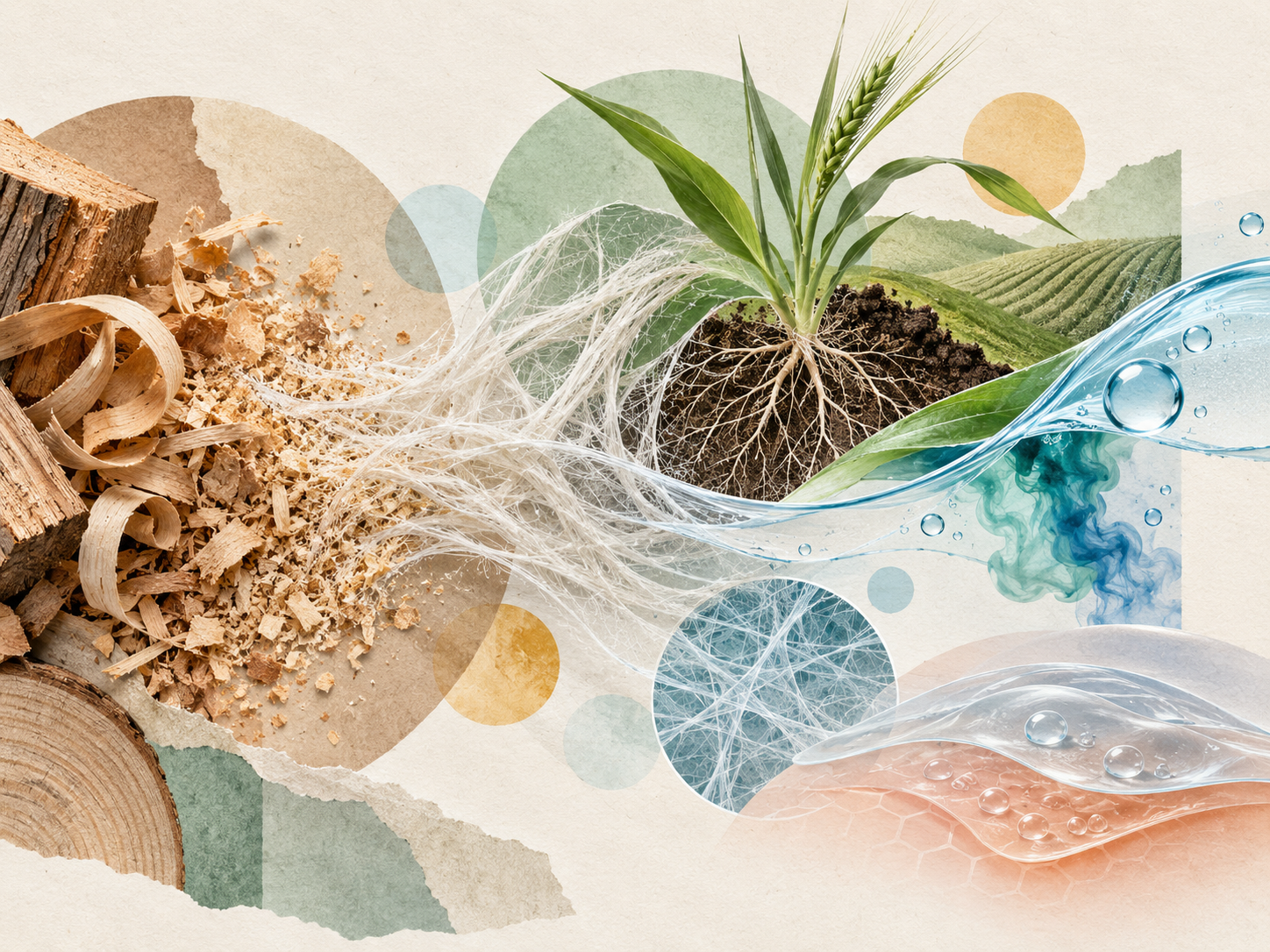
Paper: Turning wood waste into high-value nanocellulose for sustainable agriculture environmental remediation and wound healing applications. AI-generated abstract conceptual image created using ChatGPT/OpenAI
In a recent research article published in the journal Scientific Reports, researchers used a sequential chemical process to convert wood sawdust waste into cellulose particles and examined their potential in sustainable agriculture, environmental remediation, and wound healing.
Valorizing Wood Waste Challenges
Wood-processing industries worldwide generate vast amounts of sawdust and wood residues, which are often discarded or used in low-value applications, contributing to environmental pollution and resource inefficiency. Addressing this issue requires new approaches aligned with circular economy principles to transform wood waste into high-value materials.
Nanocellulose, a nanoscale cellulose derivative obtained through chemical treatments such as alkali digestion, bleaching, and acid hydrolysis, offers remarkable properties including high surface area, mechanical strength, and biocompatibility.
These features position nanocellulose as a promising material for agricultural soil amendments, environmental remediation, and wound-dressing applications.
Nanocellulose Extraction & Analysis
The research commenced with the chemical processing of sawdust through sequential treatments: alkali digestion to remove lignin and hemicellulose, peroxide bleaching to obtain purified cellulose, and acid hydrolysis to reduce cellulose fibers to the nanoscale. This yielded cellulose particles characterized using several advanced techniques.
Electron microscopy provided detailed visualization of morphological changes from raw wood to cellulose fibrils. Light-scattering particle-size analysis indicated a heterogeneous suspension containing nano-, submicron-, and larger aggregated fractions, with a Z-average diameter of 482.5 nm and a smaller population centered at 120.5 nm.
Fourier-Transform Infrared (FT-IR) spectroscopy detected characteristic cellulose-associated functional groups, including hydroxyl and glycosidic bonds, after processing.
Zeta potential was assessed to characterize surface charge and colloidal behavior, although the Results section did not report a numerical value. X-ray diffraction (XRD) patterns showed a cellulose I pattern with an estimated crystallinity index of about 91.7%.
To evaluate functionality, the study examined water retention properties by mixing nanocellulose, sawdust, and their composites with clay soil and quantifying water drainage and retention over time.
Agronomic impacts were assessed by cultivating barley (Hordeum vulgare) in soil supplemented with sawdust, nanocellulose, and combinations thereof, recording fresh weight and shoot, leaf, and root measurements, as well as physiological parameters (chlorophyll index, protein content, phenolics, flavonoids). Molecular variation was examined using RAPD-PCR and SCoT-PCR to compare DNA banding patterns across soil treatments. These methods can detect molecular differences, but they cannot determine whether those changes arise from mutations, epigenetic effects, or technical variation.
Environmental remediation efficiency was tested by analyzing the removal of synthetic dyes from aqueous solutions using sawdust and nanocellulose biosorbents. Finally, the wound healing potential of nanocellulose was examined in mice by tracking wound dimensions and visual healing over a 10-day period.
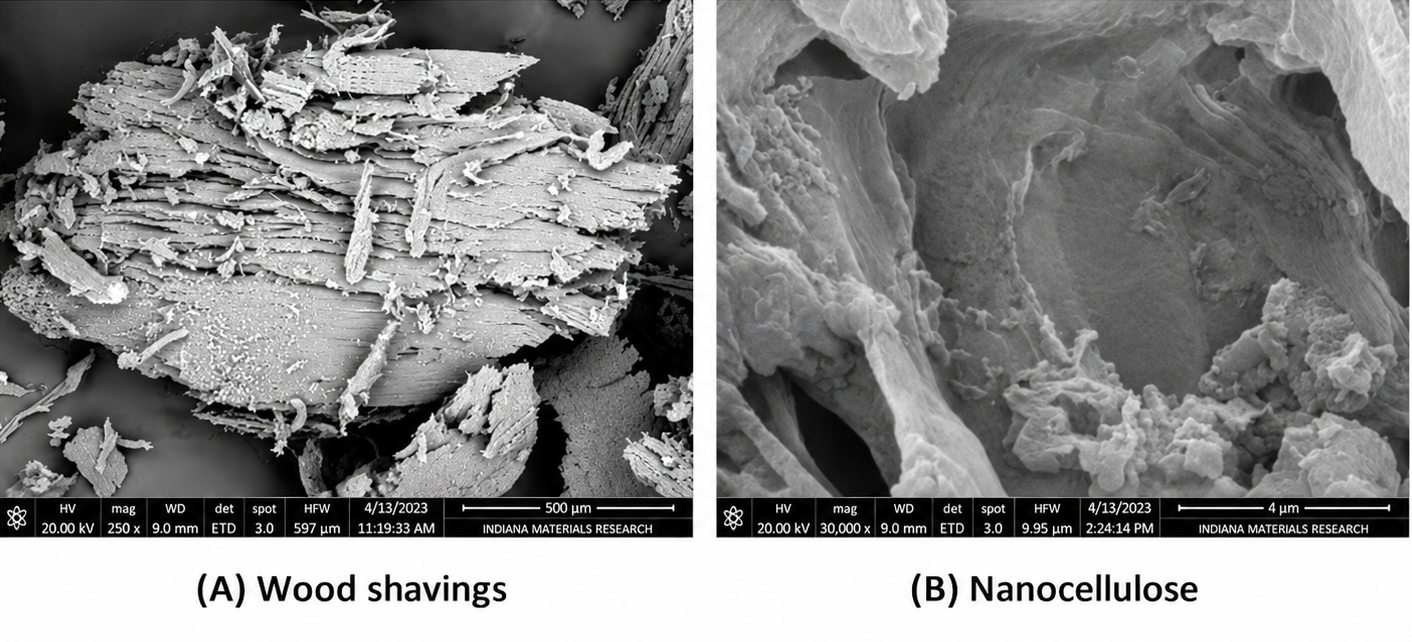
Scanning electron micrographs showing the morphological transition from raw wood to nanocellulose. (A) Raw wood shavings display large, rigid lamellar structures typical of untreated lignocellulosic biomass (magnification: 250×; scale bar: 500 μm). (B) Nanocellulose shows a fibrillated, porous structure with nanoscale features resulting from chemical processing (magnification: 30,000×; scale bar: 4 μm).
Applications in Agriculture & Healing
Nanocellulose derived from wood waste exhibited a heterogeneous particle-size distribution spanning nano- and submicron fractions, alongside a small fraction of larger aggregates. Electron microscopy also showed a porous, fibrillated structure after chemical processing.
FT-IR detected characteristic cellulose-associated functional groups after processing, and XRD indicated high crystallinity. Zeta potential was assessed to characterize surface charge and colloidal behavior, although no numerical value was reported in the Results section.
In hydration tests, sawdust exhibited superior water retention due to its porous microstructure, absorbing and holding more water than nanocellulose alone, which affected water flow but retained less moisture. Sawdust retained 26.21 mL of water, compared with 3.46 mL for nanocellulose alone and 3.87 mL for clay plus nanocellulose.
When applied to barley cultivation, the combined clay and nanocellulose treatment (S + C) promoted significant root elongation (11.5 cm) and maintained strong shoot growth (23.5 cm), with substantially better growth than sawdust alone.
Conversely, sawdust-enriched soil (S + W) yielded the highest leaf protein concentration (149.14 μg/g), phenolics, flavonoids, and chlorophyll index, resulting in the strongest biochemical profile among the tested soil conditions. The findings indicate different responses across the experiments: clay plus nanocellulose supported strong plant morphology, clay plus sawdust produced the highest measured biochemical markers, and sawdust alone retained the most water in the drainage test.
Molecular marker analyses revealed moderate polymorphism levels with 22.5% detected via RAPD and 13.7% through SCoT markers, indicating treatment-associated differences in DNA banding patterns rather than evidence of genomic safety.
The authors discuss possible genetic, epigenetic, and stress-related explanations for these banding differences, but the RAPD and SCoT assays cannot distinguish among genetic mutations, epigenetic modifications, and PCR-related variation. The findings are best described as molecular fingerprints associated with the different soil amendments.
In environmental remediation tests, both sawdust and nanocellulose reduced the visible intensity of the cationic dyes Malachite Green and Neutral Red under laboratory conditions. Sawdust performed slightly better for Malachite Green, whereas nanocellulose achieved greater decolorization of Neutral Red, which the authors attributed to its nanofibrillar structure and surface functional groups. Their removal of the anionic dye Bromophenol Blue was limited, indicating that dye charge and adsorbent interactions influenced performance.
Biomedical assessments suggested a different pattern of wound closure in nanocellulose-treated mice compared with bandage-only controls over ten days. The treated wounds measured 0.4 × 0.6 cm at baseline and 0.2 × 0.2 cm on Day 10, while control wounds changed from 0.5 × 0.8 cm to 0.1 × 0.4 cm.
The authors visually described the treated wounds as closer to complete closure by Day 10, but the groups began with slightly different wound dimensions, and the paper did not report a formal between-group significance test for wound closure. For that reason, the experiment provides preliminary evidence for a wound-dressing application rather than proof of a quantified clinical benefit.
Sustainable Impact & Future Directions
This study converted wood sawdust waste into cellulose particles and tested their use across sustainable agriculture, environmental cleanup, and wound-dressing research.
The results support further study of sawdust and wood-derived nanocellulose within a circular economy model and indicate that each application requires separate evaluation.
Future investigations are warranted to refine surface functionalization and adsorption testing under realistic wastewater conditions, clarify the origin of treatment-associated changes in molecular markers in barley, and examine tissue integration, inflammatory biomarkers, and long-term remodeling in further preclinical wound studies.
Source:
- Tawfik E., Osama N., & Tayel M. (2026). Turning wood waste into high-value nanocellulose for sustainable agriculture environmental remediation and wound healing applications. Scientific Reports 16, 28771. DOI: 10.1038/s41598-026-69470-x, https://www.nature.com/articles/s41598-026-69470-x