By pairing ligand chemistry with robotic experiments and machine learning, researchers found a way to control FAPbI3 nanocrystal growth at room temperature and test whether the method could scale up.
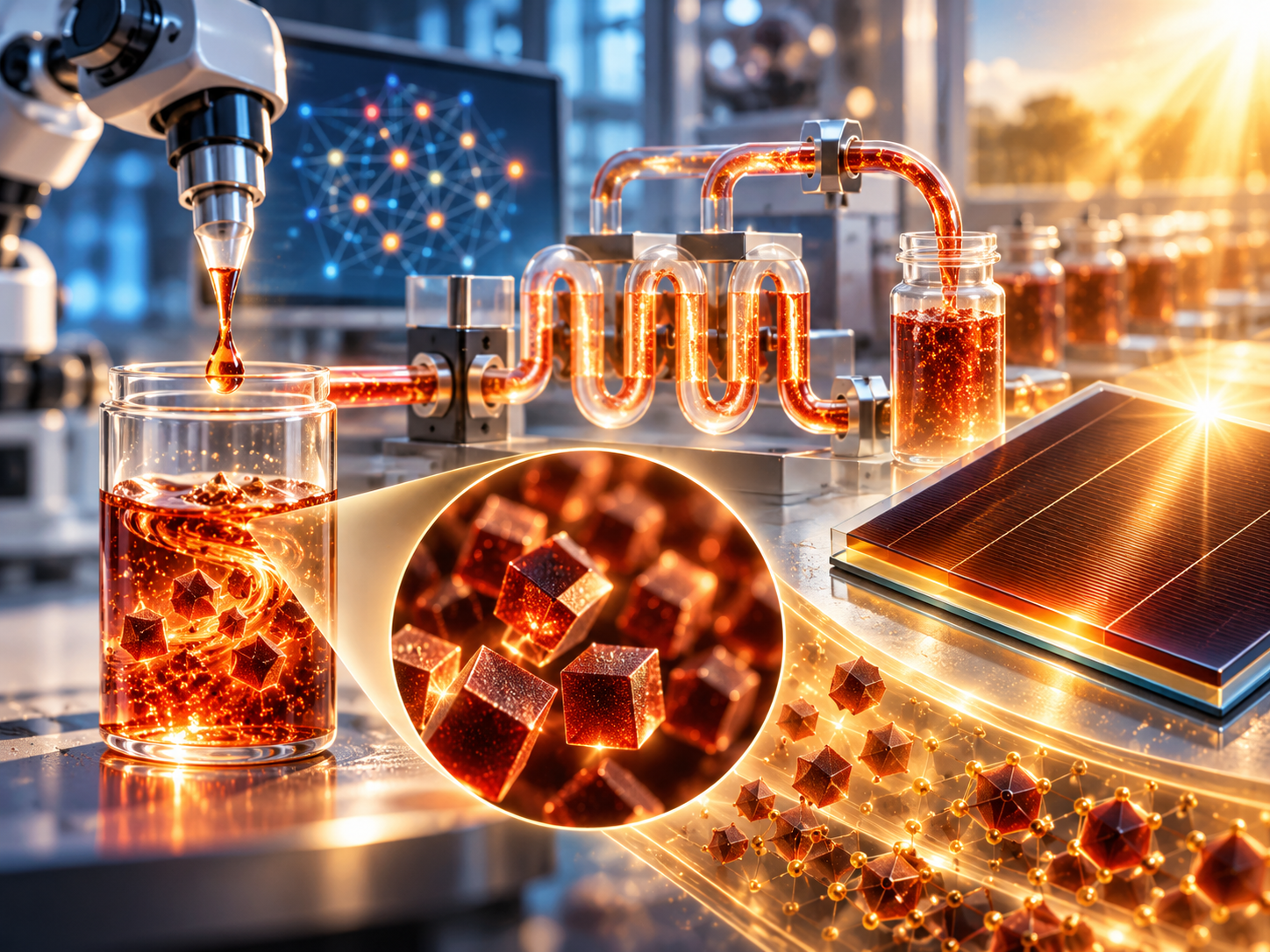
Paper: AI-accelerated scalable synthesis of nanocrystals for cost-effective photovoltaics. AI-generated abstract conceptual image created using ChatGPT/OpenAI
*Important notice: This news reports on an unedited version of an accepted paper and is awaiting final editing. Therefore, the paper should not be regarded as conclusive or treated as established information.
A recent Nature Communications study presents an artificial intelligence (AI)-aided strategy for producing formamidinium lead iodide (FAPbI3) perovskite nanocrystals (PNCs) at larger volumes.
The researchers developed a ligand-triggered room-temperature injection (LTRI) method that uses short-chain octanoic acid (OcA) to regulate nanocrystal nucleation and growth under ambient conditions. Solar cells fabricated with the resulting nanocrystals achieved a power conversion efficiency of 19.37% and showed better operational and thermal stability than cells made with hot-injection (HI) nanocrystals.
Addressing the Scale-Up Challenge for Perovskite Nanocrystals
Perovskite nanocrystals offer attractive optical and electronic properties for new photovoltaic technologies. Conventional hot-injection (HI) synthesis provides precise control over nanocrystal size and composition, but it typically relies on high temperatures, long-chain ligands, and specialized processing. These requirements add complexity and make large-volume production more difficult.
Room-temperature synthesis could simplify production, but controlling nucleation and growth remains difficult. Previous room-temperature approaches can require repeated experimental tuning, making materials development time-consuming and resource-intensive. Methods developed mainly for bromide PNCs also struggle to extend to iodide PNCs because the latter are unstable in the polar solvents used in those routes.
The researchers address these problems by combining LTRI synthesis with robotic experimentation and machine learning. Their study identifies OcA and formamidinium acetate (FAAc) as key variables that govern nanocrystal formation and properties. The combined process links materials refinement, process tuning, and higher-volume synthesis in a single workflow.
Combining Ligand Chemistry with Machine Learning
The LTRI process starts with lead iodide, oleylamine, oleic acid, and toluene. The researchers then inject a formamidinium-containing precursor with different carboxylic acids to trigger nucleation at room temperature. Screening different ligand chain lengths showed that short-chain OcA accelerates nucleation and produces more uniform FAPbI3 nanocrystals than longer-chain oleic acid.
The team used robotic synthesis to generate 109 valid experimental results for the first machine-learning model. They then selected 45 more experiments based on the model's predictions to improve its accuracy.
The second-generation model predicted PL peak position and spectral width across 16,000 synthesis conditions. The spectral width was measured as the PL full width at half maximum (FWHM), an optical measure that can reflect particle uniformity. The model treated oleic acid, oleylamine, OcA, and FAAc concentrations as four synthesis variables while keeping the lead iodide content constant.
Results that produced nanosheets or substantial aggregation were excluded from model training.
Tests of 20 randomly selected model predictions produced R² values of 0.91 for photoluminescence (PL) peak position and 0.87 for PL FWHM. SHAP analysis, a method for interpreting model predictions, identified FAAc and OcA as the strongest synthesis variables for the two PL outputs.
A separate Pearson correlation analysis associated more OcA with larger nanocrystals and better size uniformity, while more FAAc increased nanocrystal size but broadened the size distribution.
The selected LTRI formulation produced nanocrystals with an average diameter of about 15 nm and an optical bandgap of approximately 1.60 eV. They also achieved a higher average PL quantum yield of 73.9%, compared with 60.6% for the HI-synthesized nanocrystals.
Controlling Nucleation and Scaling Production
The researchers combined in situ PL measurements with transmission electron microscopy, nuclear magnetic resonance, and X-ray photoelectron spectroscopy to examine how OcA and FAAc influence nanocrystal formation. The data support a proposed mechanism in which the two components control different stages of the synthesis process.
Increasing FAAc produces larger initial nuclei and raises the concentration of formamidinium ions. At high FAAc levels, FAAc reduces ligand coverage and can promote aggregation during extended growth. OcA accelerates nanocrystal growth while suppressing secondary aggregation. These different roles give the researchers greater control over nucleation and later growth.
The team then integrated LTRI into a continuous-flow synthesis system with in situ PL monitoring. The system produced nearly 13 g of FAPbI3 nanocrystals within 1 h. Optical measurements showed little change in PNC quality as production volume increased.
In the flow tests, samples made without OcA continued to red-shift over about 10 min and later lost PL intensity, while OcA-containing samples reached a stable PL peak more quickly and showed a narrower PL width.
Toluene also has lower viscosity than octadecene, the host solvent used in the HI comparison, which reduces the risk of microchannel blockage during flow processing. The authors estimated nanocrystal production costs of US$118.81 g-¹ for HI, US$30.71 g-¹ for batch LTRI, and US$2.16 g-¹ for flow LTRI, including materials, purification, and labor.
The flow-produced nanocrystals kept about 80% of their initial PL intensity after 1000 h under ambient conditions, compared with 44% for HI-synthesized nanocrystals. The researchers incorporated the selected LTRI nanocrystals into FAPbI3 PNC solar cells. The LTRI-based devices achieved a maximum power conversion efficiency of 19.37% using a 0.04 cm² measurement aperture, compared with 17.22% for the HI-based device.
The LTRI device reached a stabilized power conversion efficiency of 19.02%, compared with 16.71% for the HI device. Nanocrystals produced at the 1 L synthesis scale also enabled solar cells with a maximum efficiency of 18.87%.
The LTRI approach also improved device stability. In separate maximum-power-point tests of unencapsulated devices under continuous one-sun illumination at ambient conditions of about 40 °C, the LTRI device kept nearly 85% of its initial efficiency after 1000 h. In a dark-storage test at 65 °C, the LTRI device retained 75.3% of its initial PCE after 800 h, while the HI device retained 26.7%.
Toward AI-Enabled Nanocrystal Manufacturing
The study shows how ligand engineering, robotic synthesis, machine learning, and flow processing can work together to address materials tuning and higher-volume synthesis. The LTRI method removes heating from the nanocrystal-synthesis step used in the HI comparison and allows rapid nanocrystal formation under ambient conditions.
The approach identifies the main aspects of nucleation and growth control. OcA promotes rapid nucleation, accelerates growth, and improves size uniformity, while FAAc influences initial nucleus size and how molecules bind at the nanocrystal surface. Machine learning helped identify synthesis conditions that balance these effects without relying entirely on lengthy trial-and-error experiments.
Flow synthesis and lower estimated production costs support further process development, but the cost figures reflect nanocrystal production rather than demonstrated costs for finished solar cells or modules. The resulting devices were laboratory-scale cells.
The authors suggest that the higher fill factor may reflect more uniform films, reduced nonradiative recombination, and better charge transport, while reduced defect density and uniform film morphology could help explain the improved stability.
The research reports a combined approach for AI-assisted development and scale-up of FAPbI3 nanocrystals. For perovskite photovoltaics, room-temperature synthesis, continuous-flow production, lower estimated costs, and laboratory-scale cells with efficiencies above 19% support further work toward larger-area manufacture. The paper does not report tests of large-area modules or continuous production of complete solar cells.
Disclaimer: The views expressed here are those of the author expressed in their private capacity and do not necessarily represent the views of AZoM.com Limited T/A AZoNetwork the owner and operator of this website. This disclaimer forms part of the Terms and conditions of use of this website.